

Catholic Conscience Rosary: the Annunciation
In the first installment of a series of Rosary reflections highlighting the principles, values, and virtues of Catholic Social Teaching, the civic evangelization organization Catholic Conscience considers the Annunciation.This reflection was first posted on the Catholic Conscience website.
______________________
The first Joyful Mystery beautifully illustrates application of the principle of subsidiarity in humility and a profound spirit of stewardship.
Scriptural Reference
Luke 1:26-38 (Catholic RSV*):
In the sixth month the angel Gabriel was sent from God to a city of Galilee named Nazareth, to a virgin betrothed to a man whose name was Joseph, of the house of David; and the virgin’s name was Mary. And he came to her and said, “Hail, O favored one, the Lord is with you!”
But she was greatly troubled at the saying, and considered in her mind what sort of greeting this might be. And the angel said to her, “Do not be afraid, Mary, for you have found favor with God. And behold, you will conceive in your womb and bear a son, and you shall call his name Jesus. He will be great, and will be called the Son of the Most High; and the Lord God will give to him the throne of his father David, and he will reign over the house of Jacob for ever; and of his kingdom there will be no end.”
And Mary said to the angel, “How shall this be, since I have no husband?” And the angel said to her, “The Holy Spirit will come upon you, and the power of the Most High will overshadow you; therefore the child to be born will be called holy, the Son of God. And behold, your kinswoman Elizabeth in her old age has also conceived a son; and this is the sixth month with her who was called barren. For with God nothing will be impossible.”
And Mary said, “Behold, I am the handmaid of the Lord; let it be to me according to your word.” And the angel departed from her.
_________
CST Reflection
The Rosary opens with a striking example of one of the most important and least understood of all Catholic social concepts: subsidiarity.
The confusion surrounding this principle appears to arise from its name. It is not actually difficult to understand, however, particularly when illustrated by example or when thought of as a Catholic form of “empowerment.”
In simple terms, the principle of subsidiarity states that each element of society should serve its own proper purpose, and support others in serving theirs, with the over-arching goal of encouraging and enabling authentic human development for the whole of society. All social elements are called to support one another by providing any required help, or “subsidium.” This includes staying out of the way of other, properly responsible social elements. One consequence of the principle is that each individual, and all smaller groups of people, should be allowed to make for themselves all the decisions that can responsibly be left to them, while rightfully being able to look to higher authorities for help, if and when help is required.
Has there ever existed a better example of this principle than the Annunciation? Consider the act of God the Almighty Father, Eternal King and Creator of the Universe, in approaching a young girl in a small village otherwise barely known to history, to ask her assistance in bringing His only Son, whom He has designated to be the savior of the world, to life in human form. Rather than doing the job the easy way, sending Christ down fully formed on a cloud with a backdrop of lightning, God elected to glorify His own creation by appointing a devout, patient, and capable young woman from a tiny and obscure village to the task, and letting her do it. Importantly, He did not just give her the job and then abandon her. He sent her support in the form of a strong, humble, understanding husband, Joseph, to watch over her as she gave birth alone in a stable, and to accompany her into exile in a foreign land to avoid her child’s slaughter. God continued to watch over them all the way along, through all of Christ’s life and mission, while Mary and Joseph put their own unique parental stamp on His Son, helping to shape the child’s experiences and responses to them.
By choosing this path, God allowed both Mary and Joseph to apply and develop their talents over their entire lifetimes. In doing so, they not only shaped Christ’s life and humanity; they also provided all the rest of us with shining examples of the virtues of charity, obedience, and humility, as well as realistic self-assessment, respect, hard work, and good stewardship: qualities that Mary and her husband have continued to put to good use on our behalf through their heavenly intercession, throughout the entire subsequent 2000 years.
As explained by the Compendium of the Social Doctrine of the Church, the Catholic principle of subsidiarity “is imperative because every person, family and intermediate group has something original to offer to the community. Experience shows that the denial of subsidiarity, or its limitation in the name of an alleged democratization or equality of all members of society, limits and sometimes even destroys the spirit of freedom and initiative.” (Compendium, 187)
_________
Fruits of the Mystery
Mother of God, we pray in the name of your divine Son that by contemplating your faithful answer to God’s call we might grow in faithful and selfless attention to our own duties, recognizing the help God sends us in our own missions and following faithfully the example you provided of impeccable stewardship of the gift of life.
_________
Credits
* Scriptural Reference: https://quod.lib.umich.edu/cgi/r/rsv/rsv-idx?type=DIV1&byte=4782437
* Image: Fra Angelico, the Annunciation. San Marco, north Corridor (Wikimedia Commons)

Saint Kateri , Canada’s Protectress
This was the title given to Saint Kateri Tekakwitha, by Pope Benedict XVI, when he canonized her on October 28th, 2012, along with six others, in Saint Peter’ Square (she had been beatified by Pope John Paul II back in 1980). With Saint Joseph as our protector, along with the Canadian martyrs, we seem to[…]Continue reading→

Remembering Father Alphonse de Valk
(Today marks the sixth anniversary of the death of Father Alphonse de Valk, C.S.B., a faithful, courageous and indefatigable Basilian priest, pro-life-and-family apostle, and the founder of Catholic Insight magazine. Here is what we wrote those on his entering into eternity five years ago, as we continue to remember him in our prayers and thoughts)[…]Continue reading→

A Tale of Two Benedicts
A grace-filled Holy Week to all our readers! As we await and prepare for the Resurrection about to dawn upon us, we might keep in mind two Benedicts: Pope Emeritus Benedict XVI, requiescat in pace, elected on this day in 2005; and today’s commemoration of the mystic pilgrim, Benedict Joseph Labre, who died on this[…]Continue reading→

My Name is Bernadette
April 16th is a propitious day, for besides the anniversary of Father de Valk’s death, who founded Catholic Insight in its print form decades ago, and the commemoration of the ‘two Benedicts’, mentioned in accompanying posts, today we also recall Saint Bernadette Soubirous, the young visionary to whom the Virgin Mary appeared numerous times at[…]Continue reading→

Saint Lydwina of Schiedam and Suffering Joyfully
Saint Lydwina of Schiedam (1380 – 1433) was one of the countless and glorious ‘victim souls’ in the history of the Church, those whose lives are filled with suffering, often of an unimaginable intensity, but who suffer joyfully. She was a fifteen-year old Dutch girl, out skating one day, when she fell and broke one[…]Continue reading→

The Glorious Martyrdoms of Martin and Maximus
As we enter into Eastertide, we recall on this 13th of April Pope Saint Martin I (+655), one of the noblest, if most tragic, of the successors of Saint Peter. Born in Umbria, Italy, he was of noble lineage, with great intelligence combined with charity and love of the poor and the Church. While still[…]Continue reading→

Canonizing Sister Faustina and Divine Mercy
HOMILY OF THE HOLY FATHER MASS IN ST PETER’S SQUARE FOR THE CANONIZATION OF SR MARY FAUSTINA KOWALSKA Sunday, 30 April 2000 1. “Confitemini Domino quoniam bonus, quoniam in saeculum misericordia eius”; “Give thanks to the Lord for he is good; his steadfast love endures for ever” (Ps 118: 1). So the Church sings on the Octave of[…]Continue reading→

Divine Mercy Sunday – An Echo of Every Mass
Reach out your hand and put it in my side. Do not doubt but believe’… ‘My Lord and my God!’ (Jn. 20:18)). Today is Divine Mercy Sunday, and as we celebrate the end of the Easter Octave, we contemplate the wounded side of our Saviour, the Church’s source of life. On Good Friday in the[…]Continue reading→
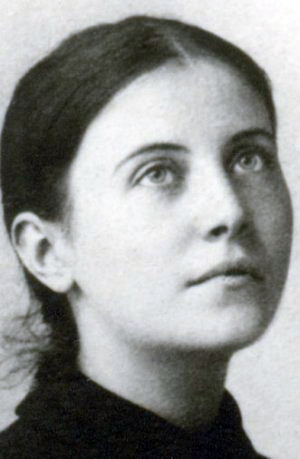
Saint Gemma Galgani
On this April 11th, in 1903 – the same year that the Italian Guiseppe Sarto was elected Pope later that summer as Pius X – a lovely, young Italian woman died, by the name of Gemma Galgani. She lived a brief life of 24 years, as did a number of other young saints, including Pier[…]Continue reading→

First Holy Communion: Sermon from May 16, 1943
Here is a sermon from the good old days by +Rev. Msgr. Vincent Nicholas Foy (August 14, 1915 – March 13, 2017), from 1943. Readers may recall that Pope Saint Pius X, by the decree Quam Singulari in 1910, lowered the customary age of reception of Holy Communion – after the rigours of the plague[…]Continue reading→