
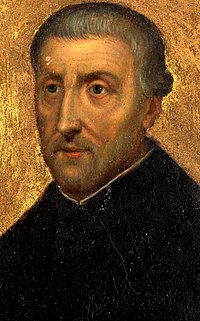
Canisius the Indefatigable Catechist
Saint Peter Canisius (1521-1597) was a Dutch Jesuit back in the earliest days of the Order, amongst the first to join Ignatius’ company, after meeting one of the founders, Peter Faber. His life spans the century of what history inaccurately calls the Protestant ‘reformation’, and our saint goes down in history as one of the foremost champions of the Catholic ‘counter-reformation’.
In reality, things were more complex, but, in broad strokes, there was a revolt against the perennial and infallible truths revealed by Christ – not least, that final authority to decide truth rested in the Church – and, then, a Catholic reaction to that revolt. This Catholic ‘counter-reformation’ was in fact a true Catholic reformation, helping to rid the Church of corruption, excess and scandal, to purify and strengthen. As Saint Paul put it to the Corinthians, heresies there must be. (1 Cor 11:19)
The symbolic beginning was with the monk Martin Luther’s pinning of his 95 theses on the church door in Wittenberg in 1517, three years before our saint was born. This was the metaphorical powder keg, and from Germany, the errors spread across Europe, unraveling the very fabric and structure of Christendom.
Father Canisius was ordained in 1546, the same year that Luther died, putting his hand to the plow and not only not looking back, but seeming never to rest. He realized that the battle was about truth, and that the key was to present the teachings of the Faith clearly and precisely, but with great charity, always with compassion for erring souls, most of whom strayed more from misunderstanding and ignorance than outright rebellion and malice. As he wrote, keeping mind that our saint was Dutch, speaking about the new German Protestants:
If you treat them right, the Germans will give you everything. Many err in matters of faith, but without arrogance. They err the German way, mostly honest, a bit simple-minded, but very open for everything Lutheran. An honest explanation of the faith would be much more effective than a polemical attack against reformers.
Indeed. Saint Ignatius – the founder of the Jesuits – recognized the potential in Father Peter, said to him ‘Germany is dying, go there…’, and sent him to re-evangelize the people. Saint Peter offered all his considerable talents – he seems to be one of those given the ‘ten’, with which he made ten more – along with his nigh-unbelievable energy to offering such ‘honest explanations’ of the Faith, in humility and truth, writing innumerable essays, sermons, articles (the titles alone of his works run in the bibliography of the Society of Jesus through 38 quarto pages!), along with three very popular catechisms, written in German, the language of the ‘folk’, including a major catechism which went through many editions. As the Catholic encyclopedia has it, the catechism of Canisius is remarkable for its ecclesiastically correct teachings, its clear, positive sentences, its mild and dignified form. It is today recognized as a masterpiece even by non-Catholics.
Father Canisius – he was offered a bishopric, but refused – was also an advisor, counsellor and confessor to emperors, queens and bishops. And, as well, he founded colleges (high schools) and universities – with little or no money. But religious orders can and did do remarkable, even seemingly impossible, things, committed as they are to celibacy, poverty, and obedience, such as the Jesuits in their early zeal. It was also Canisius who began the custom of adding the petition ‘Holy Mary, Mother of God, pray for us sinners‘ to the Hail Mary.
To top it off, Father Peter was one of the foremost periti (theological experts) at the Council of Trent, helping to shore up the doctrine of the Faith in saecula saeculorum.
He walked thousands of miles across Europe fulfilling these various apostolates, and was known as one of the greatest preachers of his era: no Protestant could match him in controversy. Even after he suffered a stroke at the age of seventy, he kept working, right up until he went to his eternal reward on this day of December, the 21st, the winter solstice, in 1597. We will only know at the final judgement – if even then – how many souls were saved by the indefatigable labours of this holy priest, and what a life completely given over to God can do.
Well done, good and faithful servant.
Peter Canisius was canonized, and declared one of the 37 doctors of the Church in the same ceremony, on May 21st, 1925 by Pope Pius XI.
In these last few days of Advent, as we make our final preparations for the birth of our Saviour, we should invoke his intercession, that the truth be proclaimed boldly and without compromise. For only with the light of the Faith, will we ever see things in the world clearly.
Saint Peter Canisius, ora pro nobis!
Carney’s Amoral Majority
After five defections – euphemistically described as ‘crossing the floor’ – and three by-elections, Mark Carney and his Liberals how have their coveted majority. One wonders what bowls of pottage were offered in back-room deals. In the archaic monarchical system that is the Dominion of Canada, this majority allows the newly-minted Prime Minister to rule[…]Continue reading→

Saint Kateri , Canada’s Protectress
This was the title given to Saint Kateri Tekakwitha, by Pope Benedict XVI, when he canonized her on October 28th, 2012, along with six others, in Saint Peter’ Square (she had been beatified by Pope John Paul II back in 1980). With Saint Joseph as our protector, along with the Canadian martyrs, we seem to[…]Continue reading→
A Closed, Unsustainable, Descending Loop
As a follow-up to my thoughts on Payette’s payout, here be a stark image of where are here in Canada. As the graph shows in, well, graphic terms, since 2025, the public sector has contributed to 95.5% of economic growth. The private sector – which funds the public sector, or is supposed to – has[…]Continue reading→

A Tale of Two Benedicts
A grace-filled Holy Week to all our readers! As we await and prepare for the Resurrection about to dawn upon us, we might keep in mind two Benedicts: Pope Emeritus Benedict XVI, requiescat in pace, elected on this day in 2005; and today’s commemoration of the mystic pilgrim, Benedict Joseph Labre, who died on this[…]Continue reading→

My Name is Bernadette
April 16th is a propitious day, for besides the anniversary of Father de Valk’s death, who founded Catholic Insight in its print form decades ago, and the commemoration of the ‘two Benedicts’, mentioned in accompanying posts, today we also recall Saint Bernadette Soubirous, the young visionary to whom the Virgin Mary appeared numerous times at[…]Continue reading→
Presidential Pardon of Weronika Krawczyk
As a good news, follow-up to our story from Poland, of the persecution of Weronika Krawczyk for her pro-life views, we heard that she has been granted a presidential pardon. One might still wonder why one needs a presidential pardon for simply holding the long-held belief that the child within the womb is a child,[…]Continue reading→

Saint Lydwina of Schiedam and Suffering Joyfully
Saint Lydwina of Schiedam (1380 – 1433) was one of the countless and glorious ‘victim souls’ in the history of the Church, those whose lives are filled with suffering, often of an unimaginable intensity, but who suffer joyfully. She was a fifteen-year old Dutch girl, out skating one day, when she fell and broke one[…]Continue reading→

The Glorious Martyrdoms of Martin and Maximus
As we enter into Eastertide, we recall on this 13th of April Pope Saint Martin I (+655), one of the noblest, if most tragic, of the successors of Saint Peter. Born in Umbria, Italy, he was of noble lineage, with great intelligence combined with charity and love of the poor and the Church. While still[…]Continue reading→
Canonizing Sister Faustina and Divine Mercy
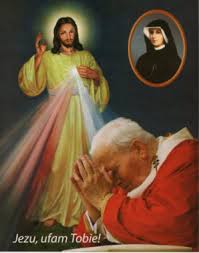
HOMILY OF THE HOLY FATHER MASS IN ST PETER’S SQUARE FOR THE CANONIZATION OF SR MARY FAUSTINA KOWALSKA Sunday, 30 April 2000 1. “Confitemini Domino quoniam bonus, quoniam in saeculum misericordia eius”; “Give thanks to the Lord for he is good; his steadfast love endures for ever” (Ps 118: 1). So the Church sings on the Octave of[…]Continue reading→
Pope Leo and a Rosary for Peace
Pope Leo XIV has asked Catholics across the world to join him in a Rosary for peace today, at 18:00 Rome time (6 pm), which would be noon from where I write (EST). If you are able, whether at that time or another, and in whatever way you pray, to join in intercession with the[…]Continue reading→