
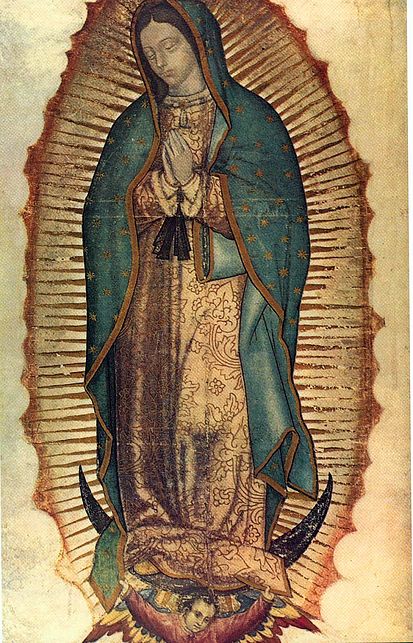
Our Lady of Guadalupe, Mother and Mystery
December the 12 is the celebration of Our Lady of Guadalupe, elevated on the eve of the Third Millennium by Pope John Paul II from a commemoration to a feast. He also declared her patroness of all of ‘America’, south, central, and north, as well as the primary intercessor for the unborn, who are much in need of all the heavenly help they can get in this culture of death.
The story of Guadalupe is a familiar one, that rings true, like the Gospels themselves: As we read a few days ago, Juan Diego – his ‘Catholic’ name – a humble mestizo peasant, was on his way to Mass and catechism class, when he saw a beautiful woman, radiant with light, in the side of Tepeyac Hill, just north of what is now Mexico City, who introduced herself as the Virgin Mary, mother of the true Deity. I love the detail that Juan heard Our Lady singing, before he saw her with his eyes – what would her voice have sounded like? Soprano? Alto? Both? Either way, she must have been perfectly in tune as she asked Juan to ask the bishop to have a chapel built on the spot, so that she might comfort her people, ravaged by war, conquest, and oppression.
When Juan obediently in turn presented this request to the bishop, his Grace asked the ‘Lady’ to provide a sign. So, on this December 12th, in 1531, Juan was going to do so, but his uncle lay dying. Instead, he went around the hill, rushing to get help, hoping to avoid the Lady in the interest of time. But Mary intervened, as she often does, and the best laid plans o’ mice and men gang aft agly.
The Virgin found him on the other side of the hill, and tenderly asked ‘Juanito’ as she called him, and through him asked all of us, ‘Am I not your mother?’, to which there is really only one answer. She promised his uncle would be cured, and for Juanito to go to the top of the hill and pick some roses, an apparent impossibility in winter in the mountains. But there they were – Castilian roses, found nowhere in Mexico, beautiful and in full bloom, which Our Lady herself arranged in Juan’s tilma made out of cactus-fibre, ordering him only to unfold them in front of the bishop.
Upon his arrival in the city, when Juan was finally admitted and presented these to the bishop, in front of several witnesses, the heavenly roses spilled out, and disappeared, and there, on the tilma, was the miraculous image of Our Lady, as though she were standing in the midst of them, as she always is.
Her miraculous image sort of ‘floats’ on fragile fabric of the tilma, which by any laws of material physics should have disintegrated within twenty years, but is just as fresh now as it was centuries ago. The image is not painted on, and when observed microscopically, almost seems to disappear into the inexplicable radiant colours on the plant fibres themselves. As well, Our Lady seems indestructible, as well she is: A worker accidentally poured acid on the tilma in 1785, which miraculously ‘self-restored’, and anti-Catholic Masons tried to blow up the tilma in 1921 with 29 sticks of dynamite, which shattered everything around for 150 feet, but left Our Lady’s image, and the ‘fragile’ cloak, perfectly intact.
The image maintains a temperature of 98.6 degrees; scientists have detected a heartbeat over her midsection of 120 beats per minute, which happens to be that of an unborn child about to be born two weeks hence.
There is in her eyes, only discernible by modern microscopic analysis, reflected not only the image of the bishop and someone else, but, again upon deeper electron microscopy, a number of others – fourteen in total – as they likely appeared to her as she appeared to them on this day in December, 1531. This effect of images reflected in the pupils of the eyes was not even known until modern times. It was, and still is, impossible to paint them.
The stars on Our Lady’s cloak mirror the constellations as seen over Mexico, yet not as seen from below, but from ‘above’, as in, looking down on Earth from some heavenly, ethereal realm outside the universe.
No scientist, as yet, has any explanation for how the image was placed on, or is maintained, and Our Lady of Guadalupe truly is one of those motiva credibilitatis, ‘motives of credibility’, which has disposed countless souls towards the Faith, and increased the Faith of many more.
Yes, she is our Mother, even in the midst of all the chaos, evil and mayhem of this world – the old paganism of Mexico, with their Aztec conquerors sacrificing untold numbers of victims to their serpent god. The victims of Islamic terrorism, enslaved and coerced. And, not least, as Patroness of the Unborn, Our Lady intercedes for and, we may hope, welcomes the millions of innocent victims of the holocaust of abortion.
Am I not your Mother? Do I not hold you in the folds of my mantle?
But we Catholics know a God Who has spoken to us, holds us in His arms as children, Who willed to take on our own humanity, to dwell amongst men, Who has taken on our own vulnerability, our pains and sorrows, the very punishment for our sins, and Who has taken a Mother, who, as she said to her ‘beloved Juanito’, in turn is our mother.
We know not how many souls Our Lady has brought into the Church through her miraculous image – many millions in the first years after her apparition, more or less converting the entirety of Mexico, mired in child-virgin-sacrificing pagan despair, and many millions in the centuries since. The Virgin appeared in 1531, as myriads of souls were leaving the Church in Europe in the Protestant ‘reformation’, whose baneful effects are still with us. Just as many millions, if not many more, were entering the Church across the Atlantic in the New World.
‘Guadalupe’ in the original Nahuatl language of Juan Diego could well be translated as ‘she who treads upon the head of the serpent’. Hmm.
We are now more than halfway through Advent, when the Light will soon be increasing, and with that, truth and hope, even though the darkness seems, and I say seems, to prevail. In the end, goodness, truth and beauty always win – Our Mother truly is a light in darkness, pointing, and leading, to the true Eternal Light, ever Ancient, ever New.
Our Lady of Guadalupe, ser una madre para nosotros!

Carney’s Amoral Majority
After five defections – euphemistically described as ‘crossing the floor’ – and three by-elections, Mark Carney and his Liberals how have their coveted majority. One wonders what bowls of pottage were offered in back-room deals. In the archaic monarchical system that is the Dominion of Canada, this majority allows the newly-minted Prime Minister to rule[…]Continue reading→

Saint Kateri , Canada’s Protectress
This was the title given to Saint Kateri Tekakwitha, by Pope Benedict XVI, when he canonized her on October 28th, 2012, along with six others, in Saint Peter’ Square (she had been beatified by Pope John Paul II back in 1980). With Saint Joseph as our protector, along with the Canadian martyrs, we seem to[…]Continue reading→

A Tale of Two Benedicts
A grace-filled Holy Week to all our readers! As we await and prepare for the Resurrection about to dawn upon us, we might keep in mind two Benedicts: Pope Emeritus Benedict XVI, requiescat in pace, elected on this day in 2005; and today’s commemoration of the mystic pilgrim, Benedict Joseph Labre, who died on this[…]Continue reading→

My Name is Bernadette
April 16th is a propitious day, for besides the anniversary of Father de Valk’s death, who founded Catholic Insight in its print form decades ago, and the commemoration of the ‘two Benedicts’, mentioned in accompanying posts, today we also recall Saint Bernadette Soubirous, the young visionary to whom the Virgin Mary appeared numerous times at[…]Continue reading→

Saint Lydwina of Schiedam and Suffering Joyfully
Saint Lydwina of Schiedam (1380 – 1433) was one of the countless and glorious ‘victim souls’ in the history of the Church, those whose lives are filled with suffering, often of an unimaginable intensity, but who suffer joyfully. She was a fifteen-year old Dutch girl, out skating one day, when she fell and broke one[…]Continue reading→

The Glorious Martyrdoms of Martin and Maximus
As we enter into Eastertide, we recall on this 13th of April Pope Saint Martin I (+655), one of the noblest, if most tragic, of the successors of Saint Peter. Born in Umbria, Italy, he was of noble lineage, with great intelligence combined with charity and love of the poor and the Church. While still[…]Continue reading→

Canonizing Sister Faustina and Divine Mercy
HOMILY OF THE HOLY FATHER MASS IN ST PETER’S SQUARE FOR THE CANONIZATION OF SR MARY FAUSTINA KOWALSKA Sunday, 30 April 2000 1. “Confitemini Domino quoniam bonus, quoniam in saeculum misericordia eius”; “Give thanks to the Lord for he is good; his steadfast love endures for ever” (Ps 118: 1). So the Church sings on the Octave of[…]Continue reading→

Saint Stanislaus of Szczepanów
We celebrate Saint Stanislaus today (+ April 11, 1079), in light of this Easter Octave, a bishop and martyr who accepted the episcopacy only at the direct order of Pope Alexander II. He proved a wise and courageous leader of his flock, put to death by his own king, Boleslaus, for rebuking the monarch’s ‘immoral[…]Continue reading→

Saint Gemma Galgani
On this April 11th, in 1903 – the same year that the Italian Guiseppe Sarto was elected Pope later that summer as Pius X – a lovely, young Italian woman died, by the name of Gemma Galgani. She lived a brief life of 24 years, as did a number of other young saints, including Pier[…]Continue reading→
An Ideological and Improper Translation
I noticed something odd with the psalm reading at Mass the other day. Our bishops’ conference here in Canada has decreed that the Mass in English – Novus Ordo – use the ‘NRSV’, the ‘New Revised Standard Version’, an ‘updated’ translation of the original RSV, first published in 1952. This ‘new translation’ has the tendency[…]Continue reading→