
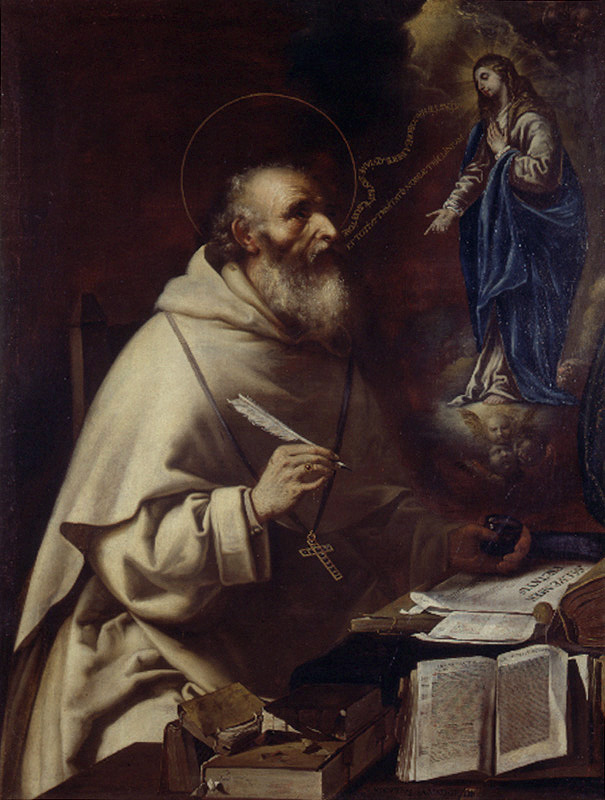
Pope Benedict and Saint Albert the Great
BENEDICT XVI
GENERAL AUDIENCE
Saint Peter’s Square
Wednesday, 24 March 2010
Saint Albert the Great
Dear Brothers and Sisters,
One of the great masters of medieval theology is St Albert the Great. The title “Great”, (Magnus), with which he has passed into history indicates the vastness and depth of his teaching, which he combined with holiness of life. However, his contemporaries did not hesitate to attribute to him titles of excellence even then. One of his disciples, Ulric of Strasbourg, called him the “wonder and miracle of our epoch”.
He was born in Germany at the beginning of the 13th century. When he was still young he went to Italy, to Padua, the seat of one of the most famous medieval universities. He devoted himself to the study of the so-called “liberal arts”: grammar, rhetoric, dialectics, arithmetic, geometry, astronomy and music, that is, to culture in general, demonstrating that characteristic interest in the natural sciences which was soon to become the favourite field for his specialization. During his stay in Padua he attended the Church of the Dominicans, whom he then joined with the profession of the religious vows. Hagiographic sources suggest that Albert came to this decision gradually. His intense relationship with God, the Dominican Friars’ example of holiness, hearing the sermons of Blessed Jordan of Saxony, St Dominic’s successor at the Master General of the Order of Preachers, were the decisive factors that helped him to overcome every doubt and even to surmount his family’s resistance. God often speaks to us in the years of our youth and points out to us the project of our life. As it was for Albert, so also for all of us, personal prayer, nourished by the Lord’s word, frequent reception of the Sacraments and the spiritual guidance of enlightened people are the means to discover and follow God’s voice. He received the religious habit from Bl. Jordan of Saxony.
After his ordination to the priesthood, his superiors sent him to teach at various theological study centres annexed to the convents of the Dominican Fathers. His brilliant intellectual qualities enabled him to perfect his theological studies at the most famous university in that period, the University of Paris. From that time on St Albert began his extraordinary activity as a writer that he was to pursue throughout his life.
Prestigious tasks were assigned to him. In 1248 he was charged with opening a theological studium at Cologne, one of the most important regional capitals of Germany, where he lived at different times and which became his adopted city. He brought with him from Paris an exceptional student, Thomas Aquinas. The sole merit of having been St Thomas’ teacher would suffice to elicit profound admiration for St Albert. A relationship of mutual esteem and friendship developed between these two great theologians, human attitudes that were very helpful in the development of this branch of knowlege. In 1254, Albert was elected Provincial of the Dominican Fathers’ “Provincia Teutoniae” Teutonic Province which included communities scattered over a vast territory in Central and Northern Europe. He distinguished himself for the zeal with which he exercised this ministry, visiting the communities and constantly recalling his confreres to fidelity, to the teaching and example of St Dominic.
(To continue reading, please see here).

Saint Kateri , Canada’s Protectress
This was the title given to Saint Kateri Tekakwitha, by Pope Benedict XVI, when he canonized her on October 28th, 2012, along with six others, in Saint Peter’ Square (she had been beatified by Pope John Paul II back in 1980). With Saint Joseph as our protector, along with the Canadian martyrs, we seem to[…]Continue reading→

Remembering Father Alphonse de Valk
(Today marks the sixth anniversary of the death of Father Alphonse de Valk, C.S.B., a faithful, courageous and indefatigable Basilian priest, pro-life-and-family apostle, and the founder of Catholic Insight magazine. Here is what we wrote those on his entering into eternity five years ago, as we continue to remember him in our prayers and thoughts)[…]Continue reading→

A Tale of Two Benedicts
A grace-filled Holy Week to all our readers! As we await and prepare for the Resurrection about to dawn upon us, we might keep in mind two Benedicts: Pope Emeritus Benedict XVI, requiescat in pace, elected on this day in 2005; and today’s commemoration of the mystic pilgrim, Benedict Joseph Labre, who died on this[…]Continue reading→

My Name is Bernadette
April 16th is a propitious day, for besides the anniversary of Father de Valk’s death, who founded Catholic Insight in its print form decades ago, and the commemoration of the ‘two Benedicts’, mentioned in accompanying posts, today we also recall Saint Bernadette Soubirous, the young visionary to whom the Virgin Mary appeared numerous times at[…]Continue reading→

Saint Lydwina of Schiedam and Suffering Joyfully
Saint Lydwina of Schiedam (1380 – 1433) was one of the countless and glorious ‘victim souls’ in the history of the Church, those whose lives are filled with suffering, often of an unimaginable intensity, but who suffer joyfully. She was a fifteen-year old Dutch girl, out skating one day, when she fell and broke one[…]Continue reading→

The Glorious Martyrdoms of Martin and Maximus
As we enter into Eastertide, we recall on this 13th of April Pope Saint Martin I (+655), one of the noblest, if most tragic, of the successors of Saint Peter. Born in Umbria, Italy, he was of noble lineage, with great intelligence combined with charity and love of the poor and the Church. While still[…]Continue reading→

Canonizing Sister Faustina and Divine Mercy
HOMILY OF THE HOLY FATHER MASS IN ST PETER’S SQUARE FOR THE CANONIZATION OF SR MARY FAUSTINA KOWALSKA Sunday, 30 April 2000 1. “Confitemini Domino quoniam bonus, quoniam in saeculum misericordia eius”; “Give thanks to the Lord for he is good; his steadfast love endures for ever” (Ps 118: 1). So the Church sings on the Octave of[…]Continue reading→

Divine Mercy Sunday – An Echo of Every Mass
Reach out your hand and put it in my side. Do not doubt but believe’… ‘My Lord and my God!’ (Jn. 20:18)). Today is Divine Mercy Sunday, and as we celebrate the end of the Easter Octave, we contemplate the wounded side of our Saviour, the Church’s source of life. On Good Friday in the[…]Continue reading→
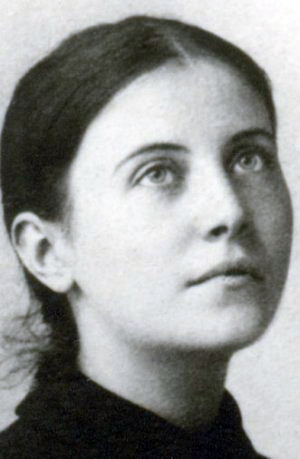
Saint Gemma Galgani
On this April 11th, in 1903 – the same year that the Italian Guiseppe Sarto was elected Pope later that summer as Pius X – a lovely, young Italian woman died, by the name of Gemma Galgani. She lived a brief life of 24 years, as did a number of other young saints, including Pier[…]Continue reading→
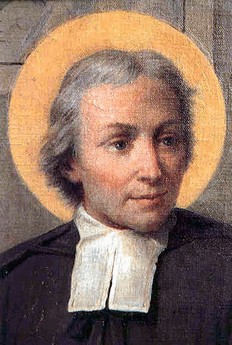
Saint Jean-Baptiste de la Salle: A Teacher for Teachers
Jean-Baptiste de la Salle (1651 – 1719), a French nobleman, ordained a priest, founded the first order in the Church’s history entirely without priests, and this came about almost by accident. I say ‘almost’, for, of course, there are no accidents with God. Destined for ordination from an early age, Jean-Baptiste never looked back, even[…]Continue reading→