
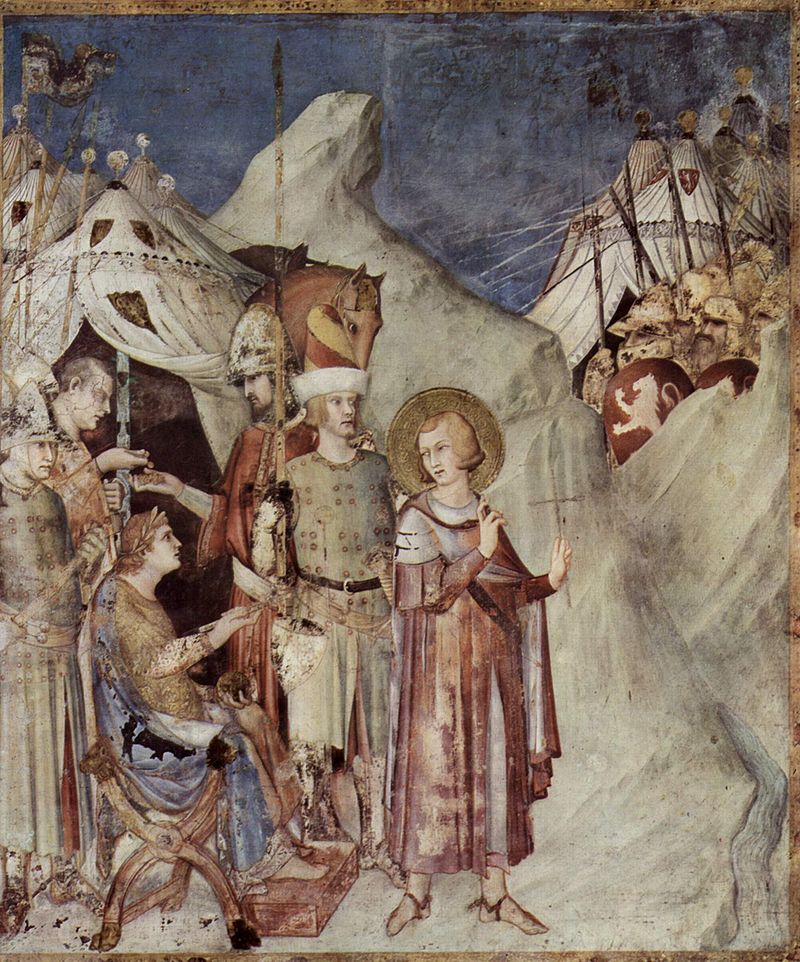
Saint Martin of Tours and Armistice Day
It’s Remembrance Day here in Canada as well as Britain and the rest of her dominions and territories; in America, it’s Veterans’ Day. Both commemorate the signing of the armistice ending the war to end all wars on the eleventh hour, on the eleventh day of the eleventh month. In the Church, it’s also the feast of one our most well-known and beloved of saints, Martin, Bishop of Tours, a providential coincidence to which we will return to in a moment.
If it is dulce et decorum pro patribus mori – ‘sweet and fitting to die for one’s country’ (literally, ‘one’s fathers’) – we in turn owe it to remember and pray for those who went before who made that ultimate sacrifice, especially in the horrors of both World Wars. Millions of young men on the battlefield, along with untold numbers of civilians, women, children, as the war to end all wars spread beyond the trenches, into the sanctuary of homes and churches. Nothing and no one was spared. Even those apparently unscathed were at the very least willing to face the worst, as they stormed over hills, onto fortified beaches in the face of machine guns and artillery; fierce guerilla warfare from house to house, or in malaria-infested jungles; infernal battlegrounds the world over.
There are distinctions to be made here, however: We do not rejoice in war itself, nor even in the oft-limited victories won. Many, perhaps all, of the more recent wars and conflicts in history have not fully fulfilled the criteria of what the Church calls a ‘just war’, and most end in some sort of uneasy and unjust compromise – as the last World War did, defeating the evils of Hitler’s Nazis, but permitting with Stalin’s atheistic and brutal Communism taking over half of Europe and much of Asia, which has set the stage for further conflict. In this life, we will have no lasting peace.
Yet, we honour the sacrifice of those who were willing to serve and die still stands.
They died for the rights and freedoms we now enjoy, those same freedoms are now being whittled away – one might say given away. The legions lads who gave their lives for that freedom, or who came home disabled, disfigured and debilitated, would not recognize the Canada or England of 2025. The right to life of the unborn is non-existent, and now this same right and God-give protection is being taken from the sick, elderly and the psychologically vulnerable, as euthanasia ravages the land. Political correctness, radical environmentalism, medical tyranny, destruction of the economy, land grabs, obeisance to the increasingly strident claims of various victim groups: These and varied other ideologies rule our schools, our media, our courts, undermining the principles of reason and right order. To paraphrase one commentator, ‘everything is crap’. And what’s left of our reason is itself being compromised by legalized marijuana, all the more easy, perhaps, to dominate a dominion of the dope-addled.
All of this would have saddened our soldiers of yore, had they been given a glimpse of the future as they fought and died As the poem warns, if he break faith with us who die. Most of the young generation now supports outright socialism, the very spirit which embodied both evil regimes our forefathers fought – Nazism and Communism, the evils of which have yet to be fully counted, and which evils we are now instantiating. What really are ‘Canadian values’, and for what might we now fight?
Let it not be said they died in vain, but may their sacrifice bear the fruit it deserves.
There is still much that is good in this fair Dominion, and we should not let it go to rack and ruin. Our primary battle is not against external enemies, but rather interior and spiritual, against the ‘principalities and powers’ that seek the destruction of souls. For if the soul of a nation is dead, what will inspire us to defend its body and its geographical borders? What, we may ask, still unites us now as Canadians?
One who was well aware of the primacy of the spiritual battle was the aforementioned Saint Martin (+397), a former soldier in the Roman empire who converted as a ten year old to Catholicism (people grew up earlier back then). Even after that, he somehow served as a Catholic in this mostly pagan army, completing his entire military service, and was not released until he was in his mid-forties. It was the accession of Julian the Apostate in 361, a rabid anti-Catholic emperor, which made up Martin’s mind, prompting him in the midst of a battle to give his life completely to Christ. Laying down his sword, refusing to fight any further, he was charged with cowardice. Au contraire, Martin retorted, offering to go to the front unarmed, from which he was saved by the enemy suing for peace.
Martin became a monk, a hermit really, but, as is oft the case with holy men, he was sought out, and acclaimed bishop of Tours in 371, instantly beloved of the people. He fulfilled the task tirelessly, devoting his military discipline and energy to serving the poor, prisoners, sinners, giving his life for all his flock, setting the foundation of the youthful Church in France, until his death in 397.
The story of his cloak, half of which he gave to a shivering beggar, and in whose form Christ later appeared to the saint in a vision, has passed into hagiographical lore: The relic of the cloak was held in such veneration that the oratory where it was kept was called a ‘capella‘, Latin for ‘cloak’, from which we now derive our English term ‘chapel’ and ‘chaplain’. Saint Martin was the first non-martyr to be officially canonized, and in the contemporary biography by fellow monk and bishop, Sulpicius Severus, Martin’s noble and pure soul shines through the ages:
I know not whether those who chose the eleventh month and the eleventh hour as the moment to end the ‘war to end all wars’ knew they were choosing also this memorial of the patron saint of soldiers, one of the most venerated of her panoply, but such are the ways of providence, and the God Who takes, shall we say, the long view of things.
As Chesterton quipped, the true soldier fights not because he hates what is in front of him, but because he loves what is behind him, home, hearth, family, and the freedom that makes such a life possible. Ultimately, we fight for those eternal truths, for every war, again to Chesterton, at its heart, is a religious one. And I will add this: The less certain a religion is about its truth, the more violent it is.
More to say on that, but for now, recall the words of David, that the battle is the Lord’s. And He is not a God of weakness, but of strength. His victory is assured. Just make sure you’re on the side that wins in the end.
Saint Martin of Tours, ora pro eis, et pro nobis.
Carney’s Amoral Majority
After five defections – euphemistically described as ‘crossing the floor’ – and three by-elections, Mark Carney and his Liberals how have their coveted majority. One wonders what bowls of pottage were offered in back-room deals. In the archaic monarchical system that is the Dominion of Canada, this majority allows the newly-minted Prime Minister to rule[…]Continue reading→

Saint Kateri , Canada’s Protectress
This was the title given to Saint Kateri Tekakwitha, by Pope Benedict XVI, when he canonized her on October 28th, 2012, along with six others, in Saint Peter’ Square (she had been beatified by Pope John Paul II back in 1980). With Saint Joseph as our protector, along with the Canadian martyrs, we seem to[…]Continue reading→
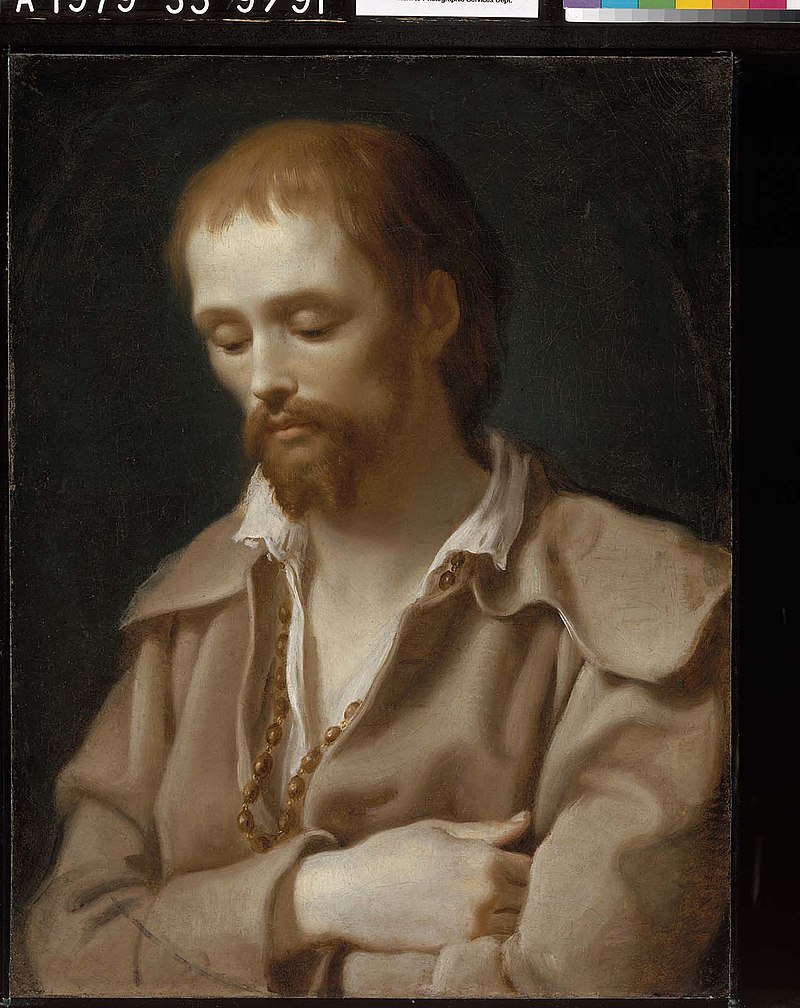
A Tale of Two Benedicts
A grace-filled Holy Week to all our readers! As we await and prepare for the Resurrection about to dawn upon us, we might keep in mind two Benedicts: Pope Emeritus Benedict XVI, requiescat in pace, elected on this day in 2005; and today’s commemoration of the mystic pilgrim, Benedict Joseph Labre, who died on this[…]Continue reading→

My Name is Bernadette
April 16th is a propitious day, for besides the anniversary of Father de Valk’s death, who founded Catholic Insight in its print form decades ago, and the commemoration of the ‘two Benedicts’, mentioned in accompanying posts, today we also recall Saint Bernadette Soubirous, the young visionary to whom the Virgin Mary appeared numerous times at[…]Continue reading→
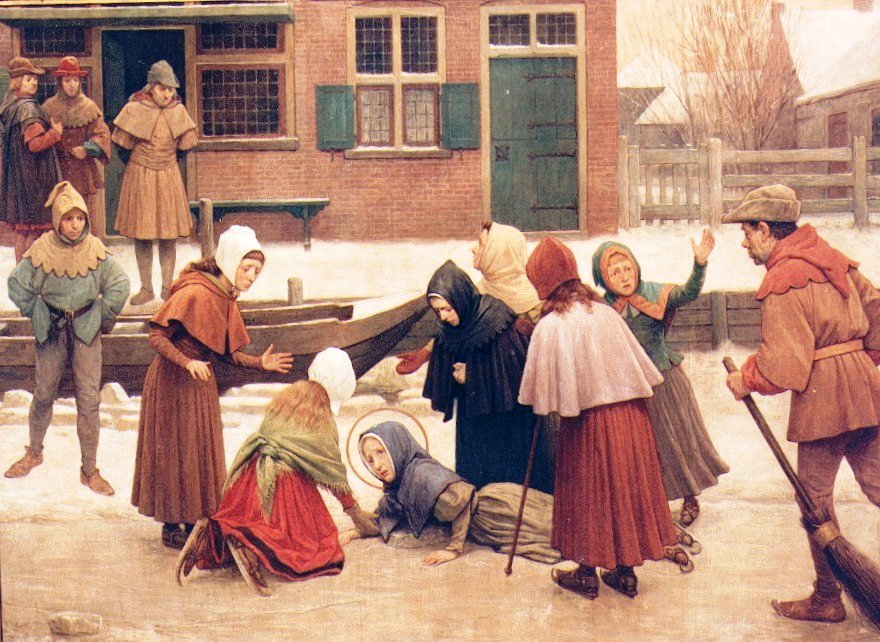
Saint Lydwina of Schiedam and Suffering Joyfully
Saint Lydwina of Schiedam (1380 – 1433) was one of the countless and glorious ‘victim souls’ in the history of the Church, those whose lives are filled with suffering, often of an unimaginable intensity, but who suffer joyfully. She was a fifteen-year old Dutch girl, out skating one day, when she fell and broke one[…]Continue reading→
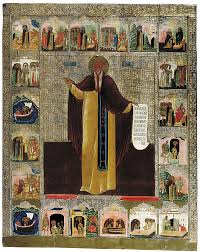
The Glorious Martyrdoms of Martin and Maximus
As we enter into Eastertide, we recall on this 13th of April Pope Saint Martin I (+655), one of the noblest, if most tragic, of the successors of Saint Peter. Born in Umbria, Italy, he was of noble lineage, with great intelligence combined with charity and love of the poor and the Church. While still[…]Continue reading→
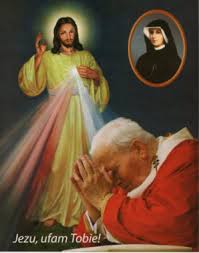
Canonizing Sister Faustina and Divine Mercy
HOMILY OF THE HOLY FATHER MASS IN ST PETER’S SQUARE FOR THE CANONIZATION OF SR MARY FAUSTINA KOWALSKA Sunday, 30 April 2000 1. “Confitemini Domino quoniam bonus, quoniam in saeculum misericordia eius”; “Give thanks to the Lord for he is good; his steadfast love endures for ever” (Ps 118: 1). So the Church sings on the Octave of[…]Continue reading→

Saint Stanislaus of Szczepanów
We celebrate Saint Stanislaus today (+ April 11, 1079), in light of this Easter Octave, a bishop and martyr who accepted the episcopacy only at the direct order of Pope Alexander II. He proved a wise and courageous leader of his flock, put to death by his own king, Boleslaus, for rebuking the monarch’s ‘immoral[…]Continue reading→
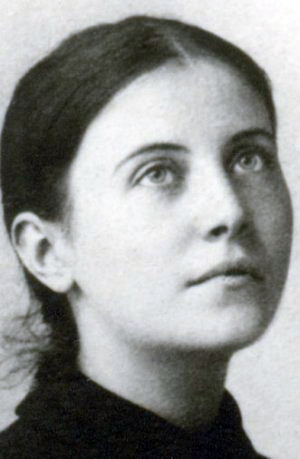
Saint Gemma Galgani
On this April 11th, in 1903 – the same year that the Italian Guiseppe Sarto was elected Pope later that summer as Pius X – a lovely, young Italian woman died, by the name of Gemma Galgani. She lived a brief life of 24 years, as did a number of other young saints, including Pier[…]Continue reading→
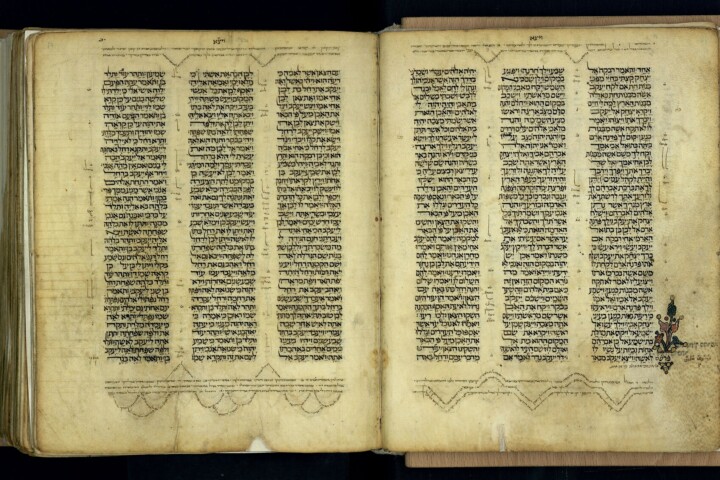
An Ideological and Improper Translation
I noticed something odd with the psalm reading at Mass the other day. Our bishops’ conference here in Canada has decreed that the Mass in English – Novus Ordo – use the ‘NRSV’, the ‘New Revised Standard Version’, an ‘updated’ translation of the original RSV, first published in 1952. This ‘new translation’ has the tendency[…]Continue reading→