
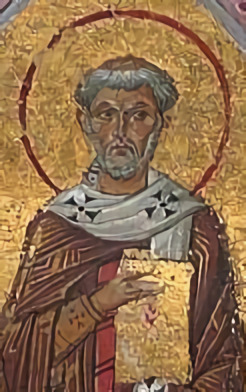
Pope Benedict on Pope Saint Leo the Great
BENEDICT XVI
GENERAL AUDIENCE
Paul VI Audience Hall
Wednesday, 5 March 2008
Saint Leo the Great
Dear Brothers and Sisters,
Continuing our journey through the Fathers of the Church, true stars that shine in the distance, at our meeting today we encounter a Pope who in 1754 Benedict XIV proclaimed a Doctor of the Church: St Leo the Great. As the nickname soon attributed to him by tradition suggests, he was truly one of the greatest Pontiffs to have honoured the Roman See and made a very important contribution to strengthening its authority and prestige. He was the first Bishop of Rome to have been called Leo, a name used subsequently by another 12 Supreme Pontiffs, and was also the first Pope whose preaching to the people who gathered round him during celebrations has come down to us. We spontaneously think of him also in the context of today’s Wednesday General Audiences, events that in past decades have become a customary meeting of the Bishop of Rome with the faithful and the many visitors from every part of the world.
Leo was a Tuscan native. In about the year 430 A.D., he became a deacon of the Church of Rome, in which he acquired over time a very important position. In the year 440 his prominent role induced Galla Placidia, who then ruled the Empire of the West, to send him to Gaul to heal a difficult situation. But in the summer of that year, Pope Sixtus III, whose name is associated with the magnificent mosaics in St Mary Major’s, died, and it was Leo who was elected to succeed him. Leo heard the news precisely while he was carrying out his peace mission in Gaul. Having returned to Rome, the new Pope was consecrated on 29 September 440. This is how his Pontificate began. It lasted more than 21 years and was undoubtedly one of the most important in the Church’s history. Pope Leo died on 10 November 461 and was buried near the tomb of St Peter. Today, his relics are preserved in one of the altars in the Vatican Basilica.
The times in which Pope Leo lived were very difficult: constant barbarian invasions, the gradual weakening of imperial authority in the West and the long, drawn-out social crisis forced the Bishop of Rome – as was to happen even more obviously a century and a half later during the Pontificate of Gregory the Great – to play an important role in civil and political events. This, naturally, could only add to the importance and prestige of the Roman See. The fame of one particular episode in Leo’s life has endured. It dates back to 452 when the Pope, together with a Roman delegation, met Attila, chief of the Huns, in Mantua and dissuaded him from continuing the war of invasion by which he had already devastated the northeastern regions of Italy. Thus, he saved the rest of the Peninsula. This important event soon became memorable and lives on as an emblematic sign of the Pontiff’s action for peace. Unfortunately, the outcome of another Papal initiative three years later was not as successful, yet it was a sign of courage that still amazes us: in the spring of 455 Leo did not manage to prevent Genseric’s Vandals, who had reached the gates of Rome, from invading the undefended city that they plundered for two weeks. This gesture of the Pope – who, defenceless and surrounded by his clergy, went forth to meet the invader to implore him to desist – nevertheless prevented Rome from being burned and assured that the Basilicas of St Peter, St Paul and St John, in which part of the terrified population sought refuge, were spared.
We are familiar with Pope Leo’s action thanks to his most beautiful sermons – almost 100 in a splendid and clear Latin have been preserved – and thanks to his approximately 150 letters. In these texts the Pontiff appears in all his greatness, devoted to the service of truth in charity through an assiduous exercise of the Word which shows him to us as both Theologian and Pastor. Leo the Great, constantly thoughtful of his faithful and of the people of Rome but also of communion between the different Churches and of their needs, was a tireless champion and upholder of the Roman Primacy, presenting himself as the Apostle Peter’s authentic heir: the many Bishops who gathered at the Council of Chalcedon, the majority of whom came from the East, were well aware of this.
This Council, held in 451 and in which 350 Bishops took part, was the most important assembly ever to have been celebrated in the history of the Church. Chalcedon represents the sure goal of the Christology of the three previous Ecumenical Councils: Nicea in 325, Constantinople in 381 and Ephesus in 431. By the sixth century these four Councils that sum up the faith of the ancient Church were already being compared to the four Gospels. This is what Gregory the Great affirms in a famous letter (I, 24): “I confess that I receive and revere, as the four books of the Gospel so also the four Councils”, because on them, Gregory explains further, “as on a four-square stone, rises the structure of the holy faith”. The Council of Chalcedon, which rejected the heresy of Eutyches who denied the true human nature of the Son of God, affirmed the union in his one Person, without confusion and without separation, of his two natures, human and divine.
The Pope asserted this faith in Jesus Christ, true God and true man, in an important doctrinal text addressed to the Bishop of Constantinople, the so-called Tome to Flavian which, read at Chalcedon, was received by the Bishops present with an eloquent acclamation. Information on it has been preserved in the proceedings of the Council: “Peter has spoken through the mouth of Leo”, the Council Fathers announced in unison.
(To continue reading, please see the Vatican webpage here)

Saint Kateri , Canada’s Protectress
This was the title given to Saint Kateri Tekakwitha, by Pope Benedict XVI, when he canonized her on October 28th, 2012, along with six others, in Saint Peter’ Square (she had been beatified by Pope John Paul II back in 1980). With Saint Joseph as our protector, along with the Canadian martyrs, we seem to[…]Continue reading→

Remembering Father Alphonse de Valk
(Today marks the sixth anniversary of the death of Father Alphonse de Valk, C.S.B., a faithful, courageous and indefatigable Basilian priest, pro-life-and-family apostle, and the founder of Catholic Insight magazine. Here is what we wrote those on his entering into eternity five years ago, as we continue to remember him in our prayers and thoughts)[…]Continue reading→

A Tale of Two Benedicts
A grace-filled Holy Week to all our readers! As we await and prepare for the Resurrection about to dawn upon us, we might keep in mind two Benedicts: Pope Emeritus Benedict XVI, requiescat in pace, elected on this day in 2005; and today’s commemoration of the mystic pilgrim, Benedict Joseph Labre, who died on this[…]Continue reading→

My Name is Bernadette
April 16th is a propitious day, for besides the anniversary of Father de Valk’s death, who founded Catholic Insight in its print form decades ago, and the commemoration of the ‘two Benedicts’, mentioned in accompanying posts, today we also recall Saint Bernadette Soubirous, the young visionary to whom the Virgin Mary appeared numerous times at[…]Continue reading→

Saint Lydwina of Schiedam and Suffering Joyfully
Saint Lydwina of Schiedam (1380 – 1433) was one of the countless and glorious ‘victim souls’ in the history of the Church, those whose lives are filled with suffering, often of an unimaginable intensity, but who suffer joyfully. She was a fifteen-year old Dutch girl, out skating one day, when she fell and broke one[…]Continue reading→

The Glorious Martyrdoms of Martin and Maximus
As we enter into Eastertide, we recall on this 13th of April Pope Saint Martin I (+655), one of the noblest, if most tragic, of the successors of Saint Peter. Born in Umbria, Italy, he was of noble lineage, with great intelligence combined with charity and love of the poor and the Church. While still[…]Continue reading→

Canonizing Sister Faustina and Divine Mercy
HOMILY OF THE HOLY FATHER MASS IN ST PETER’S SQUARE FOR THE CANONIZATION OF SR MARY FAUSTINA KOWALSKA Sunday, 30 April 2000 1. “Confitemini Domino quoniam bonus, quoniam in saeculum misericordia eius”; “Give thanks to the Lord for he is good; his steadfast love endures for ever” (Ps 118: 1). So the Church sings on the Octave of[…]Continue reading→

Divine Mercy Sunday – An Echo of Every Mass
Reach out your hand and put it in my side. Do not doubt but believe’… ‘My Lord and my God!’ (Jn. 20:18)). Today is Divine Mercy Sunday, and as we celebrate the end of the Easter Octave, we contemplate the wounded side of our Saviour, the Church’s source of life. On Good Friday in the[…]Continue reading→

Saint Stanislaus of Szczepanów
We celebrate Saint Stanislaus today (+ April 11, 1079), in light of this Easter Octave, a bishop and martyr who accepted the episcopacy only at the direct order of Pope Alexander II. He proved a wise and courageous leader of his flock, put to death by his own king, Boleslaus, for rebuking the monarch’s ‘immoral[…]Continue reading→

Saint Gemma Galgani
On this April 11th, in 1903 – the same year that the Italian Guiseppe Sarto was elected Pope later that summer as Pius X – a lovely, young Italian woman died, by the name of Gemma Galgani. She lived a brief life of 24 years, as did a number of other young saints, including Pier[…]Continue reading→