
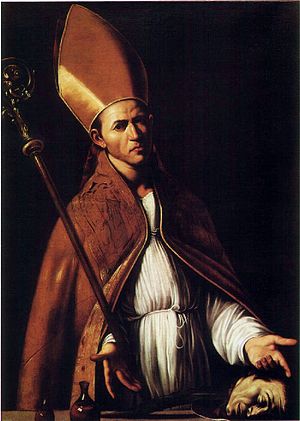
Saint Januarius’ Blood
Saint Januarius was bishop of Benevuento, in the south-west of Italy, about whom a number of legends are told – that he survived unscathed being burnt in a furnace, that wild bears refused to touch him in the amphitheatre – but all we know for relative certainty is that he was put to death in the last, great persecution, under Diocletian, sometime around 305 A.D., a decade or so before Christianity was legalized under Constantine.
What makes him more famous is the ampule of his blood kept under lock and key in the cathedral safe, which liquefies two or three times a year, for reasons that are unclear. Oft-times, the blood will liquefy in the presence of a Pope, but did not for John Paul II nor Benedict XVI, and only half-liquefied for Francis. Make of that what you will. Perhaps it’s not connected to Popes after all. One early hypothesis was that the blood liquefied when Januarius’ skull was brought near, signifying the blood’s ‘desire’ to be reunited with the body, in anticipation of the resurrection, of which Saint Paul speaks in today’s readings.
What we do know, as this article on CNA declares, is that “the liquefaction of St. Januarius’ blood happens at least three times per year: the saint’s feast day of Sept. 19, the Saturday before the first Sunday of May, and Dec. 16, which is the anniversary of the 1631 eruption of Mount Vesuvius”.
And what of the vial of blood remaining dried and clotted? Well, as the report goes on, “the failure of the blood to liquefy is believed to signal war, famine, disease, or other disaster”.
As Cardinal Crescenzio Sepe, Archbishop of Naples, says that the miracle is a sign of God’s love, goodness, and mercy, and of the closeness, the friendship, the fraternity of our St. Januarius…Glory be to God and veneration to our saint. Amen.
Although Christ warned us not to pay too much attention to signs. Still, I was heartened that, as far as I can tell, the good saint’s blood did liquefy today.
All we can say, is glory be to God, and all His saints, for all things, and may His holy and perfect will be fulfilled. +

Carney’s Amoral Majority
After five defections – euphemistically described as ‘crossing the floor’ – and three by-elections, Mark Carney and his Liberals how have their coveted majority. One wonders what bowls of pottage were offered in back-room deals. In the archaic monarchical system that is the Dominion of Canada, this majority allows the newly-minted Prime Minister to rule[…]Continue reading→

Saint Kateri , Canada’s Protectress
This was the title given to Saint Kateri Tekakwitha, by Pope Benedict XVI, when he canonized her on October 28th, 2012, along with six others, in Saint Peter’ Square (she had been beatified by Pope John Paul II back in 1980). With Saint Joseph as our protector, along with the Canadian martyrs, we seem to[…]Continue reading→

A Tale of Two Benedicts
A grace-filled Holy Week to all our readers! As we await and prepare for the Resurrection about to dawn upon us, we might keep in mind two Benedicts: Pope Emeritus Benedict XVI, requiescat in pace, elected on this day in 2005; and today’s commemoration of the mystic pilgrim, Benedict Joseph Labre, who died on this[…]Continue reading→

My Name is Bernadette
April 16th is a propitious day, for besides the anniversary of Father de Valk’s death, who founded Catholic Insight in its print form decades ago, and the commemoration of the ‘two Benedicts’, mentioned in accompanying posts, today we also recall Saint Bernadette Soubirous, the young visionary to whom the Virgin Mary appeared numerous times at[…]Continue reading→

Saint Lydwina of Schiedam and Suffering Joyfully
Saint Lydwina of Schiedam (1380 – 1433) was one of the countless and glorious ‘victim souls’ in the history of the Church, those whose lives are filled with suffering, often of an unimaginable intensity, but who suffer joyfully. She was a fifteen-year old Dutch girl, out skating one day, when she fell and broke one[…]Continue reading→

The Glorious Martyrdoms of Martin and Maximus
As we enter into Eastertide, we recall on this 13th of April Pope Saint Martin I (+655), one of the noblest, if most tragic, of the successors of Saint Peter. Born in Umbria, Italy, he was of noble lineage, with great intelligence combined with charity and love of the poor and the Church. While still[…]Continue reading→

Canonizing Sister Faustina and Divine Mercy
HOMILY OF THE HOLY FATHER MASS IN ST PETER’S SQUARE FOR THE CANONIZATION OF SR MARY FAUSTINA KOWALSKA Sunday, 30 April 2000 1. “Confitemini Domino quoniam bonus, quoniam in saeculum misericordia eius”; “Give thanks to the Lord for he is good; his steadfast love endures for ever” (Ps 118: 1). So the Church sings on the Octave of[…]Continue reading→

Saint Stanislaus of Szczepanów
We celebrate Saint Stanislaus today (+ April 11, 1079), in light of this Easter Octave, a bishop and martyr who accepted the episcopacy only at the direct order of Pope Alexander II. He proved a wise and courageous leader of his flock, put to death by his own king, Boleslaus, for rebuking the monarch’s ‘immoral[…]Continue reading→

Saint Gemma Galgani
On this April 11th, in 1903 – the same year that the Italian Guiseppe Sarto was elected Pope later that summer as Pius X – a lovely, young Italian woman died, by the name of Gemma Galgani. She lived a brief life of 24 years, as did a number of other young saints, including Pier[…]Continue reading→
An Ideological and Improper Translation
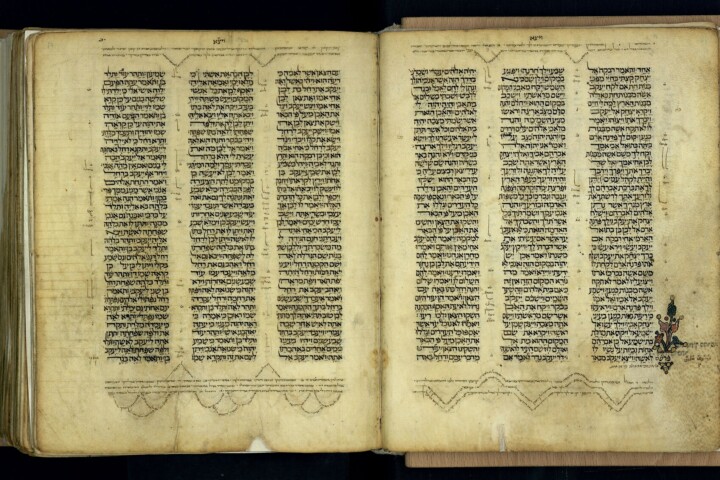
I noticed something odd with the psalm reading at Mass the other day. Our bishops’ conference here in Canada has decreed that the Mass in English – Novus Ordo – use the ‘NRSV’, the ‘New Revised Standard Version’, an ‘updated’ translation of the original RSV, first published in 1952. This ‘new translation’ has the tendency[…]Continue reading→