
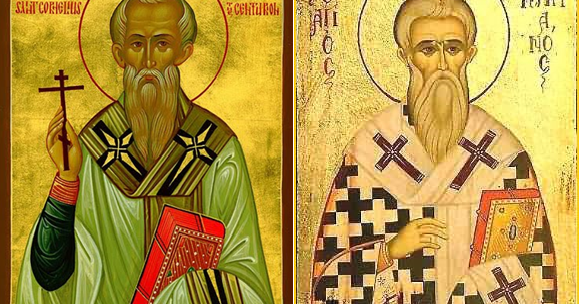
Saints Cornelius and Cyprian, Shepherds for Christ and Martyrs for His Truth
Saint Cornelius was Pope for a scant two years in the middle of the third century, elected in 251 and put to death in 253 in the persecution under Emperor Decius. During his short tenure, he had to deal with the machinations of his fellow schismatic bishop Novatian, who eventually declared himself the true Pope, thus also unwittingly making himself history’s first anti-Pope. Novatian was an early rigorist, teaching that certain sins were so evil, so beyond the pale – especially apostasy, failing in the face of martyrdom, sacrificing to the ‘gods’ even under pretense – that one could never again seek reconciliation with the Church (nor with God, one might presume). Banished! Cast off! Into the outer darkness! Anathema sit!
Cornelius, on the other hand, inspired by the Holy Spirit through the grace of his office, realized that God’s mercy was far greater than any of our sins, and that if men must forgive each other ‘seventy times seven times’, God forgiveness is infinitely beyond this, even welcoming back apostates, and those who may have apostatized seven, or seventy seven times. The only end point for repentance is death.
Novation proved implacable and obstinate, so was excommunicated along with his followers in a synod called by the Pope. But Cornelius, we may presume, would have welcomed them back in, had they too repented.
Although Cornelius helped lay the groundwork for healing this error and its schism within the Church, he was not so fortunate in placating the Roman authorities, meeting his end and gaining his final reward in succumbing to the hardships of exile – or other accounts say he was beheaded – sometime in Anno Domini 235. His remains are in the catacombs, and not in the tombs of the Popes.
Saint Cyprian, whom we also celebrate today, was bishop of the coastal city of Carthage, infamous for its hedonistic, even sadistic, culture, in what was then Roman-governed territory in North Africa. Perhaps in contrast to this, Cyprian is renowned for his theological treatises, composed in fluent and flowing classical Latin; he too was a foe of the Novatians, and helped fight and heal the ensuing schism. A certain amount of controversy surrounds his episcopacy, as he fled into hiding under the threat of martyrdom under the same Decian persecution that took the Pope’s life. But we should not be too hard on Cyprian, for who’s to say what we might have done? And the great Athanasius not only fled into hiding under persecution from the Arians, but wrote a treatise (De Fuga) justifying his decision.
Cyprian’s flight, however, was complicated by the fact that he was the bishop, and hence was seen to be abandoning his flock. He too defended his action, saying that he was more useful alive, and able to shepherd that same scattered flock, even from a distance, than dead. For would not death itself be an abandonment, of sorts? We might sympathize with that argument.
Cyprian was later to prove himself, and demonstrate his underlying courage and steadfastness, for God did call him to martyrdom eventually when a subsequent persecution arose under Emperor Valerian (the same one that took Pope Sixtus II and his deacons, including Saint Lawrence). Cyprian penned his final treatise, De exhortatione martyrii, a noble exhortation to die of the faith, and he gave his final witness, losing his head to the sword on September 14, 258, on what would later be the feast of the Triumph of the Cross.
Todays Office of Readings offers the final words of Bishop Cyprian. When the governor, Galerius Maximus, asked him, “Our most venerable emperors have commanded you to perform the religious rites”, (that is, pagan worship), Cyprian replied quite simply: “I will not do so”. Galerius Maximus said: “Consider your position”. Cyprian replied: “Follow your orders. In such a just cause there is no need for deliberation”.
Just so. Cyprian was beheaded and went straight to heaven, and may we join him and Cornelius there in whatever time and manner God so wills.
We again live in an era where bishops are fighting bishops, cardinals against cardinals, laymen against them also and each other; the language and stakes are increasing in intensity, with even bishops, as well as the current holder of the office of Peter has mentioned the spectre of schism.
I suppose there was never an era where such potential and incipient divisions in the Church were not the case. It seems now we are getting to the very nub of the matter of what it means to be ‘Catholic’, a follower of Christ and His Church. This requires a solid intellectual and spiritual foundation and formation, to guide our unruly passions, the whispers of the world in all its seductions. We must see past the fog of obfuscation, keeping our eyes focused on the truth, and the Truth, our face set like flint, in those things, those truths, that are absolutely necessary and not open to compromise, like throwing our own ‘grains of incense’ in worship of all the false gods before us.
So did our Fathers of old. So must we. And the grace of Christ will not only sustain us, but give us great joy and hope in the journey. Unity in charity, and charity in unity.
Saints Cyprian and Cornelius, orate pro nobis!
Carney’s Amoral Majority
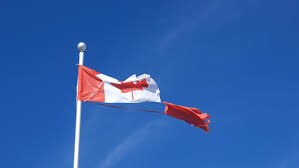
After five defections – euphemistically described as ‘crossing the floor’ – and three by-elections, Mark Carney and his Liberals how have their coveted majority. One wonders what bowls of pottage were offered in back-room deals. In the archaic monarchical system that is the Dominion of Canada, this majority allows the newly-minted Prime Minister to rule[…]Continue reading→

Saint Kateri , Canada’s Protectress
This was the title given to Saint Kateri Tekakwitha, by Pope Benedict XVI, when he canonized her on October 28th, 2012, along with six others, in Saint Peter’ Square (she had been beatified by Pope John Paul II back in 1980). With Saint Joseph as our protector, along with the Canadian martyrs, we seem to[…]Continue reading→
A Tale of Two Benedicts
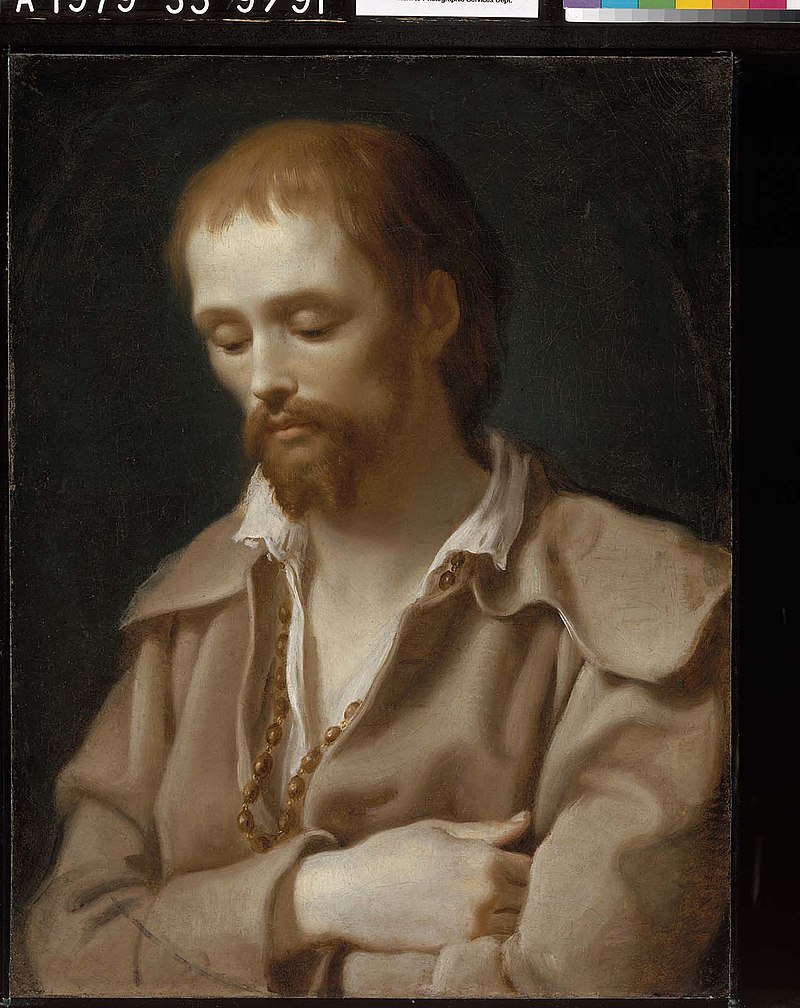
A grace-filled Holy Week to all our readers! As we await and prepare for the Resurrection about to dawn upon us, we might keep in mind two Benedicts: Pope Emeritus Benedict XVI, requiescat in pace, elected on this day in 2005; and today’s commemoration of the mystic pilgrim, Benedict Joseph Labre, who died on this[…]Continue reading→

My Name is Bernadette
April 16th is a propitious day, for besides the anniversary of Father de Valk’s death, who founded Catholic Insight in its print form decades ago, and the commemoration of the ‘two Benedicts’, mentioned in accompanying posts, today we also recall Saint Bernadette Soubirous, the young visionary to whom the Virgin Mary appeared numerous times at[…]Continue reading→
Saint Lydwina of Schiedam and Suffering Joyfully
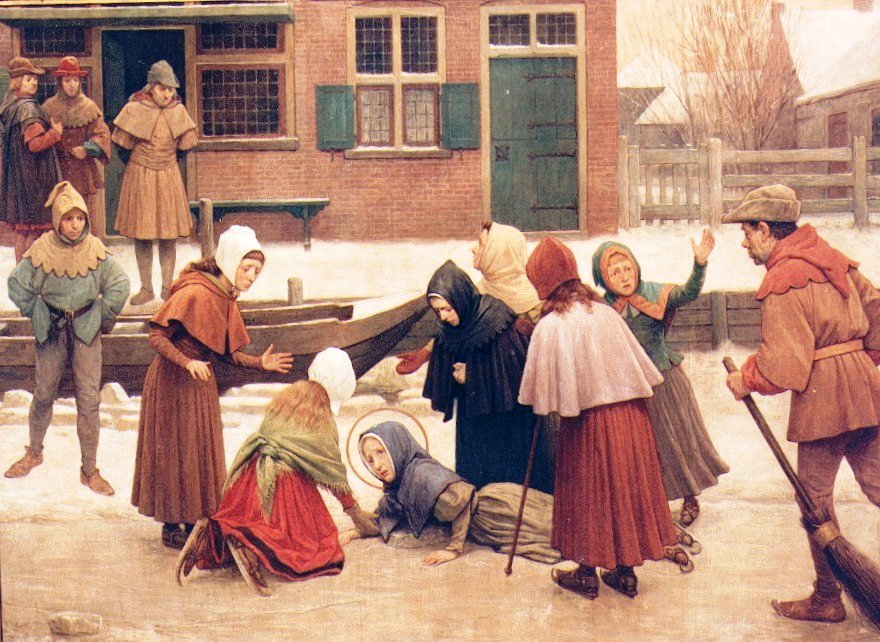
Saint Lydwina of Schiedam (1380 – 1433) was one of the countless and glorious ‘victim souls’ in the history of the Church, those whose lives are filled with suffering, often of an unimaginable intensity, but who suffer joyfully. She was a fifteen-year old Dutch girl, out skating one day, when she fell and broke one[…]Continue reading→
The Glorious Martyrdoms of Martin and Maximus
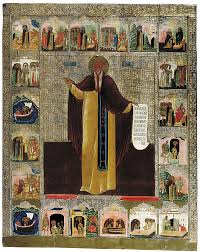
As we enter into Eastertide, we recall on this 13th of April Pope Saint Martin I (+655), one of the noblest, if most tragic, of the successors of Saint Peter. Born in Umbria, Italy, he was of noble lineage, with great intelligence combined with charity and love of the poor and the Church. While still[…]Continue reading→

Canonizing Sister Faustina and Divine Mercy
HOMILY OF THE HOLY FATHER MASS IN ST PETER’S SQUARE FOR THE CANONIZATION OF SR MARY FAUSTINA KOWALSKA Sunday, 30 April 2000 1. “Confitemini Domino quoniam bonus, quoniam in saeculum misericordia eius”; “Give thanks to the Lord for he is good; his steadfast love endures for ever” (Ps 118: 1). So the Church sings on the Octave of[…]Continue reading→

Saint Stanislaus of Szczepanów
We celebrate Saint Stanislaus today (+ April 11, 1079), in light of this Easter Octave, a bishop and martyr who accepted the episcopacy only at the direct order of Pope Alexander II. He proved a wise and courageous leader of his flock, put to death by his own king, Boleslaus, for rebuking the monarch’s ‘immoral[…]Continue reading→
Saint Gemma Galgani
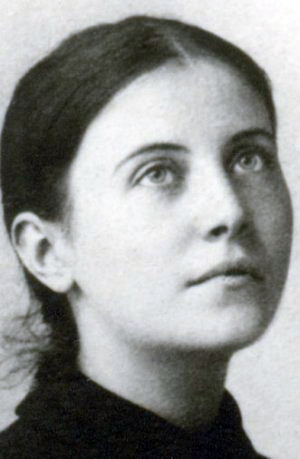
On this April 11th, in 1903 – the same year that the Italian Guiseppe Sarto was elected Pope later that summer as Pius X – a lovely, young Italian woman died, by the name of Gemma Galgani. She lived a brief life of 24 years, as did a number of other young saints, including Pier[…]Continue reading→
An Ideological and Improper Translation
I noticed something odd with the psalm reading at Mass the other day. Our bishops’ conference here in Canada has decreed that the Mass in English – Novus Ordo – use the ‘NRSV’, the ‘New Revised Standard Version’, an ‘updated’ translation of the original RSV, first published in 1952. This ‘new translation’ has the tendency[…]Continue reading→