
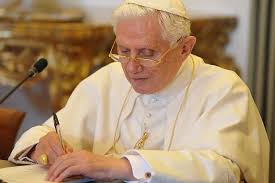
Pope Benedict’s Second Address on Pope Gregory the Great
BENEDICT XVI
GENERAL AUDIENCE
Wednesday, 4 June 2008
Saint Gregory the Great (2)
Dear Brothers and Sisters,
Today, at our Wednesday appointment, I return to the extraordinary figure of Pope Gregory the Great to receive some additional light from his rich teaching. Notwithstanding the many duties connected to his office as the Bishop of Rome, he left to us numerous works, from which the Church in successive centuries has drawn with both hands. Besides the important correspondence – in last week’s catechesis I cited the Register that contains over 800 letters – first of all he left us writings of an exegetical character, among which his Morals, a commentary on Job (known under the Latin title Moralia in Iob), the Homilies on Ezekiel and the Homilies on the Gospel stand out. Then there is an important work of a hagiographical character, the Dialogues, written by Gregory for the edification of the Lombard Queen Theodolinda. The primary and best known work is undoubtedly the Regula pastoralis (Pastoral Rule), which the Pope published at the beginning of his Pontificate with clearly programmatic goals.
Wanting to review these works quickly, we must first of all note that, in his writings, Gregory never sought to delineate “his own” doctrine, his own originality. Rather, he intended to echo the traditional teaching of the Church, he simply wanted to be the mouthpiece of Christ and of the Church on the way that must be taken to reach God. His exegetical commentaries are models of this approach.
He was a passionate reader of the Bible, which he approached not simply with a speculative purpose: from Sacred Scripture, he thought, the Christian must draw not theoretical understanding so much as the daily nourishment for his soul, for his life as man in this world. For example, in the Homilies on Ezekiel, he emphasized this function of the sacred text: to approach the Scripture simply to satisfy one’s own desire for knowledge means to succumb to the temptation of pride and thus to expose oneself to the risk of sliding into heresy. Intellectual humility is the primary rule for one who searches to penetrate the supernatural realities beginning from the sacred Book. Obviously, humility does not exclude serious study; but to ensure that the results are spiritually beneficial, facilitating true entry into the depth of the text, humility remains indispensable. Only with this interior attitude can one really listen to and eventually perceive the voice of God. On the other hand, when it is a question of the Word of God understanding it means nothing if it does not lead to action. In these Homilies on Ezekiel is also found that beautiful expression according which “the preacher must dip his pen into the blood of his heart; then he can also reach the ear of his neighbour”. Reading his homilies, one sees that Gregory truly wrote with his life-blood and, therefore, he still speaks to us today.
Gregory also developed this discourse in the Book of Morals, a Commentary on Job. Following the Patristic tradition, he examined the sacred text in the three dimensions of its meaning: the literal dimension, the allegorical dimension and the moral dimension, which are dimensions of the unique sense of Sacred Scripture. Nevertheless, Gregory gave a clear prevalence to the moral sense. In this perspective, he proposed his thought by way of some dual meanings – to know-to do, to speak-to live, to know-to act – in which he evokes the two aspects of human life that should be complementary, but which often end by being antithetical. The moral ideal, he comments, always consists in realizing a harmonious integration between word and action, thought and deed, prayer and dedication to the duties of one’s state: this is the way to realize that synthesis thanks to which the divine descends to man and man is lifted up until he becomes one with God. Thus the great Pope marks out a complete plan of life for the authentic believer; for this reason the Book of Morals, a commentary on Job, would constitute in the course of the Middle Ages a kind of summa of Christian morality.
(To continue reading, please see here...)
A Closed, Unsustainable, Descending Loop
As a follow-up to my thoughts on Payette’s payout, here be a stark image of where are here in Canada. As the graph shows in, well, graphic terms, since 2025, the public sector has contributed to 95.5% of economic growth. The private sector – which funds the public sector, or is supposed to – has[…]Continue reading→
Presidential Pardon of Weronika Krawczyk
As a good news, follow-up to our story from Poland, of the persecution of Weronika Krawczyk for her pro-life views, we heard that she has been granted a presidential pardon. One might still wonder why one needs a presidential pardon for simply holding the long-held belief that the child within the womb is a child,[…]Continue reading→
Pope Leo and a Rosary for Peace
Pope Leo XIV has asked Catholics across the world to join him in a Rosary for peace today, at 18:00 Rome time (6 pm), which would be noon from where I write (EST). If you are able, whether at that time or another, and in whatever way you pray, to join in intercession with the[…]Continue reading→
Payette’s Payout
I was glancing through some headlines, and noticed a mention of Julie Payette – engineer and astronaut and sometime the Queen’s representative in Canada – which brought back vague memories. She was appointed Governor-General by Justin Trudeau in 2017. Ms. Payette resigned in 2021, amidst claims that she created a ‘toxic work environment’, with allegations[…]Continue reading→
Weronika Krawczyk and Injustice in Poland
Catholic Action in Poland has issued a formal statement appealing to the President of the Republic of Poland to pardon Weronika Krawczyk—convicted for warning other women against an abortion-performing gynaecologist. Catholic Action (AK) emphasizes that no apology is owed to a doctor who has performed numerous abortions and proposed others; furthermore, the organization considers the[…]Continue reading→
Saint Isidore of Seville, the Internet and Industriousness
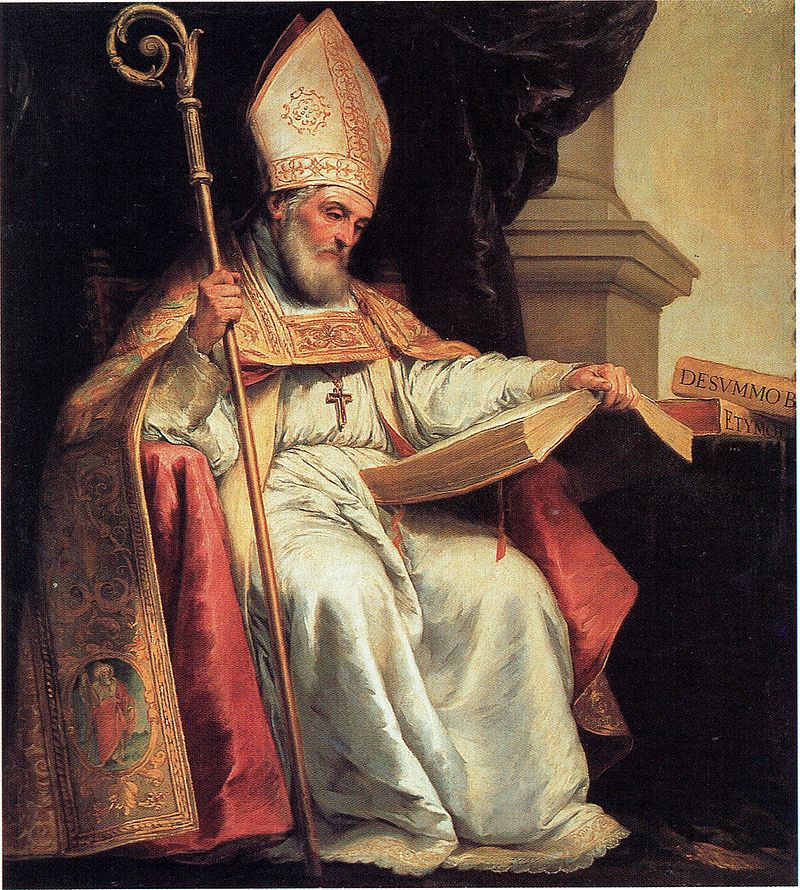
Today, April 4th, muted this year by Holy Saturday, is the commemoration of Saint Isidore of Seville (560-636) a bishop and doctor of the Church during a tumultuous age, when civilization was crumbling, coming apart at its very seams, which may sound sort of au courant. Then again, the form of this world has always[…]Continue reading→
Bishop Fulton Sheen’s 58th Good Friday Reflection
Incredible, at the beginning of this reflection, that the Venerable Bishop Sheen declares that he has given nearly 58 Good Friday reflections – this, as far as I can gather, was his final one, and he seems in full vigour in mind and body. The good bishop and evangelist died in his 84th year on[…]Continue reading→
A Minimal Friar and the Death of a Great Pope
This April the second- overshadowed by Holy Thursday this year – marks the memorial of Saint Francis of Paola (1417-1507), founder of the ‘Minim’ friars, so called for their humility and poverty, who interpreted the rule of Saint Francis of Assisi in quite a literal sense: extreme poverty, trust in God, foregoing all animal and[…]Continue reading→
Pope Benedict’s Last Holy Thursday Homily
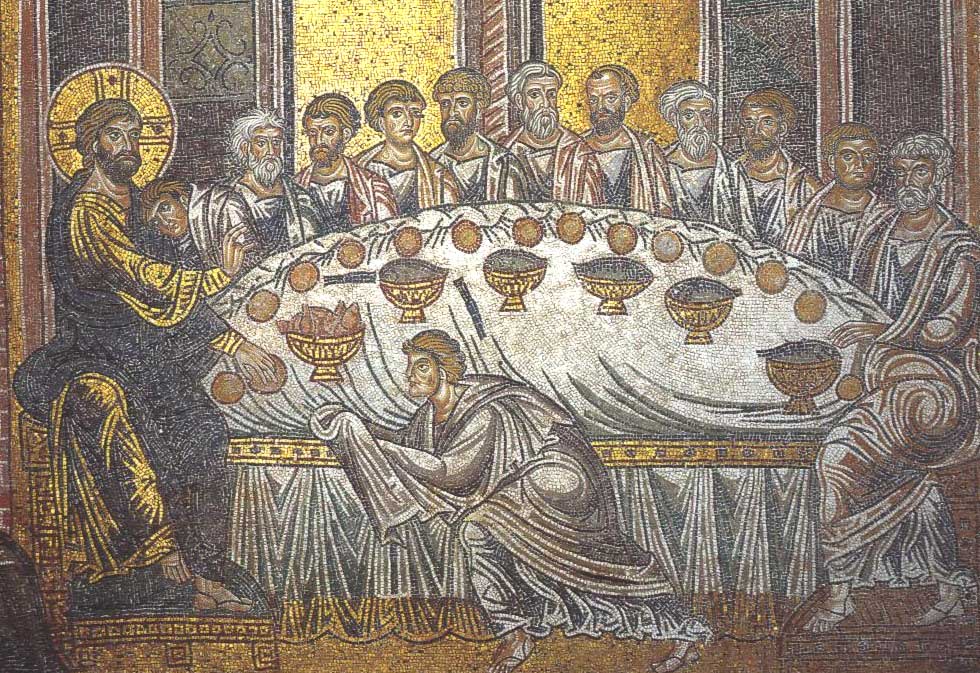
MASS OF THE LORD’S SUPPER HOMILY OF HIS HOLINESS BENEDICT XVI Basilica of St John Lateran Holy Thursday, 5 April 2012 Photo Gallery (Video) Dear Brothers and Sisters! Holy Thursday is not only the day of the institution of the Most Holy Eucharist, whose splendour bathes all else and in some ways draws it to[…]Continue reading→
Woven versus Seamless Garments
The reflection on the worthy project by Magie Dominic was intriguing, and I thought I would offer a brief follow-up commentary. The garment woven out of many pieces is a poignant symbol, even a ‘sacramental’, inspired by prayer and grace. We are all united in some way, and should strive for such unity, wherever we[…]Continue reading→