
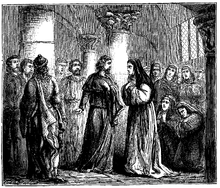
The Theologian versus the Rationalist: Bernard and Abelard
BENEDICT XVI
GENERAL AUDIENCE
Saint Peter’s Square
Wednesday, 4 November 2009
Two Theological Models in Comparison: Bernard and Abelard
Dear Brothers and Sisters,
In my last Catechesis I presented the main features of 12th-century monastic theology and scholastic theology which, in a certain sense, we might call respectively “theology of the heart” and “theology of reason”. Among the exponents of both these theological currents a broad and at times heated discussion developed, symbolically represented by the controversy between St Bernard of Clairvaux and Abelard.
In order to understand this confrontation between the two great teachers it helps to remember that theology is the search for a rational understanding, as far as this is possible, of the mysteries of Christian Revelation, believed through faith: fides quaerens intellectum faith seeks understanding to borrow a traditional, concise and effective definition. Now, whereas St Bernard, a staunch representative of monastic theology, puts the accent on the first part of the definition, namely on fides faith, Abelard, who was a scholastic, insists on the second part, that is, on the intellectus, on understanding through reason. For Bernard faith itself is endowed with a deep certitude based on the testimony of Scripture and on the teaching of the Church Fathers. Faith, moreover, is reinforced by the witness of the Saints and by the inspiration of the Holy Spirit in the individual believer’s soul. In cases of doubt and ambiguity, faith is protected and illumined by the exercise of the Magisterium of the Church. So it was that Bernard had difficulty in reaching agreement with Abelard and, more in general, with those who submitted the truths of faith to the critical examination of the intellect; an examination which in his opinion entailed a serious danger, that is, intellectualism, the relativization of truth, the questioning of the actual truths of faith. In this approach Bernard saw audacity taken to the point of unscrupulousness, a product of the pride of human intelligence that claims to “grasp” the mystery of God. In a letter he writes with regret: “Human ingenuity takes possession of everything, leaving nothing to faith. It confronts what is above and beyond it, scrutinizes what is superior to it, bursts into the world of God, alters rather than illumines the mysteries of faith; it does not open what is closed and sealed but rather uproots it, and what it does not find viable in itself it considers as nothing and refuses to believe in it” (Epistola CLXXXVIII,1: PL182, 1, 353).
Theology for Bernard had a single purpose: to encourage the intense and profound experience of God. Theology is therefore an aid to loving the Lord ever more and ever better, as the title of his Treatise on the Duty to love God says (Liber de diligendo Deo). On this journey there are various stages that Bernard describes in detail, which lead to the crowning experience when the believer’s soul becomes inebriated in ineffable love. Already on earth the human soul can attain this mystical union with the divine Word, a union that the Doctor Mellifluus describes as “spiritual nuptials”. The divine Word visits the soul, eliminates the last traces of resistance, illuminates, inflames and transforms it. In this mystical union the soul enjoys great serenity and sweetness and sings a hymn of joy to its Bridegroom. As I mentioned in the Catechesis on the life and doctrine of St Bernard, theology for him could not but be nourished by contemplative prayer, in other words by the affective union of the heart and the mind with God.
On the other hand Abelard, who among other things was the very person who introduced the term “theology” in the sense in which we understand it today, puts himself in a different perspective.
(To continue reading, please see here).

Saint Kateri , Canada’s Protectress
This was the title given to Saint Kateri Tekakwitha, by Pope Benedict XVI, when he canonized her on October 28th, 2012, along with six others, in Saint Peter’ Square (she had been beatified by Pope John Paul II back in 1980). With Saint Joseph as our protector, along with the Canadian martyrs, we seem to[…]Continue reading→
A Closed, Unsustainable, Descending Loop
As a follow-up to my thoughts on Payette’s payout, here be a stark image of where are here in Canada. As the graph shows in, well, graphic terms, since 2025, the public sector has contributed to 95.5% of economic growth. The private sector – which funds the public sector, or is supposed to – has[…]Continue reading→

A Tale of Two Benedicts
A grace-filled Holy Week to all our readers! As we await and prepare for the Resurrection about to dawn upon us, we might keep in mind two Benedicts: Pope Emeritus Benedict XVI, requiescat in pace, elected on this day in 2005; and today’s commemoration of the mystic pilgrim, Benedict Joseph Labre, who died on this[…]Continue reading→

My Name is Bernadette
April 16th is a propitious day, for besides the anniversary of Father de Valk’s death, who founded Catholic Insight in its print form decades ago, and the commemoration of the ‘two Benedicts’, mentioned in accompanying posts, today we also recall Saint Bernadette Soubirous, the young visionary to whom the Virgin Mary appeared numerous times at[…]Continue reading→
Presidential Pardon of Weronika Krawczyk
As a good news, follow-up to our story from Poland, of the persecution of Weronika Krawczyk for her pro-life views, we heard that she has been granted a presidential pardon. One might still wonder why one needs a presidential pardon for simply holding the long-held belief that the child within the womb is a child,[…]Continue reading→

Saint Lydwina of Schiedam and Suffering Joyfully
Saint Lydwina of Schiedam (1380 – 1433) was one of the countless and glorious ‘victim souls’ in the history of the Church, those whose lives are filled with suffering, often of an unimaginable intensity, but who suffer joyfully. She was a fifteen-year old Dutch girl, out skating one day, when she fell and broke one[…]Continue reading→

The Glorious Martyrdoms of Martin and Maximus
As we enter into Eastertide, we recall on this 13th of April Pope Saint Martin I (+655), one of the noblest, if most tragic, of the successors of Saint Peter. Born in Umbria, Italy, he was of noble lineage, with great intelligence combined with charity and love of the poor and the Church. While still[…]Continue reading→

Canonizing Sister Faustina and Divine Mercy
HOMILY OF THE HOLY FATHER MASS IN ST PETER’S SQUARE FOR THE CANONIZATION OF SR MARY FAUSTINA KOWALSKA Sunday, 30 April 2000 1. “Confitemini Domino quoniam bonus, quoniam in saeculum misericordia eius”; “Give thanks to the Lord for he is good; his steadfast love endures for ever” (Ps 118: 1). So the Church sings on the Octave of[…]Continue reading→
Pope Leo and a Rosary for Peace
Pope Leo XIV has asked Catholics across the world to join him in a Rosary for peace today, at 18:00 Rome time (6 pm), which would be noon from where I write (EST). If you are able, whether at that time or another, and in whatever way you pray, to join in intercession with the[…]Continue reading→
Payette’s Payout
I was glancing through some headlines, and noticed a mention of Julie Payette – engineer and astronaut and sometime the Queen’s representative in Canada – which brought back vague memories. She was appointed Governor-General by Justin Trudeau in 2017. Ms. Payette resigned in 2021, amidst claims that she created a ‘toxic work environment’, with allegations[…]Continue reading→