
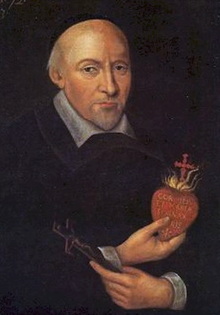
Saint John Eudes: Giving Our All
A contemporary of his fellow Frenchman, Descartes, Saint John Eudes (+1680) was of quite a different mind and spirit. Rather that meditate on whether he existed or not – cogito, ergo sum – Saint John simply accepted the very fact of creation as a gift from the Creator. And far from reducing what we might know for certain to quantitative extension – the Cartesian mathematical ‘clear and distinct ideas’ – Saint John saw reality as rich, full and deep, coming from the hand of the Creator, and extending from this life in a seamless harmony on to the next in eternity. He took a private vow of chastity at the tender age of 16, difficult to do in that hormonally-challenged time of life.
Like all saints, he was ahead of his time. During the fractious century in the wake of the Protestant ‘reformation’, which saw the rise of rationalism, unwittingly commenced by the hyper-rational and Godless French philosophes, John saw the need for men – priests especially – totally dedicated to God. At first joining the Oratory in France, which, unlike the original Oratory of Saint Philip Neri, was a religious order with vows, he proved himself a zealous and indefatigable pastor, well-read and well-formed, spiritually and intellectually. I am always heartened when I read of priests like Eudes, who ministered to the sick and dying during time of pandemic, this one a severe plague which hit France between 1627 and 1631. To avoid infecting his brethren, he lived for a time in a large cask in the middle of a field, which is something to ponder.
Part-way through his life, he discerned a call to dedicate himself specifically to the formation of priests, most of whom he perceived as ill-equipped for their demanding role. He saw that priests must be leaders, true shepherds, able to guide their flock through the increasing complexities of the vita moderna. So he founded the Congregation of Jesus and Mary, initially established on March 25, 1643, commonly called the ‘Eudists’, which continue their formative work to this day.
Saint John Eudes also found time – saints always seem to ‘find time’ – to write voluminously, spreading the then-new devotions to the Sacred Heart of Jesus and the Immaculate Heart of Mary, emphasizing the divine and human mercy and love of God for each individual person, against the paralyzing rigour and pessimism of Jansenism, which spirit also seems to be making a resurgence. This, without losing sight of the need for a healthy and balanced asceticism, working and praying hard, but all motivated by the love of God and our fellow man, and not some dour fear. In the steps of his spiritual father, Saint Philip Neri, he would have no ‘sad saints around his house’.
There is a move to have Saint John Eudes declared a Doctor of the Church; we will see, for that is a rather restricted group (37, and very slowly counting). But his works certainly make for profitable reading, and I would recommend today’s Office.
Also, please do peruse the reflection of Pope Benedict XVI from this day in 2009, where the Pontiff describes Saint John Eudes as a model pastor, in the context of the Year of Priests which he had just called, from what seems a more halcyonic time in the Church.
We could use Eudes’ example in our troubled days, where so many priests seem sad of their sacrifice, regretting their celibacy, their poverty, their workload, and the whole ‘gift of self’. But we should recall that giving oneself is required not only of priests, but of any vocation (just ask any married man, or woman, and what the sanctifying crucible of family life entails).
Saint John Eudes died at Caen on this day, August 19th, in 1680, and was canonized, quite fittingly along with the Curé d’Ars, by Pope Pius XI on May 31st, 1925, the fruit of a life spent in service to God and his fellow man in the holy priesthood.
As we heard in the reading on the feast of Saint Lawrence, God loves a cheerful giver, so, like Saint John Eudes and the whole host of saints, may we keep our hands on the plough, not look back, give all, and happily, so we gain it back a hundredfold.
Carney’s Amoral Majority
After five defections – euphemistically described as ‘crossing the floor’ – and three by-elections, Mark Carney and his Liberals how have their coveted majority. One wonders what bowls of pottage were offered in back-room deals. In the archaic monarchical system that is the Dominion of Canada, this majority allows the newly-minted Prime Minister to rule[…]Continue reading→

Saint Kateri , Canada’s Protectress
This was the title given to Saint Kateri Tekakwitha, by Pope Benedict XVI, when he canonized her on October 28th, 2012, along with six others, in Saint Peter’ Square (she had been beatified by Pope John Paul II back in 1980). With Saint Joseph as our protector, along with the Canadian martyrs, we seem to[…]Continue reading→

A Tale of Two Benedicts
A grace-filled Holy Week to all our readers! As we await and prepare for the Resurrection about to dawn upon us, we might keep in mind two Benedicts: Pope Emeritus Benedict XVI, requiescat in pace, elected on this day in 2005; and today’s commemoration of the mystic pilgrim, Benedict Joseph Labre, who died on this[…]Continue reading→

My Name is Bernadette
April 16th is a propitious day, for besides the anniversary of Father de Valk’s death, who founded Catholic Insight in its print form decades ago, and the commemoration of the ‘two Benedicts’, mentioned in accompanying posts, today we also recall Saint Bernadette Soubirous, the young visionary to whom the Virgin Mary appeared numerous times at[…]Continue reading→

Saint Lydwina of Schiedam and Suffering Joyfully
Saint Lydwina of Schiedam (1380 – 1433) was one of the countless and glorious ‘victim souls’ in the history of the Church, those whose lives are filled with suffering, often of an unimaginable intensity, but who suffer joyfully. She was a fifteen-year old Dutch girl, out skating one day, when she fell and broke one[…]Continue reading→

The Glorious Martyrdoms of Martin and Maximus
As we enter into Eastertide, we recall on this 13th of April Pope Saint Martin I (+655), one of the noblest, if most tragic, of the successors of Saint Peter. Born in Umbria, Italy, he was of noble lineage, with great intelligence combined with charity and love of the poor and the Church. While still[…]Continue reading→

Canonizing Sister Faustina and Divine Mercy
HOMILY OF THE HOLY FATHER MASS IN ST PETER’S SQUARE FOR THE CANONIZATION OF SR MARY FAUSTINA KOWALSKA Sunday, 30 April 2000 1. “Confitemini Domino quoniam bonus, quoniam in saeculum misericordia eius”; “Give thanks to the Lord for he is good; his steadfast love endures for ever” (Ps 118: 1). So the Church sings on the Octave of[…]Continue reading→

Saint Stanislaus of Szczepanów
We celebrate Saint Stanislaus today (+ April 11, 1079), in light of this Easter Octave, a bishop and martyr who accepted the episcopacy only at the direct order of Pope Alexander II. He proved a wise and courageous leader of his flock, put to death by his own king, Boleslaus, for rebuking the monarch’s ‘immoral[…]Continue reading→
Saint Gemma Galgani
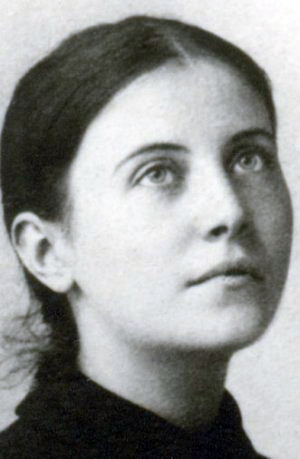
On this April 11th, in 1903 – the same year that the Italian Guiseppe Sarto was elected Pope later that summer as Pius X – a lovely, young Italian woman died, by the name of Gemma Galgani. She lived a brief life of 24 years, as did a number of other young saints, including Pier[…]Continue reading→
An Ideological and Improper Translation
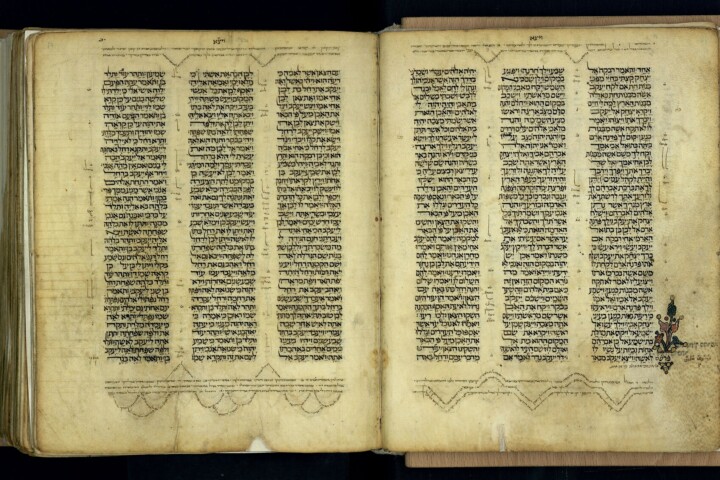
I noticed something odd with the psalm reading at Mass the other day. Our bishops’ conference here in Canada has decreed that the Mass in English – Novus Ordo – use the ‘NRSV’, the ‘New Revised Standard Version’, an ‘updated’ translation of the original RSV, first published in 1952. This ‘new translation’ has the tendency[…]Continue reading→