
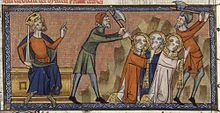
Pope Sixtus and Companions, Martyrs To the End
Historians count ten traditional persecutions of Christians in the early Church – from the first, under Nero, beginning in 63 A.D. through a series of anti-Christian emperors of various stripes and intensities, culminating in the final and most brutal of them all under Diocletian, all of which ended with the Edict of Milan in 313 issued by Emperor Constantine, who sort of converted to Catholicism, and made the religion legal (it would not become the official religion of the Roman empire until 381, under Theodosius the First). I say ‘sort of’, because Constantine, knowing he would do any number of nefarious deeds in running a still-pagan Empire, waited until his deathbed to be baptized. And even then, it was done by the Arian Eusebius of Nicomedia, the validity of whose formula was doubtful. But we may hope he made it.
Until that time, Christians never really knew when the next wave of punitive laws would come down from the princes of this world, and two of the worst and most severe were the decrees of Decius in 250 and Valerian in 258. Here is what Saint Cyprian, Bishop of Carthage, wrote just before his own martyrdom in the maelstrom that was to come:
Valerian sent a rescript to the Senate, saying that bishops, presbyters, and deacons should all receive immediate punishment; that senators, knights, and other men of importance should lose their rank and their property, and if they still persisted in being Christians, they should lose their heads; and that matrons should be deprived of their property and be sent into exile. Members of Caesar’s own household, whether they had confessed their faith before or were only confessing it now, should be deprived of their property, bound in chains, and sent as slaves to his estates.
(As a providential aside, Valerian sent this rescript while in campaign against the Persians. Soon after it was went, the Roman Legionaries were stricken with plague, lost a crucial battle and, for the first time in the history of the Empire, the Emperor himself was captured. One story relates that Shapur, the Persian king, treated Valerian as an ignominious slave, using his back to mount his horse, before eventually flaying him, and stuffing his skin with straw as a taxidermic trophy. We may hope that this humiliation may have somehow saved Valerian in the end).
Anon, back to the Church: The Pope at this time, Sixtus II was a philosopher, who helped heal the Novatian schism by defining and enforcing the orthodox teaching on the sacramental efficacy of baptism and confession independent of the holiness of the priest or the sins of the recipient, even if they had lapsed from the Faith under persecution.
The Pope had to put his head where his mouth was – for soon enough, he himself was captured, with six of his deacons. Refusing to apostatize, they were all beheaded on this day, in 258 – their Pontiff promptly volunteering to go first, as befits a pastor. Lawrence, his most prominent deacon, begged to go with them to glory, but Sixtus replied that he would follow soon enough, and he did, a few days later, on the tenth of August.
The days may soon be upon us when bishops must once again be willing to die for the truth, and we along with them. The secular powers will try to whittle down our resistance, to hide our Faith under a bushel basket, to sell our eternal treasure for a bowl of politically correct woke pottage. We all must pray and cultivate that original parrhesia, the courage and boldness to witness to the truth of our Faith, even to the loss of our own heads.
Saint Sixtus and Companion Martyrs, orate pro nobis!

Carney’s Amoral Majority
After five defections – euphemistically described as ‘crossing the floor’ – and three by-elections, Mark Carney and his Liberals how have their coveted majority. One wonders what bowls of pottage were offered in back-room deals. In the archaic monarchical system that is the Dominion of Canada, this majority allows the newly-minted Prime Minister to rule[…]Continue reading→

Saint Kateri , Canada’s Protectress
This was the title given to Saint Kateri Tekakwitha, by Pope Benedict XVI, when he canonized her on October 28th, 2012, along with six others, in Saint Peter’ Square (she had been beatified by Pope John Paul II back in 1980). With Saint Joseph as our protector, along with the Canadian martyrs, we seem to[…]Continue reading→

A Tale of Two Benedicts
A grace-filled Holy Week to all our readers! As we await and prepare for the Resurrection about to dawn upon us, we might keep in mind two Benedicts: Pope Emeritus Benedict XVI, requiescat in pace, elected on this day in 2005; and today’s commemoration of the mystic pilgrim, Benedict Joseph Labre, who died on this[…]Continue reading→

My Name is Bernadette
April 16th is a propitious day, for besides the anniversary of Father de Valk’s death, who founded Catholic Insight in its print form decades ago, and the commemoration of the ‘two Benedicts’, mentioned in accompanying posts, today we also recall Saint Bernadette Soubirous, the young visionary to whom the Virgin Mary appeared numerous times at[…]Continue reading→

Saint Lydwina of Schiedam and Suffering Joyfully
Saint Lydwina of Schiedam (1380 – 1433) was one of the countless and glorious ‘victim souls’ in the history of the Church, those whose lives are filled with suffering, often of an unimaginable intensity, but who suffer joyfully. She was a fifteen-year old Dutch girl, out skating one day, when she fell and broke one[…]Continue reading→

The Glorious Martyrdoms of Martin and Maximus
As we enter into Eastertide, we recall on this 13th of April Pope Saint Martin I (+655), one of the noblest, if most tragic, of the successors of Saint Peter. Born in Umbria, Italy, he was of noble lineage, with great intelligence combined with charity and love of the poor and the Church. While still[…]Continue reading→

Canonizing Sister Faustina and Divine Mercy
HOMILY OF THE HOLY FATHER MASS IN ST PETER’S SQUARE FOR THE CANONIZATION OF SR MARY FAUSTINA KOWALSKA Sunday, 30 April 2000 1. “Confitemini Domino quoniam bonus, quoniam in saeculum misericordia eius”; “Give thanks to the Lord for he is good; his steadfast love endures for ever” (Ps 118: 1). So the Church sings on the Octave of[…]Continue reading→

Saint Stanislaus of Szczepanów
We celebrate Saint Stanislaus today (+ April 11, 1079), in light of this Easter Octave, a bishop and martyr who accepted the episcopacy only at the direct order of Pope Alexander II. He proved a wise and courageous leader of his flock, put to death by his own king, Boleslaus, for rebuking the monarch’s ‘immoral[…]Continue reading→

Saint Gemma Galgani
On this April 11th, in 1903 – the same year that the Italian Guiseppe Sarto was elected Pope later that summer as Pius X – a lovely, young Italian woman died, by the name of Gemma Galgani. She lived a brief life of 24 years, as did a number of other young saints, including Pier[…]Continue reading→
An Ideological and Improper Translation
I noticed something odd with the psalm reading at Mass the other day. Our bishops’ conference here in Canada has decreed that the Mass in English – Novus Ordo – use the ‘NRSV’, the ‘New Revised Standard Version’, an ‘updated’ translation of the original RSV, first published in 1952. This ‘new translation’ has the tendency[…]Continue reading→