
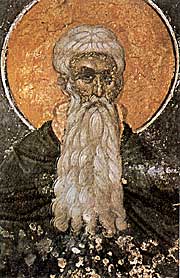
Saint Arsenius the Great, and the Silent
Saint Arsenius, called ‘the Great’, (350 – 445), whom we recall on this 19th of July, was one of the early monks of the desert, and founders of the eremitical way of monastic life. As an anchorite, he lived alone in prayer and penance. But he did not begin this way, born into wealth and privilege, and receiving the most elite of educations for his time. There was an initial conversion to a deeper spiritual life when his parents died – Arsenius sold everything, placed his sister Afrosity (love those names!) into a community of virgins, and was himself ordained a deacon. His erudition could not go unnoticed, however, and he was called to the imperial palace by Theodosius the First (also called ‘the Great’, and the same one who came into conflict, and eventual repentance, with Saint Ambrose). Arsenius was tasked with tutoring the royal sons. The emperor, much pleased, bestowed on him many favours, a lavish life, wide acclaim, and Arsenius the Deacon was beloved by all.
Even though there was nothing explicitly wrong with such a life, the grace of God called the receptive soul of Arsenius higher, and he responded with unconditional fervour, eventually resigning his post, and fleeing into the wilderness like John the Baptist, where many others had already gone, the thousands we now know as the Desert Fathers. Arsenius presented himself to the renowned Macarius, who handed him over to John the Dwarf to be tested. John was in the middle of a meal with some others, and took no notice of his noble guest, until halfway through, he tossed a piece of bread on the ground, which Arsenius sat down and ate without a word.
And so began the solitary monastic life of Arsenius for the next 55 years – he lived to ripe old age of 95, signifying the healthy nature of the ascetical modus vivendi. He would flee further into the desert whenever he was discovered, seeking the lowest and most obscure place, weeping over his past life, and mortified himself in ways that can only be understood supernaturally. One penance was that he never changed the water he used to moisten the fronds to make baskets and such – one of the employments of the monks. He would top it up, which meant that the bowl reeked so much even the angels could probably smell it, had they a sense of smell. Arsenius said that this was to atone for all the times he wore ‘perfume’ at court, which made me think of men’s cologne, which they call that since it wouldn’t sell as perfume.
He also, more to the point, and more pertinent for us, Arsenius kept an almost perpetual silence, alone with God, and it is to Arsenius that the aphorism is attributed: “Many times have I repented of having spoken, but never have I repented of having remained silent”.
Like all aphorisms, there are exceptions (I would replace ‘never’ with ‘rarely’, but who am I to correct a Desert Father?). There are times when we must speak, not least for those of us still in ‘the world’. But silence is indeed golden, and would that we take more time in our culture of constant noise, bustle and boisterousness, to reflect and be alone with God, as today’s Gospel attests.
May Saint Arsenius, the Great and the Silent, intercede for us all.

Carney’s Amoral Majority
After five defections – euphemistically described as ‘crossing the floor’ – and three by-elections, Mark Carney and his Liberals how have their coveted majority. One wonders what bowls of pottage were offered in back-room deals. In the archaic monarchical system that is the Dominion of Canada, this majority allows the newly-minted Prime Minister to rule[…]Continue reading→

Saint Kateri , Canada’s Protectress
This was the title given to Saint Kateri Tekakwitha, by Pope Benedict XVI, when he canonized her on October 28th, 2012, along with six others, in Saint Peter’ Square (she had been beatified by Pope John Paul II back in 1980). With Saint Joseph as our protector, along with the Canadian martyrs, we seem to[…]Continue reading→

A Tale of Two Benedicts
A grace-filled Holy Week to all our readers! As we await and prepare for the Resurrection about to dawn upon us, we might keep in mind two Benedicts: Pope Emeritus Benedict XVI, requiescat in pace, elected on this day in 2005; and today’s commemoration of the mystic pilgrim, Benedict Joseph Labre, who died on this[…]Continue reading→

My Name is Bernadette
April 16th is a propitious day, for besides the anniversary of Father de Valk’s death, who founded Catholic Insight in its print form decades ago, and the commemoration of the ‘two Benedicts’, mentioned in accompanying posts, today we also recall Saint Bernadette Soubirous, the young visionary to whom the Virgin Mary appeared numerous times at[…]Continue reading→

Saint Lydwina of Schiedam and Suffering Joyfully
Saint Lydwina of Schiedam (1380 – 1433) was one of the countless and glorious ‘victim souls’ in the history of the Church, those whose lives are filled with suffering, often of an unimaginable intensity, but who suffer joyfully. She was a fifteen-year old Dutch girl, out skating one day, when she fell and broke one[…]Continue reading→

The Glorious Martyrdoms of Martin and Maximus
As we enter into Eastertide, we recall on this 13th of April Pope Saint Martin I (+655), one of the noblest, if most tragic, of the successors of Saint Peter. Born in Umbria, Italy, he was of noble lineage, with great intelligence combined with charity and love of the poor and the Church. While still[…]Continue reading→

Saint Stanislaus of Szczepanów
We celebrate Saint Stanislaus today (+ April 11, 1079), in light of this Easter Octave, a bishop and martyr who accepted the episcopacy only at the direct order of Pope Alexander II. He proved a wise and courageous leader of his flock, put to death by his own king, Boleslaus, for rebuking the monarch’s ‘immoral[…]Continue reading→
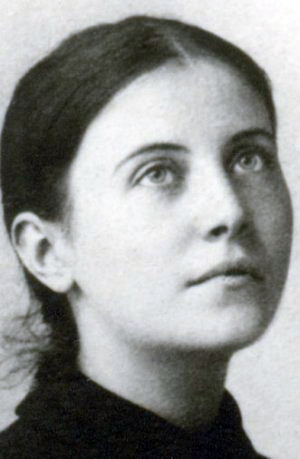
Saint Gemma Galgani
On this April 11th, in 1903 – the same year that the Italian Guiseppe Sarto was elected Pope later that summer as Pius X – a lovely, young Italian woman died, by the name of Gemma Galgani. She lived a brief life of 24 years, as did a number of other young saints, including Pier[…]Continue reading→
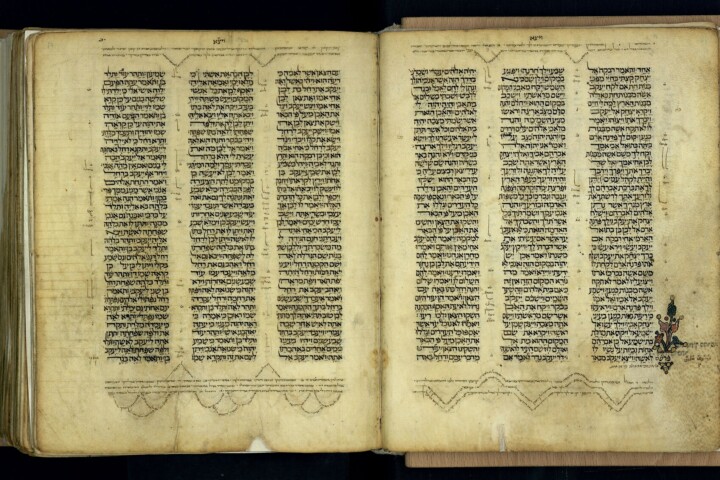
An Ideological and Improper Translation
I noticed something odd with the psalm reading at Mass the other day. Our bishops’ conference here in Canada has decreed that the Mass in English – Novus Ordo – use the ‘NRSV’, the ‘New Revised Standard Version’, an ‘updated’ translation of the original RSV, first published in 1952. This ‘new translation’ has the tendency[…]Continue reading→
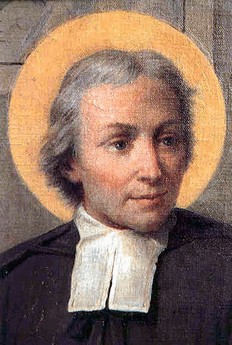
Saint Jean-Baptiste de la Salle: A Teacher for Teachers
Jean-Baptiste de la Salle (1651 – 1719), a French nobleman, ordained a priest, founded the first order in the Church’s history entirely without priests, and this came about almost by accident. I say ‘almost’, for, of course, there are no accidents with God. Destined for ordination from an early age, Jean-Baptiste never looked back, even[…]Continue reading→