
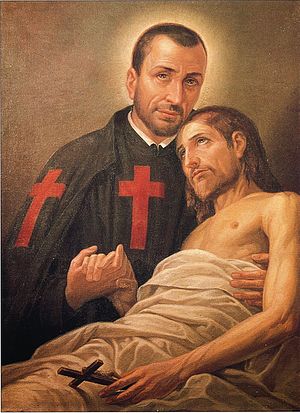
Saint Camillus de Lellis: Alea Iacta Est
A true saint for our times is the one we celebrate today – Camillus de Lellis (+1614) (we will follow the Canadian calendar, and for those American readers who would like to reflect on Saint Kateri Tekakwitha, please see here).
Camillus was born in what is now Abruzzo, in Naples, in 1550. His father was a soldier who was often away on campaign, and, with his mother dying young, Camillus as a child was left more or less neglected, eventually orphaned. It may not be surprising that the lad adopted dissolute habits. Yet he was physically precocious, large and strong, so followed his father’s footsteps in the military life – which back then usually meant becoming a mercenary, hiring out your arms and sword to the highest bidder, a path without much nobility or honour.
Camillus walked the wayward labyrinth of the prodigal son, dissipating what inheritance he had on women, wine and, most of all, gambling, addicted to ‘dice’, casting his lots for everything, and lost it all. As may have been expected, his life descended in a spiral – many of us must learn the wages of sin the hard and long way round, and some descend into that pit deeper than others.
It was when he had gambled away his boots that Camillus knew he had hit bottom, for this was in the days before Value Village and thrift stores, when footwear was hard to come by, and going barefoot meant penury and not much soldiering. He had also developed a suppurating wound in his leg that refused to heal. No shoes, no money – but he thought to himself, he could still serve others. The wayward wanderer, now a dissipated giant, made his way to the Franciscan convent at Manfredonia, signing up as a lay-brother, doing whatever menial tasks were required. By their preaching, and more, their prayers and example, Camillus experienced a deep conversion in his 25th year – after having lived a full life – in the year of 1575.
He tried thrice to join them as a novice, but, with his suppurating leg still refusing to heal, they had to let him go each time. So he made his way, poor, limping and in pain, to the San Giacomo hospital in Rome for the incurables, where he received some help, and did what chores were needed. As a patient, he saw how badly his fellow patients were treated – neglected, wallowing in their own filth, left more or less to die – and thought, well, what should I do? What could I do?
He knew he had to help, so began to act as a voluntary caregiver, working his way up to superintendent, and reformed the hospital from the ground up – and along with that, hospital management in general. He was way ahead of his time in the proper care for the sick, with hygiene, gentle bedside manners, personal attention, prayer and conversation with those ailing, healing of both body and soul.
Camillus placed himself under the spiritual direction of a fellow saint, Father Philip Neri, founder of the Oratory – who would later share with him the title ‘Apostle of Rome’. Saint Philip could scarcely restrain the zeal of this reformer, who seemed to know no bounds in his love and devotion to the sick, carrying them on his back if need be, racking up debts, trusting in God, and practising a personal asceticism – hairshirts, sleepless nights – that was divinely inspired. Camillus knew that any external reform had to begin with what the Church describes as interiore conversione, that re-forming of one’s own mind, heart and soul. That is the real revolution we need.
In a moment of near-despair at the heavy burdens he was carrying, Camillus heard a voice from the cross: Why are you afraid? Do you not realize that this is not your work but mine?
Under Philip’s direction, to better serve his beloved sick and suffering, Camillus began studying for the priesthood at 32 years of age – which evokes the earlier example of Ignatius of Loyola, when ’32’ was far older then than it is now, persevering through the Latin, philosophy and theology. He was ordained on Pentecost of 1584, by Bishop Thomas Goldwell, the last Catholic bishop of England and Wales for three centuries (before the re-establishing of the Church there in the 1850).
Not yet content – saints never are – Father Camillus then went on to found a community to continue and expand his work for the sick, and so was born the Order of Clerks Regular, Ministers of the Infirm (M.I.), more commonly called the Camillians, which received formal recognition in that same year of 1584 by Pope Sixtus V. They currently number over a thousand members, serving in 35 countries across the globe, recognizable by the large red cross on their originally black – later white – habits, which symbol was later adopted by the society of the Red Cross in 1863 in Switzerland.
Their members, as Camillus requested, make a fourth vow, to serve the sick, even with danger to one’s own life, words upon which some our current, and much more highly paid, physicians treating patients only via ‘Zoom’, or in full hazmat suits, might want to reflect, and the same might be said for those spiritual ministers who are called to treat our souls as well….After all, it is God’s work, not ours. Might He not protect His own? In the words of Pope Saint John Paul II, in his address to the Camillians:
At the same time, however, I cannot forget the Camillian religious who down the centuries “have given their lives in service to victims of contagious diseases, confirming the truth that dedication to the point of heroism belongs to the prophetic nature of the consecrated life” (Vita consecrata, n. 83). How can we not see in this flourishing holiness a confirmation of the validity of the Camillian charism as a way to the perfection of charity?
Just so. The Camillians served in all sorts of conditions, including the resurgence of the bubonic plague, whose effects, not to downplay anyone’s individual suffering, put our own malaise into perspective. But they were generally preserved from the illness, and Father Camillus was credited with the gifts of healing, prophecy, interior locutions. He himself always refused to be treated, dragging himself to serve his fellow sick when he couldn’t even stand, and it was of an illness he died – with his boots on – on this day in 1614, at the age of 64.
He was immediately hailed as a saint, beatified by Pope Benedict XIV in 1742 (himself a remarkable figure, and perhaps one of most scholarly of Popes in history), and canonized by the same Pontiff soon afterwards, in 1746.
Saint Camillus de Lellis’ body rests in the Church of Saint Mary Magdalene in Rome – fittingly, a fellow convert from wayward ways – and he shines through the ages as an exemplar and intercessor of what ‘practising medicine’ really means – to give all, to risk all, and to rely completely upon God when we feel we have nothing left.
It is not your work, but mine. Not a bad motto, that.
Saint Camillus de Lellis, ora pro nobis, et ora pro infirmos!
Carney’s Amoral Majority
After five defections – euphemistically described as ‘crossing the floor’ – and three by-elections, Mark Carney and his Liberals how have their coveted majority. One wonders what bowls of pottage were offered in back-room deals. In the archaic monarchical system that is the Dominion of Canada, this majority allows the newly-minted Prime Minister to rule[…]Continue reading→

Saint Kateri , Canada’s Protectress
This was the title given to Saint Kateri Tekakwitha, by Pope Benedict XVI, when he canonized her on October 28th, 2012, along with six others, in Saint Peter’ Square (she had been beatified by Pope John Paul II back in 1980). With Saint Joseph as our protector, along with the Canadian martyrs, we seem to[…]Continue reading→
A Closed, Unsustainable, Descending Loop
As a follow-up to my thoughts on Payette’s payout, here be a stark image of where are here in Canada. As the graph shows in, well, graphic terms, since 2025, the public sector has contributed to 95.5% of economic growth. The private sector – which funds the public sector, or is supposed to – has[…]Continue reading→

Remembering Father Alphonse de Valk
(Today marks the sixth anniversary of the death of Father Alphonse de Valk, C.S.B., a faithful, courageous and indefatigable Basilian priest, pro-life-and-family apostle, and the founder of Catholic Insight magazine. Here is what we wrote those on his entering into eternity five years ago, as we continue to remember him in our prayers and thoughts)[…]Continue reading→

A Tale of Two Benedicts
A grace-filled Holy Week to all our readers! As we await and prepare for the Resurrection about to dawn upon us, we might keep in mind two Benedicts: Pope Emeritus Benedict XVI, requiescat in pace, elected on this day in 2005; and today’s commemoration of the mystic pilgrim, Benedict Joseph Labre, who died on this[…]Continue reading→

My Name is Bernadette
April 16th is a propitious day, for besides the anniversary of Father de Valk’s death, who founded Catholic Insight in its print form decades ago, and the commemoration of the ‘two Benedicts’, mentioned in accompanying posts, today we also recall Saint Bernadette Soubirous, the young visionary to whom the Virgin Mary appeared numerous times at[…]Continue reading→
Presidential Pardon of Weronika Krawczyk
As a good news, follow-up to our story from Poland, of the persecution of Weronika Krawczyk for her pro-life views, we heard that she has been granted a presidential pardon. One might still wonder why one needs a presidential pardon for simply holding the long-held belief that the child within the womb is a child,[…]Continue reading→

Saint Lydwina of Schiedam and Suffering Joyfully
Saint Lydwina of Schiedam (1380 – 1433) was one of the countless and glorious ‘victim souls’ in the history of the Church, those whose lives are filled with suffering, often of an unimaginable intensity, but who suffer joyfully. She was a fifteen-year old Dutch girl, out skating one day, when she fell and broke one[…]Continue reading→

The Glorious Martyrdoms of Martin and Maximus
As we enter into Eastertide, we recall on this 13th of April Pope Saint Martin I (+655), one of the noblest, if most tragic, of the successors of Saint Peter. Born in Umbria, Italy, he was of noble lineage, with great intelligence combined with charity and love of the poor and the Church. While still[…]Continue reading→

Canonizing Sister Faustina and Divine Mercy
HOMILY OF THE HOLY FATHER MASS IN ST PETER’S SQUARE FOR THE CANONIZATION OF SR MARY FAUSTINA KOWALSKA Sunday, 30 April 2000 1. “Confitemini Domino quoniam bonus, quoniam in saeculum misericordia eius”; “Give thanks to the Lord for he is good; his steadfast love endures for ever” (Ps 118: 1). So the Church sings on the Octave of[…]Continue reading→