
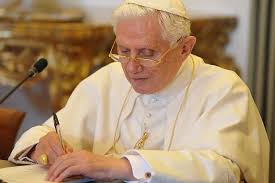
Pope Benedict on Saint Benedict
BENEDICT XVI
GENERAL AUDIENCE
St Peter’s Square
Wednesday, 9 April 2008
Saint Benedict of Norcia
Dear Brothers and Sisters,
Today, I would like to speak about Benedict, the Founder of Western Monasticism and also the Patron of my Pontificate. I begin with words that St Gregory the Great wrote about St Benedict: “The man of God who shone on this earth among so many miracles was just as brilliant in the eloquent exposition of his teaching” (cf. Dialogues II, 36). The great Pope wrote these words in 592 A.D. The holy monk, who had died barely 50 years earlier, lived on in people’s memories and especially in the flourishing religious Order he had founded. St Benedict of Norcia, with his life and his work, had a fundamental influence on the development of European civilization and culture. The most important source on Benedict’s life is the second book of St Gregory the Great’s Dialogues. It is not a biography in the classical sense. In accordance with the ideas of his time, by giving the example of a real man – St Benedict, in this case – Gregory wished to illustrate the ascent to the peak of contemplation which can be achieved by those who abandon themselves to God. He therefore gives us a model for human life in the climb towards the summit of perfection. St Gregory the Great also tells in this book of the Dialogues of many miracles worked by the Saint, and here too he does not merely wish to recount something curious but rather to show how God, by admonishing, helping and even punishing, intervenes in the practical situations of man’s life. Gregory’s aim was to demonstrate that God is not a distant hypothesis placed at the origin of the world but is present in the life of man, of every man.
This perspective of the “biographer” is also explained in light of the general context of his time: straddling the fifth and sixth centuries, “the world was overturned by a tremendous crisis of values and institutions caused by the collapse of the Roman Empire, the invasion of new peoples and the decay of morals”. But in this terrible situation, here, in this very city of Rome, Gregory presented St Benedict as a “luminous star” in order to point the way out of the “black night of history” (cf. John Paul II, 18 May 1979). In fact, the Saint’s work and particularly his Rule were to prove heralds of an authentic spiritual leaven which, in the course of the centuries, far beyond the boundaries of his country and time, changed the face of Europe following the fall of the political unity created by the Roman Empire, inspiring a new spiritual and cultural unity, that of the Christian faith shared by the peoples of the Continent. This is how the reality we call “Europe” came into being.
St Benedict was born around the year 480. As St Gregory said, he came “ex provincia Nursiae” – from the province of Norcia. His well-to-do parents sent him to study in Rome. However, he did not stay long in the Eternal City. As a fully plausible explanation, Gregory mentions that the young Benedict was put off by the dissolute lifestyle of many of his fellow students and did not wish to make the same mistakes. He wanted only to please God: “soli Deo placere desiderans” (II Dialogues, Prol. 1). Thus, even before he finished his studies, Benedict left Rome and withdrew to the solitude of the mountains east of Rome. After a short stay in the village of Enfide (today, Affile), where for a time he lived with a “religious community” of monks, he became a hermit in the neighbouring locality of Subiaco. He lived there completely alone for three years in a cave which has been the heart of a Benedictine Monastery called the “Sacro Speco” (Holy Grotto) since the early Middle Ages. The period in Subiaco, a time of solitude with God, was a time of maturation for Benedict. It was here that he bore and overcame the three fundamental temptations of every human being: the temptation of self-affirmation and the desire to put oneself at the centre, the temptation of sensuality and, lastly, the temptation of anger and revenge. In fact, Benedict was convinced that only after overcoming these temptations would he be able to say a useful word to others about their own situations of neediness. Thus, having tranquilized his soul, he could be in full control of the drive of his ego and thus create peace around him. Only then did he decide to found his first monasteries in the Valley of the Anio, near Subiaco.
(To continue reading, please see here)

Saint Kateri , Canada’s Protectress
This was the title given to Saint Kateri Tekakwitha, by Pope Benedict XVI, when he canonized her on October 28th, 2012, along with six others, in Saint Peter’ Square (she had been beatified by Pope John Paul II back in 1980). With Saint Joseph as our protector, along with the Canadian martyrs, we seem to[…]Continue reading→

Remembering Father Alphonse de Valk
(Today marks the sixth anniversary of the death of Father Alphonse de Valk, C.S.B., a faithful, courageous and indefatigable Basilian priest, pro-life-and-family apostle, and the founder of Catholic Insight magazine. Here is what we wrote those on his entering into eternity five years ago, as we continue to remember him in our prayers and thoughts)[…]Continue reading→

A Tale of Two Benedicts
A grace-filled Holy Week to all our readers! As we await and prepare for the Resurrection about to dawn upon us, we might keep in mind two Benedicts: Pope Emeritus Benedict XVI, requiescat in pace, elected on this day in 2005; and today’s commemoration of the mystic pilgrim, Benedict Joseph Labre, who died on this[…]Continue reading→

My Name is Bernadette
April 16th is a propitious day, for besides the anniversary of Father de Valk’s death, who founded Catholic Insight in its print form decades ago, and the commemoration of the ‘two Benedicts’, mentioned in accompanying posts, today we also recall Saint Bernadette Soubirous, the young visionary to whom the Virgin Mary appeared numerous times at[…]Continue reading→

Saint Lydwina of Schiedam and Suffering Joyfully
Saint Lydwina of Schiedam (1380 – 1433) was one of the countless and glorious ‘victim souls’ in the history of the Church, those whose lives are filled with suffering, often of an unimaginable intensity, but who suffer joyfully. She was a fifteen-year old Dutch girl, out skating one day, when she fell and broke one[…]Continue reading→

The Glorious Martyrdoms of Martin and Maximus
As we enter into Eastertide, we recall on this 13th of April Pope Saint Martin I (+655), one of the noblest, if most tragic, of the successors of Saint Peter. Born in Umbria, Italy, he was of noble lineage, with great intelligence combined with charity and love of the poor and the Church. While still[…]Continue reading→
Canonizing Sister Faustina and Divine Mercy
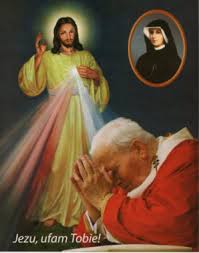
HOMILY OF THE HOLY FATHER MASS IN ST PETER’S SQUARE FOR THE CANONIZATION OF SR MARY FAUSTINA KOWALSKA Sunday, 30 April 2000 1. “Confitemini Domino quoniam bonus, quoniam in saeculum misericordia eius”; “Give thanks to the Lord for he is good; his steadfast love endures for ever” (Ps 118: 1). So the Church sings on the Octave of[…]Continue reading→

Divine Mercy Sunday – An Echo of Every Mass
Reach out your hand and put it in my side. Do not doubt but believe’… ‘My Lord and my God!’ (Jn. 20:18)). Today is Divine Mercy Sunday, and as we celebrate the end of the Easter Octave, we contemplate the wounded side of our Saviour, the Church’s source of life. On Good Friday in the[…]Continue reading→

Saint Stanislaus of Szczepanów
We celebrate Saint Stanislaus today (+ April 11, 1079), in light of this Easter Octave, a bishop and martyr who accepted the episcopacy only at the direct order of Pope Alexander II. He proved a wise and courageous leader of his flock, put to death by his own king, Boleslaus, for rebuking the monarch’s ‘immoral[…]Continue reading→
Saint Gemma Galgani
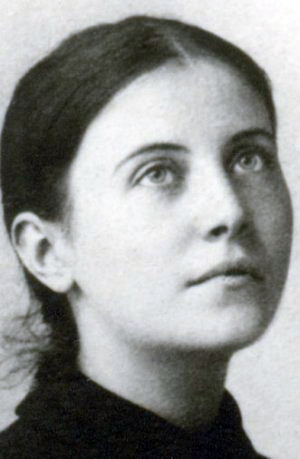
On this April 11th, in 1903 – the same year that the Italian Guiseppe Sarto was elected Pope later that summer as Pius X – a lovely, young Italian woman died, by the name of Gemma Galgani. She lived a brief life of 24 years, as did a number of other young saints, including Pier[…]Continue reading→