
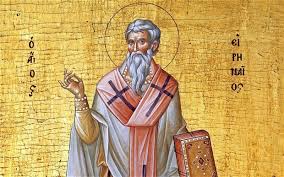
Pope Benedict and Saint Irenaeus of Lyons
(Saint Irenaeus of Lyons, whose feast we celebrate on the 28th of June, just before Saints Peter and Paul, was declared a Doctor of the Church by Pope Francis in 2022, bringing their exalted number to 37. Editor)
BENEDICT XVI
GENERAL AUDIENCE
St Peter’s Square
Wednesday, 28 March 2007
Saint Irenaeus of Lyons
Dear Brothers and Sisters,
In the Catechesis on the prominent figures of the early Church, today we come to the eminent personality of St Irenaeus of Lyons. The biographical information on him comes from his own testimony, handed down to us by Eusebius in his fifth book on Church History.
Irenaeus was in all probability born in Smyrna (today, Izmir in Turkey) in about 135-140, where in his youth, he attended the school of Bishop Polycarp, a disciple in his turn of the Apostle John. We do not know when he moved from Asia Minor to Gaul, but his move must have coincided with the first development of the Christian community in Lyons: here, in 177, we find Irenaeus listed in the college of presbyters. In that very year, he was sent to Rome bearing a letter from the community in Lyons to Pope Eleutherius. His mission to Rome saved Irenaeus from the persecution of Marcus Aurelius which took a toll of at least 48 martyrs, including the 90-year old Bishop Pontinus of Lyons, who died from ill-treatment in prison. Thus, on his return Irenaeus was appointed Bishop of the city. The new Pastor devoted himself without reserve to his episcopal ministry which ended in about 202-203, perhaps with martyrdom.
Irenaeus was first and foremost a man of faith and a Pastor. Like a good Pastor, he had a good sense of proportion, a wealth of doctrine, and missionary enthusiasm. As a writer, he pursued a twofold aim: to defend true doctrine from the attacks of heretics, and to explain the truth of the faith clearly. His two extant works – the five books of The Detection and Overthrow of the False Gnosis and Demonstration of the Apostolic Teaching (which can also be called the oldest “catechism of Christian doctrine”) – exactly corresponded with these aims. In short, Irenaeus can be defined as the champion in the fight against heresies. The second-century Church was threatened by the so-called Gnosis, a doctrine which affirmed that the faith taught in the Church was merely a symbolism for the simple who were unable to grasp difficult concepts; instead, the initiates, the intellectuals – Gnostics, they were called – claimed to understand what was behind these symbols and thus formed an elitist and intellectualist Christianity. Obviously, this intellectual Christianity became increasingly fragmented, splitting into different currents with ideas that were often bizarre and extravagant, yet attractive to many. One element these different currents had in common was “dualism”: they denied faith in the one God and Father of all, Creator and Saviour of man and of the world. To explain evil in the world, they affirmed the existence, besides the Good God, of a negative principle. This negative principle was supposed to have produced material things, matter.
Firmly rooted in the biblical doctrine of creation, Irenaeus refuted the Gnostic dualism and pessimism which debased corporeal realities. He decisively claimed the original holiness of matter, of the body, of the flesh no less than of the spirit. But his work went far beyond the confutation of heresy: in fact, one can say that he emerges as the first great Church theologian who created systematic theology; he himself speaks of the system of theology, that is, of the internal coherence of all faith. At the heart of his doctrine is the question of the “rule of faith” and its transmission. For Irenaeus, the “rule of faith” coincided in practice with the Apostles’ Creed, which gives us the key for interpreting the Gospel, for interpreting the Creed in light of the Gospel. The Creed, which is a sort of Gospel synthesis, helps us understand what it means and how we should read the Gospel itself.
(To continue reading, please see here)

Saint Kateri , Canada’s Protectress
This was the title given to Saint Kateri Tekakwitha, by Pope Benedict XVI, when he canonized her on October 28th, 2012, along with six others, in Saint Peter’ Square (she had been beatified by Pope John Paul II back in 1980). With Saint Joseph as our protector, along with the Canadian martyrs, we seem to[…]Continue reading→

Remembering Father Alphonse de Valk
(Today marks the sixth anniversary of the death of Father Alphonse de Valk, C.S.B., a faithful, courageous and indefatigable Basilian priest, pro-life-and-family apostle, and the founder of Catholic Insight magazine. Here is what we wrote those on his entering into eternity five years ago, as we continue to remember him in our prayers and thoughts)[…]Continue reading→

A Tale of Two Benedicts
A grace-filled Holy Week to all our readers! As we await and prepare for the Resurrection about to dawn upon us, we might keep in mind two Benedicts: Pope Emeritus Benedict XVI, requiescat in pace, elected on this day in 2005; and today’s commemoration of the mystic pilgrim, Benedict Joseph Labre, who died on this[…]Continue reading→

My Name is Bernadette
April 16th is a propitious day, for besides the anniversary of Father de Valk’s death, who founded Catholic Insight in its print form decades ago, and the commemoration of the ‘two Benedicts’, mentioned in accompanying posts, today we also recall Saint Bernadette Soubirous, the young visionary to whom the Virgin Mary appeared numerous times at[…]Continue reading→

Saint Lydwina of Schiedam and Suffering Joyfully
Saint Lydwina of Schiedam (1380 – 1433) was one of the countless and glorious ‘victim souls’ in the history of the Church, those whose lives are filled with suffering, often of an unimaginable intensity, but who suffer joyfully. She was a fifteen-year old Dutch girl, out skating one day, when she fell and broke one[…]Continue reading→

The Glorious Martyrdoms of Martin and Maximus
As we enter into Eastertide, we recall on this 13th of April Pope Saint Martin I (+655), one of the noblest, if most tragic, of the successors of Saint Peter. Born in Umbria, Italy, he was of noble lineage, with great intelligence combined with charity and love of the poor and the Church. While still[…]Continue reading→

Canonizing Sister Faustina and Divine Mercy
HOMILY OF THE HOLY FATHER MASS IN ST PETER’S SQUARE FOR THE CANONIZATION OF SR MARY FAUSTINA KOWALSKA Sunday, 30 April 2000 1. “Confitemini Domino quoniam bonus, quoniam in saeculum misericordia eius”; “Give thanks to the Lord for he is good; his steadfast love endures for ever” (Ps 118: 1). So the Church sings on the Octave of[…]Continue reading→

Divine Mercy Sunday – An Echo of Every Mass
Reach out your hand and put it in my side. Do not doubt but believe’… ‘My Lord and my God!’ (Jn. 20:18)). Today is Divine Mercy Sunday, and as we celebrate the end of the Easter Octave, we contemplate the wounded side of our Saviour, the Church’s source of life. On Good Friday in the[…]Continue reading→

Saint Stanislaus of Szczepanów
We celebrate Saint Stanislaus today (+ April 11, 1079), in light of this Easter Octave, a bishop and martyr who accepted the episcopacy only at the direct order of Pope Alexander II. He proved a wise and courageous leader of his flock, put to death by his own king, Boleslaus, for rebuking the monarch’s ‘immoral[…]Continue reading→
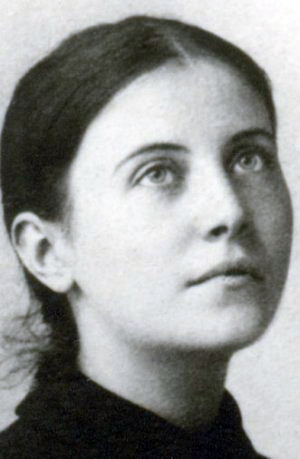
Saint Gemma Galgani
On this April 11th, in 1903 – the same year that the Italian Guiseppe Sarto was elected Pope later that summer as Pius X – a lovely, young Italian woman died, by the name of Gemma Galgani. She lived a brief life of 24 years, as did a number of other young saints, including Pier[…]Continue reading→