
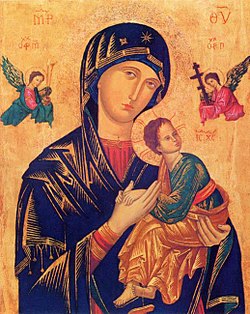
Our Lady of Perpetual Help, and Saint Cyril of Alexandria
Today is the traditional feast of Our Lady of Perpetual Help, even if it be muted this year due to the Sacred Heart – signified in one of the most famous ‘icons’ of the Virgin Mother, which, by tradition – legend, some might say – goes back to Saint Luke himself, who besides being a physician was also an artist, an iconographer who ‘wrote’ the true living image of Our Lady on the dinner table of the Holy Family.
The icon itself has a long and varied history, and, after a restoration in 1866 by a Polish painter, now resides in the church of Saint Alphonsus in Rome, under the care of the Redemptorists. A perpetual novena – if a nine-day prayer may be said to be perpetual – is recited on Wednesdays there, and in churches across the world, beseeching the Mother for whatever help we may need. And we need a lot of it.
Fittingly, this is also the memorial of Saint Cyril of Alexandria (+444), doctor of the Church, who, after a solid intellectual and spiritual formation, while still young was appointed Patriarch of the great see of Alexandria in October of 412. In the midst of much theological controversy and societal unrest, Cyril went on to govern the see for 32 years, during which time he produced a plethora of profound theological writings, commentaries on Scripture, sermons and letters, and was declared a Doctor of the Church by Pope Leo XIII in 1882.
He was a staunch defender of the truth against heresy. Soon after Cyril’s accession of Alexandria, the agitator Nestorius, originally from Antioch, had assumed the patriarchate of Constantinople, and his restless but literalistic mind brought forth the new-fangled teaching that the Virgin Mary was not really the ‘Mother of God’, Theotokos, but rather the ‘Mother of Christ’, Christotokos, for how, as he figured, could a human creature give birth to the eternal God, or the same God undergo a human birth? For Nestorius, Mary gave birth to the human person of Christ, but not the divine Person. In other words, by logical consequence, Christ was two persons.
When I ask students in class – to introduce them to the concept of ‘material heresy’ – if Christ was and is a human person, almost all enthusiastically respond, ‘of course’. But not so.
It was up to the great mind and soul of Cyril to defend Mary’s traditional title as Theotokos, in defending the hypostatic unity of the Incarnation, that Christ is one divine Person – hypostasis in Greek – the Second Person of the Blessed Trinity, and this one divine Person united His eternal divine nature with our human nature in that one hypostasis, so that all things done in and through that human nature were truly divine, actions of God Himself. Christ was and is not a human person, but a divine one, with two natures. And this union between God and Man permeated through all our human nature, so that we all in some sense are elevated, perfect, ennobled, just from the very Incarnation itself, or Himself.
As Gaudium et Spes puts it: For by His incarnation the Son of God has united Himself in some fashion with every man
Every heresy is an attempt to understand the Faith fully, to rationalize things, to make its mysterious and eternal truths fit within the small limited compact of our own brains. The thing is, God is bigger than our minds, and can do far greater things than we may imagine, including truly becoming Man or, more properly, assuming human nature. [1]
Nestorius’ doctrine would have bifurcated Christ into two persons, one human and the other divine, the unity between them lost in the vague fog of such terms as ‘moral unity’. In sum, Nestorianism, as it came to be called, would have destroyed the truth of the Incarnation, as Cyril clearly perceived.
Cyril’s teaching – the traditional doctrine of the Church – was vindicated at the Council of Ephesus in 431, which declared for all time Mary’s divine maternity of the Second Person of the Trinity in His human nature, and the icon of the Theotokos was paraded with great joy through the streets. People took theology quite seriously in those days, as they should now, for all things are ultimately theological, as the religious frenzy of the current ‘protests’ make clear.
But all hinges on that one central historical fact of the Incarnation, and the response to Christ’s own question to all us: “Who do you say that I am?”, the answer to which changes everything, forever.
[1] For those interested in a very valuable, readable and edifying take on this doctrine and its convoluted history, please do peruse Aaron Riches’ book, Ecce Homo.

Carney’s Amoral Majority
After five defections – euphemistically described as ‘crossing the floor’ – and three by-elections, Mark Carney and his Liberals how have their coveted majority. One wonders what bowls of pottage were offered in back-room deals. In the archaic monarchical system that is the Dominion of Canada, this majority allows the newly-minted Prime Minister to rule[…]Continue reading→

Saint Kateri , Canada’s Protectress
This was the title given to Saint Kateri Tekakwitha, by Pope Benedict XVI, when he canonized her on October 28th, 2012, along with six others, in Saint Peter’ Square (she had been beatified by Pope John Paul II back in 1980). With Saint Joseph as our protector, along with the Canadian martyrs, we seem to[…]Continue reading→

A Tale of Two Benedicts
A grace-filled Holy Week to all our readers! As we await and prepare for the Resurrection about to dawn upon us, we might keep in mind two Benedicts: Pope Emeritus Benedict XVI, requiescat in pace, elected on this day in 2005; and today’s commemoration of the mystic pilgrim, Benedict Joseph Labre, who died on this[…]Continue reading→

My Name is Bernadette
April 16th is a propitious day, for besides the anniversary of Father de Valk’s death, who founded Catholic Insight in its print form decades ago, and the commemoration of the ‘two Benedicts’, mentioned in accompanying posts, today we also recall Saint Bernadette Soubirous, the young visionary to whom the Virgin Mary appeared numerous times at[…]Continue reading→

Saint Lydwina of Schiedam and Suffering Joyfully
Saint Lydwina of Schiedam (1380 – 1433) was one of the countless and glorious ‘victim souls’ in the history of the Church, those whose lives are filled with suffering, often of an unimaginable intensity, but who suffer joyfully. She was a fifteen-year old Dutch girl, out skating one day, when she fell and broke one[…]Continue reading→

The Glorious Martyrdoms of Martin and Maximus
As we enter into Eastertide, we recall on this 13th of April Pope Saint Martin I (+655), one of the noblest, if most tragic, of the successors of Saint Peter. Born in Umbria, Italy, he was of noble lineage, with great intelligence combined with charity and love of the poor and the Church. While still[…]Continue reading→

Canonizing Sister Faustina and Divine Mercy
HOMILY OF THE HOLY FATHER MASS IN ST PETER’S SQUARE FOR THE CANONIZATION OF SR MARY FAUSTINA KOWALSKA Sunday, 30 April 2000 1. “Confitemini Domino quoniam bonus, quoniam in saeculum misericordia eius”; “Give thanks to the Lord for he is good; his steadfast love endures for ever” (Ps 118: 1). So the Church sings on the Octave of[…]Continue reading→

Saint Stanislaus of Szczepanów
We celebrate Saint Stanislaus today (+ April 11, 1079), in light of this Easter Octave, a bishop and martyr who accepted the episcopacy only at the direct order of Pope Alexander II. He proved a wise and courageous leader of his flock, put to death by his own king, Boleslaus, for rebuking the monarch’s ‘immoral[…]Continue reading→
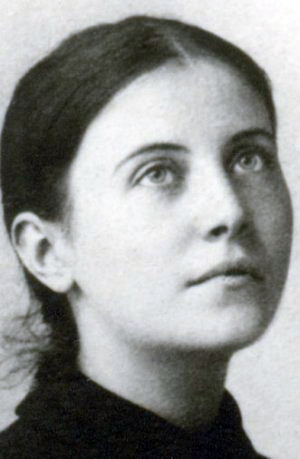
Saint Gemma Galgani
On this April 11th, in 1903 – the same year that the Italian Guiseppe Sarto was elected Pope later that summer as Pius X – a lovely, young Italian woman died, by the name of Gemma Galgani. She lived a brief life of 24 years, as did a number of other young saints, including Pier[…]Continue reading→
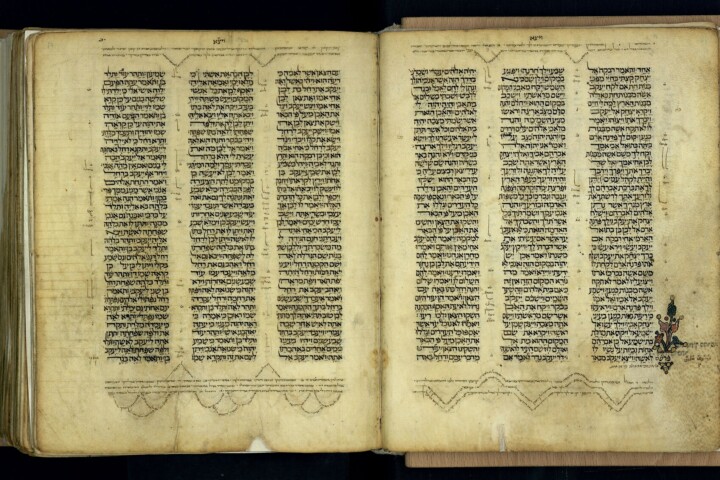
An Ideological and Improper Translation
I noticed something odd with the psalm reading at Mass the other day. Our bishops’ conference here in Canada has decreed that the Mass in English – Novus Ordo – use the ‘NRSV’, the ‘New Revised Standard Version’, an ‘updated’ translation of the original RSV, first published in 1952. This ‘new translation’ has the tendency[…]Continue reading→