
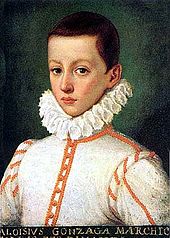
Saint Aloysius Gonzaga’s Summer’s Solstice
On this 21st day of June, we remember Saint Aloysius Gonzaga (+ 1591), a Jesuit scholastic who died at what we might consider the too-young age of 23 (just short of the 24 club, but an honorary member) while solicitously caring for victims of the plague in Rome. But he accomplished much in a short time.
Aloysius, whose original name was Luigi, hailed from a rich, noble family, and was intended for a life of honour and privilege. In spite of his parents’ and relatives’ urgings, he began to distance himself from their intended end for him, even while a young boy. Soon after receiving his First Communion from Saint Charles Borromeo, he took a private vow of chastity when he turned nine, and adopted a life of strict asceticism. Later in his teen years, against his father’s wishes (who finally relented), Aloysius firmly and unequivocally decided to enter the Jesuits, renouncing all rights to his significant inheritance. He was the ‘rich young man’ who did not turn away sorrowful, but followed Christ, full of joy, giving all.
As a novice, Aloysius’ spiritual director was none other than Saint Robert Bellarmine (saints forming saints!), a fellow Jesuit and a Cardinal, one of the great lights of the post-Tridentine reform and renewal. It was Bellarmine who would later offer sage advice to Galileo, and may have been able to avert that crisis and debacle, had he lived long enough. But guiding a young novice to holiness is no small feat in itself. Aloysius once admitted to his director that the smell and uncleanness of the plague victims made him violently sick, a repugnance that he suppressed so well that no one ever suspected, his zeal for the unenviable task seemed so evident to those around him. Aloysius was well aware of his own potential for sin and vice, in which so many around him were immersed, once admitting, I am but a crooked piece of iron, and have come into religion to be made straight by the hammer of mortification and penance.
We might also add, by the grace of the good God. For holiness is primarily His work, with our cooperation. Such penance as we do simply removes the obstacles to what God Himself wills to do within us. Holiness is also interior, consisting in conforming our own will to God’s, even in the smallest things. As Saint Philip Neri, who died four years after Aloysius (but six decades older) once quipped: ‘Sanctity resides in the space of three fingers’, in the mortifactione rationale, the mortification of our reason, and submitting our minds and wills to God, through holy obedience.
But we should ponder, if such an endeavour cost Aloysius so much, what should it cost us? Christ warns us of the ‘wide and easy path’ to perdition, and exhorts us to choose the ‘narrow and hard’ way to salvation. Following that in youth is much easier than trying to find it in late middle age, even if all things are possible to God.
We know not what the idealistic and inspired soul of Aloysius might have done in a life long lived. But such was not to be, for, like any number of other saints, Pier Giorgio, Dominic Savio, Therese of Lisieux, he was snatched up to heaven young, his soul already purified, which is what life is about, really: to reach that potential of sanctity to which we are all called. Aloysius offers a very fitting example to the youth of today, immersed in ‘sins of the flesh’, impurity and all those vices contra naturam, like no other generation perhaps in history, the ubiquitous ‘smartphones’ too often a portal into the depths of Dante’s inferno, and Satan’s own portal into their young souls. Would that they used those same devices to read the lives of the saints!
The mystic Maria Magdalena de Pazzi (May 25th) had a vision of the saint on April 4, 1600, a decade after his death, wherein it was revealed to her that he had died an ‘interior martyr’, and is now known primarily for his virtue of purity, integrating his affective powers – those ‘bent pieces of iron’ – towards that love of God which in the end is the source and summit of all our loves. As Aloysius once wrote to his mother:
When He takes away what He once lent us, His purpose is to store our treasure elsewhere, more safely and bestow on us, those very blessings, that we ourselves would most choose to have.
Saint Aloysius was taken away from his mother soon afterward, dying on this day, the 21st of June in 1591, of the illness he had contracted from the patients for whom he was caring – a death he himself prophesied. He was canonized on December 31st, 1736 by Pope Benedict XIII.
As his Collect for today says, let those of us who have not followed his innocence, at least follow his path of penitence and conversion in the time that remains to us.
This is the first full day of summer, the longest day of the year (in the northern hemisphere), solstice marking the Earth’s bending its own curve through space and time in its midway point in its 186 million mile journey around the Sun, in whose health-giving warmth and light, a symbol of that eternal Light, we may rejoice.
Saint Aloysius Gonzaga, ora pro nobis! +

Carney’s Amoral Majority
After five defections – euphemistically described as ‘crossing the floor’ – and three by-elections, Mark Carney and his Liberals how have their coveted majority. One wonders what bowls of pottage were offered in back-room deals. In the archaic monarchical system that is the Dominion of Canada, this majority allows the newly-minted Prime Minister to rule[…]Continue reading→

Saint Kateri , Canada’s Protectress
This was the title given to Saint Kateri Tekakwitha, by Pope Benedict XVI, when he canonized her on October 28th, 2012, along with six others, in Saint Peter’ Square (she had been beatified by Pope John Paul II back in 1980). With Saint Joseph as our protector, along with the Canadian martyrs, we seem to[…]Continue reading→

A Tale of Two Benedicts
A grace-filled Holy Week to all our readers! As we await and prepare for the Resurrection about to dawn upon us, we might keep in mind two Benedicts: Pope Emeritus Benedict XVI, requiescat in pace, elected on this day in 2005; and today’s commemoration of the mystic pilgrim, Benedict Joseph Labre, who died on this[…]Continue reading→

My Name is Bernadette
April 16th is a propitious day, for besides the anniversary of Father de Valk’s death, who founded Catholic Insight in its print form decades ago, and the commemoration of the ‘two Benedicts’, mentioned in accompanying posts, today we also recall Saint Bernadette Soubirous, the young visionary to whom the Virgin Mary appeared numerous times at[…]Continue reading→

Saint Lydwina of Schiedam and Suffering Joyfully
Saint Lydwina of Schiedam (1380 – 1433) was one of the countless and glorious ‘victim souls’ in the history of the Church, those whose lives are filled with suffering, often of an unimaginable intensity, but who suffer joyfully. She was a fifteen-year old Dutch girl, out skating one day, when she fell and broke one[…]Continue reading→

The Glorious Martyrdoms of Martin and Maximus
As we enter into Eastertide, we recall on this 13th of April Pope Saint Martin I (+655), one of the noblest, if most tragic, of the successors of Saint Peter. Born in Umbria, Italy, he was of noble lineage, with great intelligence combined with charity and love of the poor and the Church. While still[…]Continue reading→

Canonizing Sister Faustina and Divine Mercy
HOMILY OF THE HOLY FATHER MASS IN ST PETER’S SQUARE FOR THE CANONIZATION OF SR MARY FAUSTINA KOWALSKA Sunday, 30 April 2000 1. “Confitemini Domino quoniam bonus, quoniam in saeculum misericordia eius”; “Give thanks to the Lord for he is good; his steadfast love endures for ever” (Ps 118: 1). So the Church sings on the Octave of[…]Continue reading→

Saint Stanislaus of Szczepanów
We celebrate Saint Stanislaus today (+ April 11, 1079), in light of this Easter Octave, a bishop and martyr who accepted the episcopacy only at the direct order of Pope Alexander II. He proved a wise and courageous leader of his flock, put to death by his own king, Boleslaus, for rebuking the monarch’s ‘immoral[…]Continue reading→

Saint Gemma Galgani
On this April 11th, in 1903 – the same year that the Italian Guiseppe Sarto was elected Pope later that summer as Pius X – a lovely, young Italian woman died, by the name of Gemma Galgani. She lived a brief life of 24 years, as did a number of other young saints, including Pier[…]Continue reading→
An Ideological and Improper Translation
I noticed something odd with the psalm reading at Mass the other day. Our bishops’ conference here in Canada has decreed that the Mass in English – Novus Ordo – use the ‘NRSV’, the ‘New Revised Standard Version’, an ‘updated’ translation of the original RSV, first published in 1952. This ‘new translation’ has the tendency[…]Continue reading→