
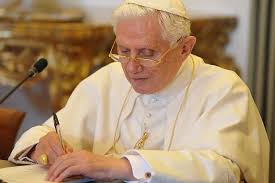
Pope Benedict and Saint Barnabas
BENEDICT XVI
GENERAL AUDIENCE
Wednesday, 31 January 2007
Barnabas, Silas (also called Silvanus), and Apollos
Dear Brothers and Sisters,
Continuing our journey among the protagonists who were the first to spread Christianity, today let us turn our attention to some of St Paul’s other collaborators. We must recognize that the Apostle is an eloquent example of a man open to collaboration: he did not want to do everything in the Church on his own but availed himself of many and very different colleagues.
We cannot reflect on all these precious assistants because they were numerous. It suffices to recall among the others, Epaphras (cf. Col 1: 7; 4: 12; Phlm 23); Epaphroditus (cf. Phil 2: 25; 4: 18), Tychicus (cf. Acts 20: 4; Eph 6: 21; Col 4: 7; II Tm 4: 12; Ti 3: 12), Urbanus (cf. Rm 16: 9), Gaius and Aristarchus (cf. Acts 19: 29; 20: 4; 27: 2; Col 4: 10). And women such as Phoebe, (Rom 16: 1), Tryphaena and Tryphosa (cf. Rom 16: 12), Persis, the mother of Rufus, whom Paul called “his mother and mine” (cf. Rom 16: 12-13), not to mention married couples such as Prisca and Aquila (cf. Rom 16: 3; I Cor 16: 19; II Tm 4: 19).
Among this great array of St Paul’s male and female collaborators, let us focus today on three of these people who played a particularly significant role in the initial evangelization: Barnabas, Silas, and Apollos.
Barnabas means “son of encouragement” (Acts 4: 36) or “son of consolation”. He was a Levite Jew, a native of Cyprus, and this was his nickname. Having settled in Jerusalem, he was one of the first to embrace Christianity after the Lord’s Resurrection. With immense generosity, he sold a field which belonged to him, and gave the money to the Apostles for the Church’s needs (Acts 4: 37).
It was he who vouched for the sincerity of Saul’s conversion before the Jerusalem community that still feared its former persecutor (cf. Acts 9: 27).
Sent to Antioch in Syria, he went to meet Paul in Tarsus, where he had withdrawn, and spent a whole year with him there, dedicated to the evangelization of that important city in whose Church Barnabas was known as a prophet and teacher (cf. Acts 13: 1).
At the time of the first conversions of the Gentiles, therefore, Barnabas realized that Saul’s hour had come. As Paul had retired to his native town of Tarsus, he went there to look for him. Thus, at that important moment, Barnabas, as it were, restored Paul to the Church; in this sense he gave back to her the Apostle to the Gentiles.
The Church of Antioch sent Barnabas on a mission with Paul, which became known as the Apostle’s first missionary journey. In fact, it was Barnabas’ missionary voyage since it was he who was really in charge of it and Paul had joined him as a collaborator, visiting the regions of Cyprus and Central and Southern Anatolia in present-day Turkey, with the cities of Attalia, Perga, Antioch of Pisidia, Iconium, Lystra and Derbe (cf. Acts 13-14).
Together with Paul, he then went to the so-called Council of Jerusalem where after a profound examination of the question, the Apostles with the Elders decided to discontinue the practice of circumcision so that it was no longer a feature of the Christian identity (cf. Acts 15: 1-35). It was only in this way that, in the end, they officially made possible the Church of the Gentiles, a Church without circumcision; we are children of Abraham simply through faith in Christ.
The two, Paul and Barnabas, disagreed at the beginning of the second missionary journey because Barnabas was determined to take with them as a companion John called Mark, whereas Paul was against it, since the young man had deserted them during their previous journey (cf. Acts 13: 13; 15: 36-40).
Hence there are also disputes, disagreements and controversies among saints. And I find this very comforting, because we see that the saints have not “fallen from Heaven”. They are people like us, who also have complicated problems.
Holiness does not consist in never having erred or sinned. Holiness increases the capacity for conversion, for repentance, for willingness to start again and, especially, for reconciliation and forgiveness.
To continue reading, please see here)

Saint Kateri , Canada’s Protectress
This was the title given to Saint Kateri Tekakwitha, by Pope Benedict XVI, when he canonized her on October 28th, 2012, along with six others, in Saint Peter’ Square (she had been beatified by Pope John Paul II back in 1980). With Saint Joseph as our protector, along with the Canadian martyrs, we seem to[…]Continue reading→

Remembering Father Alphonse de Valk
(Today marks the sixth anniversary of the death of Father Alphonse de Valk, C.S.B., a faithful, courageous and indefatigable Basilian priest, pro-life-and-family apostle, and the founder of Catholic Insight magazine. Here is what we wrote those on his entering into eternity five years ago, as we continue to remember him in our prayers and thoughts)[…]Continue reading→

A Tale of Two Benedicts
A grace-filled Holy Week to all our readers! As we await and prepare for the Resurrection about to dawn upon us, we might keep in mind two Benedicts: Pope Emeritus Benedict XVI, requiescat in pace, elected on this day in 2005; and today’s commemoration of the mystic pilgrim, Benedict Joseph Labre, who died on this[…]Continue reading→

My Name is Bernadette
April 16th is a propitious day, for besides the anniversary of Father de Valk’s death, who founded Catholic Insight in its print form decades ago, and the commemoration of the ‘two Benedicts’, mentioned in accompanying posts, today we also recall Saint Bernadette Soubirous, the young visionary to whom the Virgin Mary appeared numerous times at[…]Continue reading→

Saint Lydwina of Schiedam and Suffering Joyfully
Saint Lydwina of Schiedam (1380 – 1433) was one of the countless and glorious ‘victim souls’ in the history of the Church, those whose lives are filled with suffering, often of an unimaginable intensity, but who suffer joyfully. She was a fifteen-year old Dutch girl, out skating one day, when she fell and broke one[…]Continue reading→

The Glorious Martyrdoms of Martin and Maximus
As we enter into Eastertide, we recall on this 13th of April Pope Saint Martin I (+655), one of the noblest, if most tragic, of the successors of Saint Peter. Born in Umbria, Italy, he was of noble lineage, with great intelligence combined with charity and love of the poor and the Church. While still[…]Continue reading→

Canonizing Sister Faustina and Divine Mercy
HOMILY OF THE HOLY FATHER MASS IN ST PETER’S SQUARE FOR THE CANONIZATION OF SR MARY FAUSTINA KOWALSKA Sunday, 30 April 2000 1. “Confitemini Domino quoniam bonus, quoniam in saeculum misericordia eius”; “Give thanks to the Lord for he is good; his steadfast love endures for ever” (Ps 118: 1). So the Church sings on the Octave of[…]Continue reading→

Divine Mercy Sunday – An Echo of Every Mass
Reach out your hand and put it in my side. Do not doubt but believe’… ‘My Lord and my God!’ (Jn. 20:18)). Today is Divine Mercy Sunday, and as we celebrate the end of the Easter Octave, we contemplate the wounded side of our Saviour, the Church’s source of life. On Good Friday in the[…]Continue reading→

Saint Stanislaus of Szczepanów
We celebrate Saint Stanislaus today (+ April 11, 1079), in light of this Easter Octave, a bishop and martyr who accepted the episcopacy only at the direct order of Pope Alexander II. He proved a wise and courageous leader of his flock, put to death by his own king, Boleslaus, for rebuking the monarch’s ‘immoral[…]Continue reading→

Saint Gemma Galgani
On this April 11th, in 1903 – the same year that the Italian Guiseppe Sarto was elected Pope later that summer as Pius X – a lovely, young Italian woman died, by the name of Gemma Galgani. She lived a brief life of 24 years, as did a number of other young saints, including Pier[…]Continue reading→