
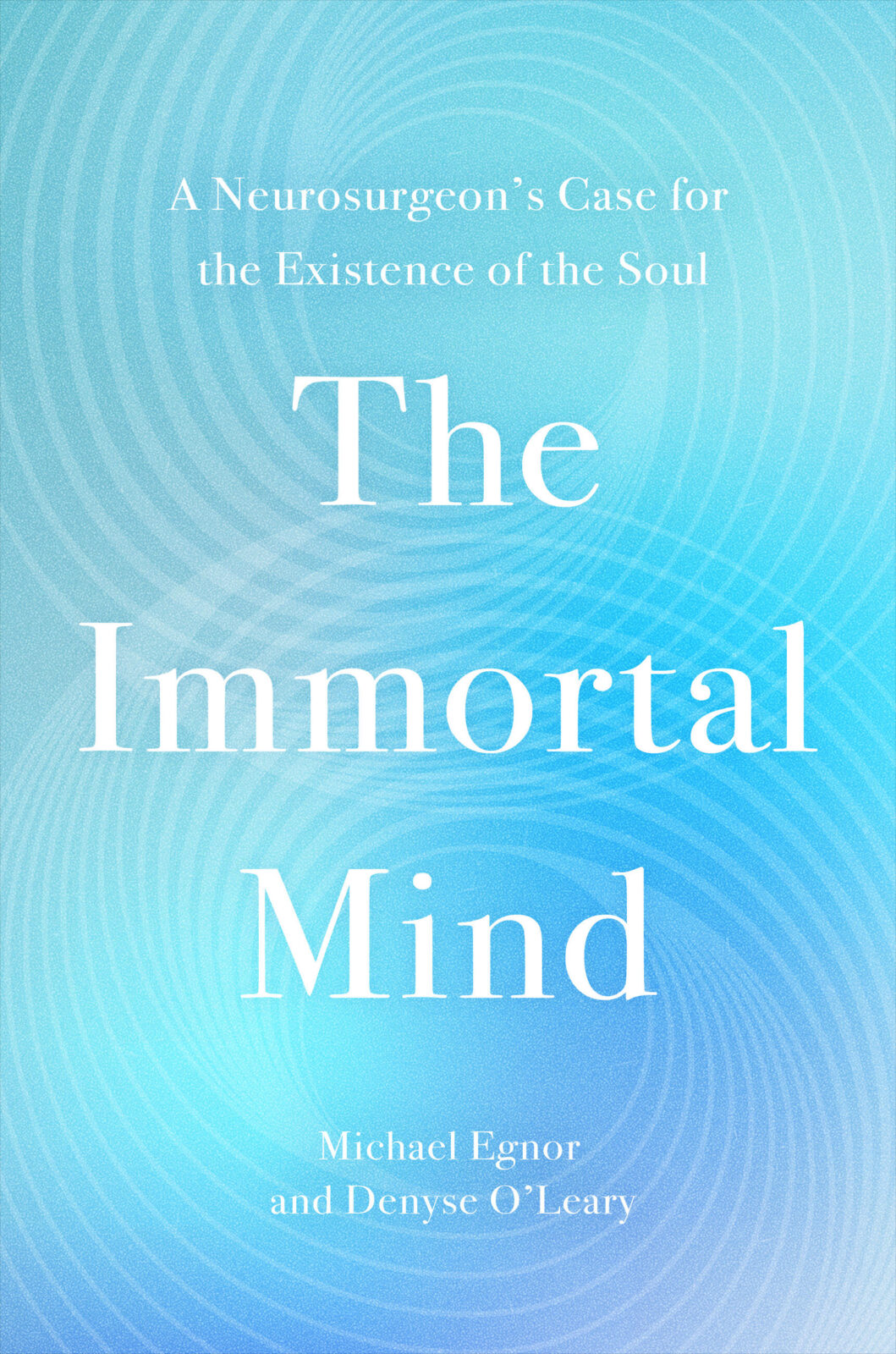
The Immortal Mind: A Review
The Immortal Mind: A Neurosurgeon’s Case for the Existence of the Soul
by Michael Egnor and Denyse O’Leary
Worthy Publishers, New York, Nashville, June 2025
237 p.
The Immortal Mind is an intriguing book – a bit of a pot-pourri, traversing the gamut from Aristotle to Aquinas to the techniques and discoveries of neurosurgery, with a number of stops in-between. Written by Dr. Michael Egnor, a neurosurgeon with forty years’ experience cutting through cortices, and Denyse O’Leary, a science writer, The Immortal Mind offers a number of proofs for the immortality, or at least the transcendence, of the human mind (or soul).
We should clarify the term ‘proof’, for as the Catechism says of God’s existence, such may be proved, not in the sense of Euclidean axioms, but rather with ‘converging and convincing’ arguments, that together make the fact of a being such as God – or, here, the immaterial and immortal soul – beyond reasonable doubt, or perhaps at least reasonable.
The authors recount of a number of anecdotal cases that the mind has an operation that transcends the brain, signifying a mysterious connection between the mind and brain. Dr. Egnor begins with a vivid recounting of his own son’s apparent cure from what seemed severe autism, in response to a pleading prayer he made as an atheist in a Catholic chapel, which led to his own conversion.
This sets the stage for Dr. Egnor description patients who, after losing much of their brain through surgery or accident, but who still lived fully functional lives, with much of their ‘mind’ intact. These include patients with their corpus callosum cut (which allows the hemispheres to ‘speak’ to each other), and even those who have lost entire sections of cortical tissue.
Also recounted is the groundbreaking work of Montreal neurosurgeon Dr. Wilder Penfield (+1976), who in stimulating patients’ brains surgery (a necessary procedure so nothing vital is cut away), or when the brain is involuntarily excited during epileptic seizures, “evoke only movements, sensations, emotions or memories, but never reasoning or free will”. That is, there are no ‘arithmetic seizures’, ‘logic seizures’, or ‘Shakespeare seizures’. As the neurosurgeon concludes, “thought is a function of something other than and beyond the physical brain”. The will, abstract thought and voluntary actions, seem not to reside in the brain, but in something beyond, and not fully dependent upon it.
A section on near-death experiences (NDEs), which may be called in some sense after death experiences, in which patients can recount details of things outside their bodies, while clinically ‘dead’ on the operating table. (I’ve always wondered about these, and how real they be. After death, comes judgement, something that is not made fully explicit here).
And then there are the comatose, sometimes called human ‘vegetables’ (a term now eschewed), who were thought to have nothing going on inside. But many of those who did eventually ‘wake up’ claimed they could sense and think, even though their brains seemed asleep and non-functioning.
Added towards the end are some models of the mind, and a discourse on how the mind could not ‘evolve’, even if the body may have. Human minds are different in kind than whatever sort of ‘mind’ an animal may have. Empirical evidence supports this, although it’s difficult to prove definitively.
The book closes with some proofs for the existence of God, from creation, including Saint Thomas’ ‘five ways’ from his Summa, along with arguments that the computer, nor AI, could ever be a ‘mind’, as they cannot ‘transcend’ themselves (more on this in my own thought soon). Just so, a mind is not a computer, for, as we have just seen, unlike an algorithm, it does go beyond its own materiality.
All in all, this book is a fitting complement to the many theological and philosophical arguments for the existence of an immortal soul, and for a mind that uses the brain, may even need the brain, but transcends the brain, and goes beyond its materiality, even the brain’s existence.
Our Faith tells us this, for even though we may glean glimpses of immortality from reason (and science), it is still a difficult truth, as Saint Paul found out. Death still looms large in our thoughts, especially as we grow older or become mortally ill, and we need the strength and hope that God’s revelation gives us. In today’s reading, he confronts the Sadducees, who believed in neither the ‘resurrection, angel or spirit’, and there are many modern Sadducees, materialists to the core.
The Immortal Mind offers hope, that when our brains and bodies die, our minds and souls live on, immortally and forever. We just have to ensure that we live the right way here, so that we live the better way there.

Carney’s Amoral Majority
After five defections – euphemistically described as ‘crossing the floor’ – and three by-elections, Mark Carney and his Liberals how have their coveted majority. One wonders what bowls of pottage were offered in back-room deals. In the archaic monarchical system that is the Dominion of Canada, this majority allows the newly-minted Prime Minister to rule[…]Continue reading→

Saint Kateri , Canada’s Protectress
This was the title given to Saint Kateri Tekakwitha, by Pope Benedict XVI, when he canonized her on October 28th, 2012, along with six others, in Saint Peter’ Square (she had been beatified by Pope John Paul II back in 1980). With Saint Joseph as our protector, along with the Canadian martyrs, we seem to[…]Continue reading→

A Tale of Two Benedicts
A grace-filled Holy Week to all our readers! As we await and prepare for the Resurrection about to dawn upon us, we might keep in mind two Benedicts: Pope Emeritus Benedict XVI, requiescat in pace, elected on this day in 2005; and today’s commemoration of the mystic pilgrim, Benedict Joseph Labre, who died on this[…]Continue reading→

My Name is Bernadette
April 16th is a propitious day, for besides the anniversary of Father de Valk’s death, who founded Catholic Insight in its print form decades ago, and the commemoration of the ‘two Benedicts’, mentioned in accompanying posts, today we also recall Saint Bernadette Soubirous, the young visionary to whom the Virgin Mary appeared numerous times at[…]Continue reading→

Saint Lydwina of Schiedam and Suffering Joyfully
Saint Lydwina of Schiedam (1380 – 1433) was one of the countless and glorious ‘victim souls’ in the history of the Church, those whose lives are filled with suffering, often of an unimaginable intensity, but who suffer joyfully. She was a fifteen-year old Dutch girl, out skating one day, when she fell and broke one[…]Continue reading→

The Glorious Martyrdoms of Martin and Maximus
As we enter into Eastertide, we recall on this 13th of April Pope Saint Martin I (+655), one of the noblest, if most tragic, of the successors of Saint Peter. Born in Umbria, Italy, he was of noble lineage, with great intelligence combined with charity and love of the poor and the Church. While still[…]Continue reading→

Saint Stanislaus of Szczepanów
We celebrate Saint Stanislaus today (+ April 11, 1079), in light of this Easter Octave, a bishop and martyr who accepted the episcopacy only at the direct order of Pope Alexander II. He proved a wise and courageous leader of his flock, put to death by his own king, Boleslaus, for rebuking the monarch’s ‘immoral[…]Continue reading→

Saint Gemma Galgani
On this April 11th, in 1903 – the same year that the Italian Guiseppe Sarto was elected Pope later that summer as Pius X – a lovely, young Italian woman died, by the name of Gemma Galgani. She lived a brief life of 24 years, as did a number of other young saints, including Pier[…]Continue reading→

An Ideological and Improper Translation
I noticed something odd with the psalm reading at Mass the other day. Our bishops’ conference here in Canada has decreed that the Mass in English – Novus Ordo – use the ‘NRSV’, the ‘New Revised Standard Version’, an ‘updated’ translation of the original RSV, first published in 1952. This ‘new translation’ has the tendency[…]Continue reading→
Saint Jean-Baptiste de la Salle: A Teacher for Teachers
Jean-Baptiste de la Salle (1651 – 1719), a French nobleman, ordained a priest, founded the first order in the Church’s history entirely without priests, and this came about almost by accident. I say ‘almost’, for, of course, there are no accidents with God. Destined for ordination from an early age, Jean-Baptiste never looked back, even[…]Continue reading→