
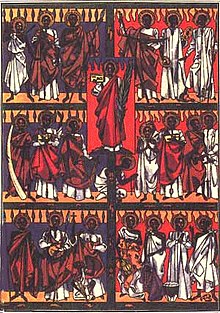
Saint Charles Lwanga and Companion Martyrs: The Hope of Africa
If the Church seems moribund in North America, there is hope in the vast continent of Africa, where there are untold millions of Catholics, fervent, joyful and full of life, a spiritual energy that was sown by those who came before, not least the countless martyrs through the ages, from Saints Perpetua and Felicity in the third century, to a group of whom we celebrate today from the nineteenth, on this memorial of Charles Llwanga and his companions, put to death for the Faith in Uganda between 1885 and 1887.
The principal motivation of the martyrdoms, the victims horrifically burnt alive, was that these Christian converts, Catholics and Anglicans, refused to submit to the homosexual lust of the king, Mwanga II, a sodomite and pederast. They were young men – pages and ministers at the king’s court – who chose death rather than renounce their faith and be defiled; so they gladly perished in the flames prompted by Mwanga’s diabolical rage and fury.
But where sin abounds, grace – not least in this case, heroism and courage – abound all the more. These martyrs are fitting patrons for our age, wherein Mwanga’s vices and perversions are becoming ‘normalized’, even in children, and anyone who dares demur…well, we will see.
There were 22 whom the Catholic Church beatified by Pope Benedict XV 1920, the same year that the Pope canonized the eight North American/Canadian Jesuit martyrs, who were also tortured to death by those who had refused Christ. Pope Saint Paul VI then canonized them African martyrs in 1964 in the midst of the Second Vatican Council, praising also the 23 Anglican martyrs. His homily for the occasion signifies much, and might even be considered politically ‘incorrect’ in today’s zeitgeist of multiculturalism. But the Holy Father was well aware that Christian civilization had to purify pagan barbarism, and that the latter had to be replaced with the former, keeping, of course, whatever is true and good in the native genius:
The infamous crime by which these young men were put to death was so unspeakable and so expressive of the times. It shows us clearly that a new people needs a moral foundation, needs new spiritual customs firmly planted, to be handed down to posterity. Symbolically, this crime also reveals that a simple and rough way of life – enriched by many fine human qualities yet enslaved by its own weakness and corruption – must give way to a more civilised life wherein the higher expressions of the mind and better social conditions prevail.
Tragically, Uganda later had to endure the savage, even demonic, rule of Idi Amin (1971-79, +2003), who seized power in a military coup seven years after the canonization of the martyrs, and who soon revealed himself as an even-more corrupt Mwanga redivivus, massacring an untold number of his own people in a reign of terror that nearly defies description. We must learn from history, which includes the witness of others, or we may well be doomed to repeat it, as we are finding out on various fronts of this fallen world.
I will leave you with Paul VI’s own words, which give us hope that all is indeed not lost, and much gained:
These African martyrs herald the dawn of a new age. If only the mind of man might be directed not towards persecutions and religious conflicts but towards a rebirth of Christianity and civilisation!
Africa has been washed by the blood of these latest martyrs, the first of this new age (and, God willing, let them be the last, although such a holocaust is precious indeed). Africa is reborn free and independent.
The blood of Christians really is the seed of the Church, as the early Father, Tertullian (himself an African) quipped in the third century, perhaps more true now than then. And the rebirth of the Church in the third millennium, if current demography is any indication, will be out of Africa, one of the few places on Earth still having enough children to perpetuate humanity. We have much to learn, or re-learn, from these noble people, and may this burgeoning continent perfect their own genius by the supernatural grace the Faith offers.
Saint Charles Llwanga and companion martyrs, orate pro nobis!

Carney’s Amoral Majority
After five defections – euphemistically described as ‘crossing the floor’ – and three by-elections, Mark Carney and his Liberals how have their coveted majority. One wonders what bowls of pottage were offered in back-room deals. In the archaic monarchical system that is the Dominion of Canada, this majority allows the newly-minted Prime Minister to rule[…]Continue reading→

Saint Kateri , Canada’s Protectress
This was the title given to Saint Kateri Tekakwitha, by Pope Benedict XVI, when he canonized her on October 28th, 2012, along with six others, in Saint Peter’ Square (she had been beatified by Pope John Paul II back in 1980). With Saint Joseph as our protector, along with the Canadian martyrs, we seem to[…]Continue reading→

A Tale of Two Benedicts
A grace-filled Holy Week to all our readers! As we await and prepare for the Resurrection about to dawn upon us, we might keep in mind two Benedicts: Pope Emeritus Benedict XVI, requiescat in pace, elected on this day in 2005; and today’s commemoration of the mystic pilgrim, Benedict Joseph Labre, who died on this[…]Continue reading→

My Name is Bernadette
April 16th is a propitious day, for besides the anniversary of Father de Valk’s death, who founded Catholic Insight in its print form decades ago, and the commemoration of the ‘two Benedicts’, mentioned in accompanying posts, today we also recall Saint Bernadette Soubirous, the young visionary to whom the Virgin Mary appeared numerous times at[…]Continue reading→

Saint Lydwina of Schiedam and Suffering Joyfully
Saint Lydwina of Schiedam (1380 – 1433) was one of the countless and glorious ‘victim souls’ in the history of the Church, those whose lives are filled with suffering, often of an unimaginable intensity, but who suffer joyfully. She was a fifteen-year old Dutch girl, out skating one day, when she fell and broke one[…]Continue reading→

The Glorious Martyrdoms of Martin and Maximus
As we enter into Eastertide, we recall on this 13th of April Pope Saint Martin I (+655), one of the noblest, if most tragic, of the successors of Saint Peter. Born in Umbria, Italy, he was of noble lineage, with great intelligence combined with charity and love of the poor and the Church. While still[…]Continue reading→

Canonizing Sister Faustina and Divine Mercy
HOMILY OF THE HOLY FATHER MASS IN ST PETER’S SQUARE FOR THE CANONIZATION OF SR MARY FAUSTINA KOWALSKA Sunday, 30 April 2000 1. “Confitemini Domino quoniam bonus, quoniam in saeculum misericordia eius”; “Give thanks to the Lord for he is good; his steadfast love endures for ever” (Ps 118: 1). So the Church sings on the Octave of[…]Continue reading→

Saint Stanislaus of Szczepanów
We celebrate Saint Stanislaus today (+ April 11, 1079), in light of this Easter Octave, a bishop and martyr who accepted the episcopacy only at the direct order of Pope Alexander II. He proved a wise and courageous leader of his flock, put to death by his own king, Boleslaus, for rebuking the monarch’s ‘immoral[…]Continue reading→

Saint Gemma Galgani
On this April 11th, in 1903 – the same year that the Italian Guiseppe Sarto was elected Pope later that summer as Pius X – a lovely, young Italian woman died, by the name of Gemma Galgani. She lived a brief life of 24 years, as did a number of other young saints, including Pier[…]Continue reading→

An Ideological and Improper Translation
I noticed something odd with the psalm reading at Mass the other day. Our bishops’ conference here in Canada has decreed that the Mass in English – Novus Ordo – use the ‘NRSV’, the ‘New Revised Standard Version’, an ‘updated’ translation of the original RSV, first published in 1952. This ‘new translation’ has the tendency[…]Continue reading→