
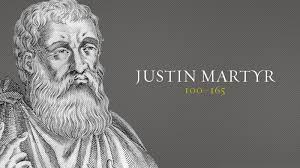
Justin, the Philosophical Martyr
Saint Justin (+165) who is called the ‘Martyr’, was born around the time the last Apostle, John, departed this life for heaven. Justin was not raised in the Catholic faith – few were in those incipient days of the Church – but was rather a pagan convert to Christianity. He first investigated the various philosophies of the age, Platonism, Socratic, Peripatetic, Stoic, Pythagorean, but none satisfied his desire for the ‘whole truth and nothing but…’.
It was a chance meeting with an old man, a Syrian Christian, who offered him the simplicity and coherence of the Catholic faith, which satisfied Justin’s desire for truth and beauty, and his mind and soul were made up. He entered the Church, receiving Baptism, and never looked back – It is from Justin’s pen that we have one of the earliest descriptions of the Holy Mass, in a letter to Antoninus Pius in around 155 A.D. (cf., CCC, #1345), along with much other evidence of the Church’s earliest – and already very ‘Catholic’ – traditions.
Justin adopted the life of an itinerant teacher, eventually starting a school in Rome, writing much, but the only treatises that survive are two dialogues and an ‘apology’; hence is called the first of the ‘apologists’, those who made an apologia for the Faith – a ‘reasoned defence’, not an apology in our modern sense – as Saint Peter exhorted us to do (1 Pet 3:15).
Justin saw the truth as dispersed throughout history like seeds, and that anyone who follows the truth as it was known to them – even the pagan philosophers of old – could be considered an ‘unwitting’ Christian. Salvation really is open to all, although easier with the more truth that one has. And, before we get too comfy with an easy interpretation of that, Justin would claim that one should move from ‘truth to truth’ as one proceeds in the spiritual life. As the Church’s constitution, Lumen Gentium, states:
Whosoever, therefore, knowing (non ignorantes) that the Catholic Church was made necessary by Christ, would refuse to enter or to remain in it, could not be saved (14)
Once one accepts the truth of Christ’s divinity, for example, then why not the Eucharist and the rest of the sacraments? Or the dignity of human life, and the prohibition of abortion? The ideal of married love, and striving for purity and chastity. And so on. In the end, all truths should lead one to ‘the universal truth’ found in the one, true Church.
Yet, as we have seen in our own houses of government, media, and influence, some seem blinded to the truth, perhaps deliberately so, shutting their eyes and ears so they cannot – or will not – see and hear. Rather than submit to the truth, they respond with violence. And so it was, after a dispute with the cynic philosopher Crescens, Justin was denounced to the authorities, and beheaded in 165 A.D., under the persecution of the Stoic emperor Marcus Aurelius.
The contemporary account of Justin’s trial and martyrdom makes for some visceral reading, as a bold and courageous witness to the Truth. Contrary to the ambiguous message of works like Silence, Saint Justin declared that he had no need to deliberate on whether to offer sacrifice to false gods, regardless of what inducements they offered, and that he would never give up his Faith.
Do what you will. We are Christians; we do not offer sacrifice to idols
He knew that philosophy has its limits, and that the Faith is more certain than any human science. Justin’s loss of his temporal life, giving all, even his very mind, to Christ, meant that he received it all back, a hundredfold.
The prefect Rusticus said: “Do you have an idea that you will go up to heaven to receive some suitable rewards?” Justin said: “It is not an idea that I have; it is something I know well and hold to be most certain.”
Amen. So have confidence, be of good cheer, and be not seduced by the world and its arguments. For the form of this world is passing away, but the truth abides forever.
May Saint Justin intercede for all those who know not this salvific truth, that they turn from their ways, and, respond to the grace that is give them.
Carney’s Amoral Majority
After five defections – euphemistically described as ‘crossing the floor’ – and three by-elections, Mark Carney and his Liberals how have their coveted majority. One wonders what bowls of pottage were offered in back-room deals. In the archaic monarchical system that is the Dominion of Canada, this majority allows the newly-minted Prime Minister to rule[…]Continue reading→

Saint Kateri , Canada’s Protectress
This was the title given to Saint Kateri Tekakwitha, by Pope Benedict XVI, when he canonized her on October 28th, 2012, along with six others, in Saint Peter’ Square (she had been beatified by Pope John Paul II back in 1980). With Saint Joseph as our protector, along with the Canadian martyrs, we seem to[…]Continue reading→

A Tale of Two Benedicts
A grace-filled Holy Week to all our readers! As we await and prepare for the Resurrection about to dawn upon us, we might keep in mind two Benedicts: Pope Emeritus Benedict XVI, requiescat in pace, elected on this day in 2005; and today’s commemoration of the mystic pilgrim, Benedict Joseph Labre, who died on this[…]Continue reading→

My Name is Bernadette
April 16th is a propitious day, for besides the anniversary of Father de Valk’s death, who founded Catholic Insight in its print form decades ago, and the commemoration of the ‘two Benedicts’, mentioned in accompanying posts, today we also recall Saint Bernadette Soubirous, the young visionary to whom the Virgin Mary appeared numerous times at[…]Continue reading→

Saint Lydwina of Schiedam and Suffering Joyfully
Saint Lydwina of Schiedam (1380 – 1433) was one of the countless and glorious ‘victim souls’ in the history of the Church, those whose lives are filled with suffering, often of an unimaginable intensity, but who suffer joyfully. She was a fifteen-year old Dutch girl, out skating one day, when she fell and broke one[…]Continue reading→

The Glorious Martyrdoms of Martin and Maximus
As we enter into Eastertide, we recall on this 13th of April Pope Saint Martin I (+655), one of the noblest, if most tragic, of the successors of Saint Peter. Born in Umbria, Italy, he was of noble lineage, with great intelligence combined with charity and love of the poor and the Church. While still[…]Continue reading→

Canonizing Sister Faustina and Divine Mercy
HOMILY OF THE HOLY FATHER MASS IN ST PETER’S SQUARE FOR THE CANONIZATION OF SR MARY FAUSTINA KOWALSKA Sunday, 30 April 2000 1. “Confitemini Domino quoniam bonus, quoniam in saeculum misericordia eius”; “Give thanks to the Lord for he is good; his steadfast love endures for ever” (Ps 118: 1). So the Church sings on the Octave of[…]Continue reading→

Saint Stanislaus of Szczepanów
We celebrate Saint Stanislaus today (+ April 11, 1079), in light of this Easter Octave, a bishop and martyr who accepted the episcopacy only at the direct order of Pope Alexander II. He proved a wise and courageous leader of his flock, put to death by his own king, Boleslaus, for rebuking the monarch’s ‘immoral[…]Continue reading→

Saint Gemma Galgani
On this April 11th, in 1903 – the same year that the Italian Guiseppe Sarto was elected Pope later that summer as Pius X – a lovely, young Italian woman died, by the name of Gemma Galgani. She lived a brief life of 24 years, as did a number of other young saints, including Pier[…]Continue reading→
An Ideological and Improper Translation
I noticed something odd with the psalm reading at Mass the other day. Our bishops’ conference here in Canada has decreed that the Mass in English – Novus Ordo – use the ‘NRSV’, the ‘New Revised Standard Version’, an ‘updated’ translation of the original RSV, first published in 1952. This ‘new translation’ has the tendency[…]Continue reading→