
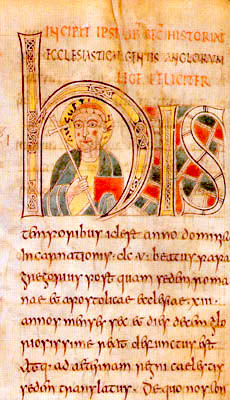
Saint Augustine of Canterbury, the Man Who Who Made England Catholic
There are two Saints Augustine – the bishop of Hippo, and author of the Confessions and numerous other theological masterpieces, and, today’s saint, Augustine, the first bishop of Canterbury, (+604), often pronounced in England, ‘Austin’. Both were Roman citizens, for there was but one civilization and one ‘world’ in those days, united by the Faith. So too, there was one Church to which they belonged, which was the source of that culture: Hence, Roman and Catholic.
As Hilaire Belloc points out, the notion of ‘nations’ came much later in history. There was Christendom, outside of which was the darkness of the pagan world, the un-civilized, the barbarians, the yet-to-be-redeemed. We were then a long way yet from Rousseau’s imaginary dreams of the ‘noble savage’.
Also, there were no ‘denominations’ of Christians; just Catholics and the one, true Church, governed by the Bishop of Rome. As Newman discovered in his own historical research, England’s Anglicanism, the long-sought-for via media, did not come to be until after Henry VIII, its progenitor; as the Oratorian put it, to delve into history is to cease to be a Protestant. England was Catholic, and much of that is owed to Augustine of Canterbury.
Although we now know him after the name of his diocese, Augustine was an Italian, belonging to the Benedictine monastery of Saint Andrew’s on the Coelian Hill in Rome, which had recently been founded by Pope Gregory, later to be called ‘Great’. It was Gregory who in 595 chose his fellow monk Augustine, then prior, to lead the mission to the pagan people in the south of Britain, with forty other monks.
Contemporary accounts say that Gregory’s missionary zeal was prompted after witnessing some of them being sold as slaves in a market place. Gregory was moved to do something to turn these fair-haired ‘Angles’, who would give their name to England, into ‘Angels’, and not just them, but all the other tribes on the misty island: the Saxons, Celts, Picts, all of those ‘outside the frontier’ of Catholic civilization.
England had been evangelized before, but the land remained largely pagan. The Romans had implanted throughout the empire the material benefits of their culture, the codification of laws, military discipline and training, building techniques, plumbing and clean water, heated flooring and fine Italian wine, literature, and two refined and advanced languages (Latin and Greek). All of this provided the material basis for the planting of the Faith.
But the legionaries had departed in 410, not to return, and the island had sunk back into barbarism. Irish missionaries such as Columbkille made some advance in evangelizing the north of the island – Scotland and Northumbria – but the south remained largely unconverted.
Gregory and Augustine wanted to offer the pagans all the supernatural goodness that would perfect what natural foundation they had: the Church’s creed, her moral code, and a structured prayer and liturgical life, not least the Holy Eucharist (which is ultimately why all the cathedrals were built, and which holds everything else together). They were not dominating or ‘colonising’, but offering all that was good and true, necessary for human flourishing, in this life but, more importantly, in the next.
Augustine and his band began their journey from Rome in 595, but soon became discouraged, with the difficulty of travel, and reports of the savagery of the barbaric Angles. Augustine returned to Rome, but was prompted by Pope Gregory to persevere, given further authority, so on they went, landing on the isle of Thanet in 597, whence they finally made their way to the ancient town of Canterbury, about 18 miles from the coast, then called by its original Latin name of Durovernum.
The people of Canterbury were struck by the solemn procession of the monks into the town, these hardy, masculine, celibate men, completely dedicated to God, bearing the Cross and intoning in unison one of the ‘rogation’ litanies, in that beautiful and mystical Gregorian chant, named after the same Pope who had sent them.
King Aethelbert, a pagan, had married, Bertha, a Catholic, the daughter of Chilibert, the King of France. He was moved by the grace and virtue of Augustine, and gave him permission to convert whom he and his monks might, and many were so moved. Over Christmas, 597, it is said that Augustine baptized ten thousand people. The king himself, soon convinced by the teaching and example of the monks, followed suit.
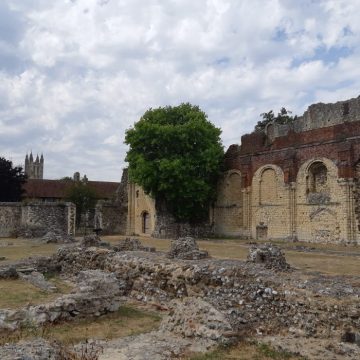
Aethelbert gave them a grant of land outside the town, with the church of Saint Martin – the oldest parish church in the English speaking world – and the monks, as is their wont, got to building, tilling and cultivating; the ruins of their impressive monastery stand to this day as a silent, but powerfully evocative, testament to what they accomplished.
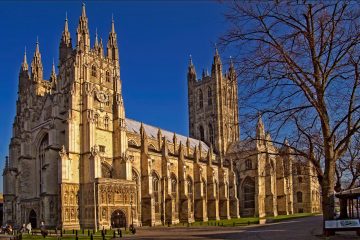
Author Antony McCallum: uploader, photographer, full copyright owner and proprietor of WyrdLight.com
The nearby Canterbury cathedral, which dwarfs in size most modern buildings, where Thomas Becket would be martyred near a side altar six centuries later, was constructed in the 12th century, itself a witness to the deep faith that had been instilled in the once-pagan ‘Angles’.
Augustine, who had been consecrated a bishop by the Pope, set up his episcopal see at Canterbury, overseeing and building up the church in England, until the whole land was converted. The holy monk and bishop, full of good works, went to his eternal reward on May 26th, 604, and was immediately hailed as a saint.
As Pope Gregory himself wrote of the fruit of Augustine’s missionary work:
Who, dear brother, is capable of describing the great joy of believers when they have learned what the grace of Almighty God and your own cooperation achieved among the Angles? They abandoned the errors of darkness and were bathed with the light of holy faith. With full awareness they trampled on the idols which they had previously adored with savage fear. They are now committed to Almighty God. The guidelines given them for their preaching restrain them from falling into evil ways. In their minds they are submissive to the divine precepts and consequently feel uplifted.
And so Canterbury, and all of England remained, Catholic to the core, until the tragic years of 1535-40, when King Henry, driven by greed and whatever other demons we know not, dissolved and ransacked all the monasteries, including Augustine’s own, disbanded the monks to roam the earth, hoarded their wealth, and gave the land, and often the buildings – otherwise left to rack and ruin – to his obsequious courtiers.
The Faith was all-but-obliterated from Britain. But the very ruins of Canterbury’s monastery still evoke what Augustine and those monks had accomplished against insuperable odds, by the grace of God; and what they did, we may do again.
England does not need a new Robin Hood and his merry men, James Bond or the amoral Kingsmen, but rather a band of stalwart and God-ly men like Augustine, full of hope and joy, who may once again sow the seeds of Faith, which will bear fruit amongst the wreckage, like sparks in stubble, so that England – and Europe, and the world – may be what they are meant to be: one, holy, apostolic and Catholic.
Saint Augustine of Canterbury, ora pro nobis!

Carney’s Amoral Majority
After five defections – euphemistically described as ‘crossing the floor’ – and three by-elections, Mark Carney and his Liberals how have their coveted majority. One wonders what bowls of pottage were offered in back-room deals. In the archaic monarchical system that is the Dominion of Canada, this majority allows the newly-minted Prime Minister to rule[…]Continue reading→

Saint Kateri , Canada’s Protectress
This was the title given to Saint Kateri Tekakwitha, by Pope Benedict XVI, when he canonized her on October 28th, 2012, along with six others, in Saint Peter’ Square (she had been beatified by Pope John Paul II back in 1980). With Saint Joseph as our protector, along with the Canadian martyrs, we seem to[…]Continue reading→
A Tale of Two Benedicts
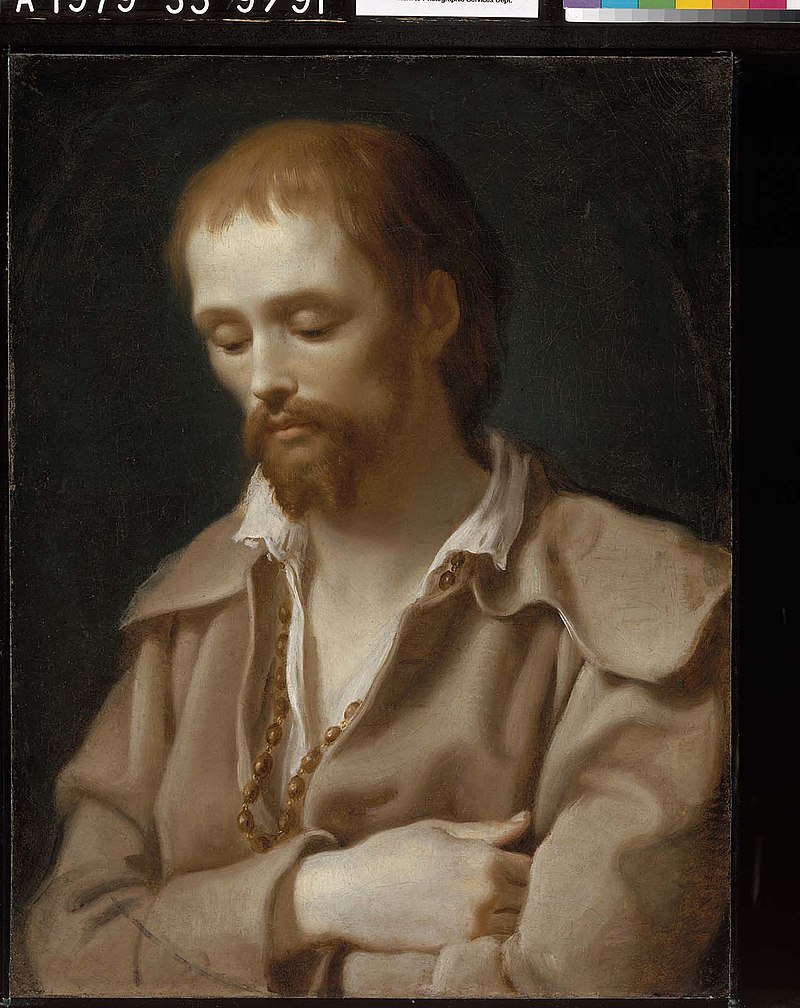
A grace-filled Holy Week to all our readers! As we await and prepare for the Resurrection about to dawn upon us, we might keep in mind two Benedicts: Pope Emeritus Benedict XVI, requiescat in pace, elected on this day in 2005; and today’s commemoration of the mystic pilgrim, Benedict Joseph Labre, who died on this[…]Continue reading→

My Name is Bernadette
April 16th is a propitious day, for besides the anniversary of Father de Valk’s death, who founded Catholic Insight in its print form decades ago, and the commemoration of the ‘two Benedicts’, mentioned in accompanying posts, today we also recall Saint Bernadette Soubirous, the young visionary to whom the Virgin Mary appeared numerous times at[…]Continue reading→
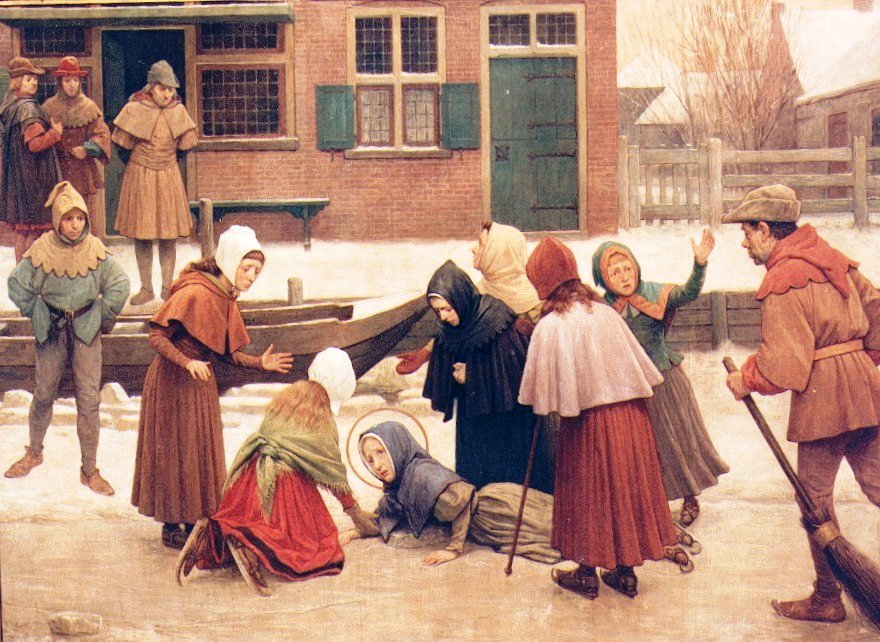
Saint Lydwina of Schiedam and Suffering Joyfully
Saint Lydwina of Schiedam (1380 – 1433) was one of the countless and glorious ‘victim souls’ in the history of the Church, those whose lives are filled with suffering, often of an unimaginable intensity, but who suffer joyfully. She was a fifteen-year old Dutch girl, out skating one day, when she fell and broke one[…]Continue reading→
The Glorious Martyrdoms of Martin and Maximus
As we enter into Eastertide, we recall on this 13th of April Pope Saint Martin I (+655), one of the noblest, if most tragic, of the successors of Saint Peter. Born in Umbria, Italy, he was of noble lineage, with great intelligence combined with charity and love of the poor and the Church. While still[…]Continue reading→
Canonizing Sister Faustina and Divine Mercy
HOMILY OF THE HOLY FATHER MASS IN ST PETER’S SQUARE FOR THE CANONIZATION OF SR MARY FAUSTINA KOWALSKA Sunday, 30 April 2000 1. “Confitemini Domino quoniam bonus, quoniam in saeculum misericordia eius”; “Give thanks to the Lord for he is good; his steadfast love endures for ever” (Ps 118: 1). So the Church sings on the Octave of[…]Continue reading→

Saint Stanislaus of Szczepanów
We celebrate Saint Stanislaus today (+ April 11, 1079), in light of this Easter Octave, a bishop and martyr who accepted the episcopacy only at the direct order of Pope Alexander II. He proved a wise and courageous leader of his flock, put to death by his own king, Boleslaus, for rebuking the monarch’s ‘immoral[…]Continue reading→
Saint Gemma Galgani
On this April 11th, in 1903 – the same year that the Italian Guiseppe Sarto was elected Pope later that summer as Pius X – a lovely, young Italian woman died, by the name of Gemma Galgani. She lived a brief life of 24 years, as did a number of other young saints, including Pier[…]Continue reading→
An Ideological and Improper Translation
I noticed something odd with the psalm reading at Mass the other day. Our bishops’ conference here in Canada has decreed that the Mass in English – Novus Ordo – use the ‘NRSV’, the ‘New Revised Standard Version’, an ‘updated’ translation of the original RSV, first published in 1952. This ‘new translation’ has the tendency[…]Continue reading→