
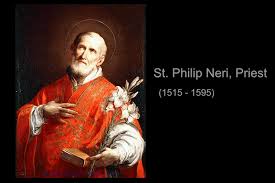
Saint Philip Neri’s Joyful Heart
We celebrate today one of the most joyful and idiosyncratic – the two are not unrelated – of saints, Philip Neri, (+1595), the founder of the Congregation of the Oratory named after him. Born and raised in the great city of Florence, which has produced a whole host of luminaries from Dante to da Vinci to Galileo, Philip was originally destined for the mercantile trade, and consequent riches. But a conversion experience at the age of 18 made him realize the transitoriness of such earthly gains. As he would later say to a similarly ambitious young man years later, as he listed all the things he wanted to accomplish: ‘E pui‘? – ‘And then?’. Eventually, the ‘and thens’ lead to our judgement at the end of our lives, which will be based on love, the charity we have shown to God and neighbour.
Philip made his way to Rome (the city of which he was later to be called the ‘second Apostle’), where he lived sort of as a tutoring hermit, devoted to prayer – his winning personality and charisma evinced the great joy that should be a hallmark of our Faith, and he led many souls to God. As he put it, a joyful heart is much easier to lead to sanctity than a downcast one. In this month of May, it is good to recall what the saint said, quoted by his fellow saint, John Paul II, on his feast day in 1979: This reason alone should be enough to keep a member of the faithful joyful, the knowledge that he has the Virgin Mary praying for him, close to God.
He at first wanted to be a missionary, and give his life for the Faith in pagan lands, like Francis Xavier, but his confessor more or less ordered him to become a priest and evangelize the centre of Christendom, the eternal city of Rome. Philip would lead others in prayer, in visiting the sick and in a rich and vivid sacramental ministry; soon enough, other priests gathered around him. They lived in community, with a regular prayer life, taking turns preaching, fostering beautiful liturgy and music – Palestrina was a spiritual disciple of Saint Philp. What we now know as the ‘Oratory’ grew around Father Philip, priests (and brothers) living together in community, under a superior and a rule, but without religious vows, bound by the ‘bond of charity’ alone. John Henry Newman joined the Oratory when he converted to Catholicism in 1845, and brought the society to England, whence it came to North American. They now have houses throughout the U.S. and the world. (This year, 2025, marks the 50th anniversary of the founding of the Oratory in Canada, first in Montreal, and now in Toronto).
Philip was known for his perennially youthful, exuberant spirit, the antithesis of the sadness, depression and ennui – in all of which the Devil rejoices – that so palls our modern world, not least in these oft bitter, divided days. But as Philip used to quip, ‘I’ll have no sad saints in my house!’ In the Catholic faith, even our sorrow should always be tinged with joy and hope – for as Saint Paul says, what can they, the devil and his minions, do to us? We’re on our way to heaven, and being martyred – upon which Saint Philip recommended we meditate often – is simply a shortcut thereto.
The house of the Oratory was open to one and all, and when his fellow priests complained about the rambunctious young people making too much noise, Philip would reply that ‘he would have them chop wood on my back, if it would keep them from sin’. A mystical experience in the catacombs, in which the Holy Spirit entering Philip in the form of fire, increased the saint’s love for God, so that it became nearly all-consuming. His heart would beat with divine charity, often shaking the very room. After his death, that same heart was found to be physically twice its normal size, so filled was he with divine charity.
Father Philip was a saint of the ‘counter-Reformation’ more properly called the Catholic restoration, a much-needed antidote in his day to the gloominess and grimness of the Calvinism and Jansenism leading souls to despair, the answer to which is not a hedonistic paganism and losing oneself in the illusory pleasures of the ‘world, the flesh and the devil’ – themselves a subtle form of despair – but Christ’s true message of hope and salvation.
Catholics should be known for their cheerfulness and happiness, even if we carry some, or many, sorrows. For beneath the surface turbulence, at a deeper level, we should have that peace and joy that transcends understanding. In living out God’s will there is light, and the Light, at the end of the tunnel, however long and dark it may seem.
Pope John Paul’s message to youth (and his spirit resembled Saint Philip’s in many ways) was to cast into the deep and be not afraid, be who you are meant to be. God always loves you and wants to bring you higher – Pier Giorgio! – to Himself. The only way we can be truly sad is to live apart from Him, our Creator, our Redeemer, our Sanctifier, in Whom delights know no end.
The best way to fight acedia and sadness, the Fathers taught, was to give God that initial ‘yes’, an act of the will that at first may seem difficult, but, once given, we find that His yoke really is easy, and burden light. As Saint Thomas put it, even great and difficult works, if done with love, seem so little, and we will always want to do more, with that joy and zeal that should be the hallmarks of sanctity, to which we are all called.
For Philip, the main way to joy is humility, and he would say that sanctity resided in the space of three fingers, the width of our forehead, the mortificatione rationale – the mortification of our reason, and always doing our own will. Amare nesciri he would tell his companions, ‘love to be unknown!’. Or to be ridiculed. Father Philip would wear large clown shoes, or shave off half his beard, just so people would think less of him, and to mortify that reason, so ready to rebel against the God Who bestowed it upon as a gift to serve Him, often in hidden holiness. When someone called him a saint, he replied vehemently, ‘A saint? I am a very devil!’. He would say that what we know of the saints is the least part of them – the struggle against sin that cost them so much. That ‘greater part’ would make hagiography more interesting to our itching ears, but much of that is locked within the secret of the confessional.
Philip lived that message until his 79th year, when he died peacefully, all too well known, for truly burning lamps cannot be hid, after leading untold numbers of souls to God. He was one of the most remarkable of confessors, able to read hearts, and leading his penitents to see the true evil of sin, and the true goodness of virtue. He had all his writings and letters burned, but his spirit, his sayings, maxims, counsels, and most of all his example, will live on through the ages, until the end of time.
So rejoice and be glad, for our salvation is always near at hand.
Saint Philip Neri, ora pro nobis!

Carney’s Amoral Majority
After five defections – euphemistically described as ‘crossing the floor’ – and three by-elections, Mark Carney and his Liberals how have their coveted majority. One wonders what bowls of pottage were offered in back-room deals. In the archaic monarchical system that is the Dominion of Canada, this majority allows the newly-minted Prime Minister to rule[…]Continue reading→

Saint Kateri , Canada’s Protectress
This was the title given to Saint Kateri Tekakwitha, by Pope Benedict XVI, when he canonized her on October 28th, 2012, along with six others, in Saint Peter’ Square (she had been beatified by Pope John Paul II back in 1980). With Saint Joseph as our protector, along with the Canadian martyrs, we seem to[…]Continue reading→

Remembering Father Alphonse de Valk
(Today marks the sixth anniversary of the death of Father Alphonse de Valk, C.S.B., a faithful, courageous and indefatigable Basilian priest, pro-life-and-family apostle, and the founder of Catholic Insight magazine. Here is what we wrote those on his entering into eternity five years ago, as we continue to remember him in our prayers and thoughts)[…]Continue reading→

A Tale of Two Benedicts
A grace-filled Holy Week to all our readers! As we await and prepare for the Resurrection about to dawn upon us, we might keep in mind two Benedicts: Pope Emeritus Benedict XVI, requiescat in pace, elected on this day in 2005; and today’s commemoration of the mystic pilgrim, Benedict Joseph Labre, who died on this[…]Continue reading→

My Name is Bernadette
April 16th is a propitious day, for besides the anniversary of Father de Valk’s death, who founded Catholic Insight in its print form decades ago, and the commemoration of the ‘two Benedicts’, mentioned in accompanying posts, today we also recall Saint Bernadette Soubirous, the young visionary to whom the Virgin Mary appeared numerous times at[…]Continue reading→

Saint Lydwina of Schiedam and Suffering Joyfully
Saint Lydwina of Schiedam (1380 – 1433) was one of the countless and glorious ‘victim souls’ in the history of the Church, those whose lives are filled with suffering, often of an unimaginable intensity, but who suffer joyfully. She was a fifteen-year old Dutch girl, out skating one day, when she fell and broke one[…]Continue reading→

The Glorious Martyrdoms of Martin and Maximus
As we enter into Eastertide, we recall on this 13th of April Pope Saint Martin I (+655), one of the noblest, if most tragic, of the successors of Saint Peter. Born in Umbria, Italy, he was of noble lineage, with great intelligence combined with charity and love of the poor and the Church. While still[…]Continue reading→

Canonizing Sister Faustina and Divine Mercy
HOMILY OF THE HOLY FATHER MASS IN ST PETER’S SQUARE FOR THE CANONIZATION OF SR MARY FAUSTINA KOWALSKA Sunday, 30 April 2000 1. “Confitemini Domino quoniam bonus, quoniam in saeculum misericordia eius”; “Give thanks to the Lord for he is good; his steadfast love endures for ever” (Ps 118: 1). So the Church sings on the Octave of[…]Continue reading→

Divine Mercy Sunday – An Echo of Every Mass
Reach out your hand and put it in my side. Do not doubt but believe’… ‘My Lord and my God!’ (Jn. 20:18)). Today is Divine Mercy Sunday, and as we celebrate the end of the Easter Octave, we contemplate the wounded side of our Saviour, the Church’s source of life. On Good Friday in the[…]Continue reading→
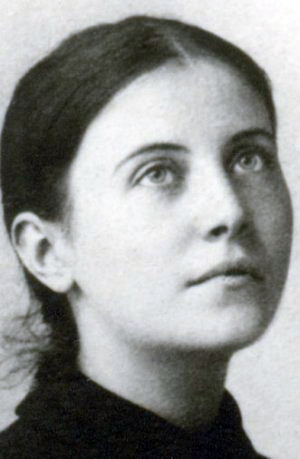
Saint Gemma Galgani
On this April 11th, in 1903 – the same year that the Italian Guiseppe Sarto was elected Pope later that summer as Pius X – a lovely, young Italian woman died, by the name of Gemma Galgani. She lived a brief life of 24 years, as did a number of other young saints, including Pier[…]Continue reading→