
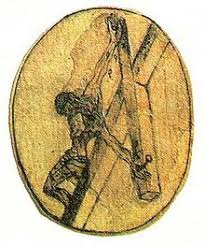
Words from the Cross
The final words of Jesus on the Cross at the last moments of his earthly life offer us demanding instructions for our prayers. Jesus, who asks the Father to forgive those who are crucifying him, invites us to take the difficult step of also praying for those who wrong us and have injured us.
Jesus, who at the moment of death entrusts himself totally to the hands of God the Father, communicates to us the certainty that, however harsh the trial, however difficult the problems, however acute the suffering may be, we shall never fall from God’s grace that created us and sustain us on our way through life — we are guided by His infinite and faithful love.
These final words of instruction come to us through the three times that Jesus spoke on the Cross.
The first prayer that Jesus addresses to the Father is a prayer of intercession — He asks for the forgiveness of His executioners. By so doing, Jesus is doing in person what He taught in the Sermon on the Mount when He said: “But to you who hear I say, love your enemies, do good to those who hate you” (Luke 6:27). He also promised to those who are able to forgive: “But rather, love your enemies and do good to them, and lend expecting nothing back; then your reward will be great and you will be children of the Most High …” (Luke 6:35). Now, from the Cross, Jesus not only pardons His executioners, but also addresses the Father directly interceding for them. Jesus’ actions are imitated in the account of the stoning of St. Stephen, the first martyr. Stephen, nearing his end, “knelt down and cried in a loud voice, “Then he fell to his knees and cried out in a loud voice, ‘Lord, do not hold this sin against them’; and when he said this, he fell asleep” (Acts 7:60). The comparison between Jesus’ prayer for forgiveness and that of the first martyr is significant. St. Stephen turns to the Risen Lord and asks that his killing not be held against those who stoned him.
Jesus on the Cross addresses the Father not only asking for the forgiveness of those who crucify Him, but also reflects on what is happening. According to what He says, the men who are crucifying Him: “Father, forgive them, they know not what they do” (Luke 23:34). He postulates ignorance, not knowing, as the reason for His request for the Father’s forgiveness. This then opens the door to conversion as happens in the words of the centurion at Jesus’ death: “This man was innocent beyond doubt” (Luke 23:34)
The second time that Jesus speaks on the Cross is His answer to the prayer of one of the two men crucified with Him. The good thief comes to his senses and repents before Jesus. He realizes that he is facing the Son of God and begs Him, “… “Jesus, remember me when you come into your kingdom” (Luke 23:42). Jesus’ answer to this prayer goes far beyond the request. In fact, He says, “Amen, I say to you, today you will be with me in Paradise” (Luke 23:43). Jesus knows that He is coming into direct communication with the Father and reopening to man the way to God’s paradise. With this response, Jesus gives us the firm hope that God’s goodness can also touch us, even at the very last moment of life. Sincere prayer, even after a wrong life, opens the arms of the Father who awaits the return of His Son.
Let us consider the last words of Jesus dying: “It was now about noon and darkness came over the whole land until three in the afternoon because of an eclipse of the sun. Then the veil of the temple was torn down the middle. Jesus cried out in a loud voice, ‘Father, into your hands I commend my spirit’; and when he had said this, he breathed his last” (Luke 23:44-46). The words spoken by Jesus’ invocation to the Father borrow an invocation from Psalm 31:5, ‘Into your hands I commit my spirit.” These words express Jesus’ firm decision to deliver Himself to the Father in an act of total abandonment and total trust in God’s love. Jesus’ prayer as He faces death is dramatic, but it is also imbued with a deep calmness that comes from trust in the Father and the desire to commend oneself totally to Him.
In Gethsemane, Jesus began His final struggle, and “He was in such agony and he prayed so fervently that his sweat became like drops of blood falling on the ground” (Luke 22:44). Nevertheless, He was fully obedient to God’s will, and because of this “and to strengthen Him an angel from heaven appeared to him” (Luke 22:43). Now in these moments, Jesus turns to the Father, telling Him into whose hands he really commits His whole life.
Now that life is about to depart from Him, He seals His last decision in prayer: Jesus let Himself be delivered into “the hands of men”, but it is into the hands of the Father that He places his Spirit, thus, as the Evangelist John affirms (John 3: 16), all was finished, the supreme act of love was carried to the end, to the limit and beyond the limit.
This article is adapted from a reflection presented at St. Andrew Catholic Church, Cape Coral, Florida on February 23, 2025

Saint Kateri , Canada’s Protectress
This was the title given to Saint Kateri Tekakwitha, by Pope Benedict XVI, when he canonized her on October 28th, 2012, along with six others, in Saint Peter’ Square (she had been beatified by Pope John Paul II back in 1980). With Saint Joseph as our protector, along with the Canadian martyrs, we seem to[…]Continue reading→

Remembering Father Alphonse de Valk
(Today marks the sixth anniversary of the death of Father Alphonse de Valk, C.S.B., a faithful, courageous and indefatigable Basilian priest, pro-life-and-family apostle, and the founder of Catholic Insight magazine. Here is what we wrote those on his entering into eternity five years ago, as we continue to remember him in our prayers and thoughts)[…]Continue reading→

My Name is Bernadette
April 16th is a propitious day, for besides the anniversary of Father de Valk’s death, who founded Catholic Insight in its print form decades ago, and the commemoration of the ‘two Benedicts’, mentioned in accompanying posts, today we also recall Saint Bernadette Soubirous, the young visionary to whom the Virgin Mary appeared numerous times at[…]Continue reading→

Canonizing Sister Faustina and Divine Mercy
HOMILY OF THE HOLY FATHER MASS IN ST PETER’S SQUARE FOR THE CANONIZATION OF SR MARY FAUSTINA KOWALSKA Sunday, 30 April 2000 1. “Confitemini Domino quoniam bonus, quoniam in saeculum misericordia eius”; “Give thanks to the Lord for he is good; his steadfast love endures for ever” (Ps 118: 1). So the Church sings on the Octave of[…]Continue reading→

Divine Mercy Sunday – An Echo of Every Mass
Reach out your hand and put it in my side. Do not doubt but believe’… ‘My Lord and my God!’ (Jn. 20:18)). Today is Divine Mercy Sunday, and as we celebrate the end of the Easter Octave, we contemplate the wounded side of our Saviour, the Church’s source of life. On Good Friday in the[…]Continue reading→

Saint Stanislaus of Szczepanów
We celebrate Saint Stanislaus today (+ April 11, 1079), in light of this Easter Octave, a bishop and martyr who accepted the episcopacy only at the direct order of Pope Alexander II. He proved a wise and courageous leader of his flock, put to death by his own king, Boleslaus, for rebuking the monarch’s ‘immoral[…]Continue reading→

First Holy Communion: Sermon from May 16, 1943
Here is a sermon from the good old days by +Rev. Msgr. Vincent Nicholas Foy (August 14, 1915 – March 13, 2017), from 1943. Readers may recall that Pope Saint Pius X, by the decree Quam Singulari in 1910, lowered the customary age of reception of Holy Communion – after the rigours of the plague[…]Continue reading→

In the Glorious Light of Easter, Alleluia!
Set your minds on things that are above, not on things that are on earth, for you have died, and your life is hidden with Christ in God. When Christ who is your life is revealed, then you also will be revealed with him in glory (Col. 3:3-4). The Resurrection of Our Lord and Saviour[…]Continue reading→

An Ancient Homily for Holy Saturday
The time between Good Friday and Easter Sunday is one of waiting, in silence, as the world wonders – anticipates – what will happen, after the death of Christ. We re-live this time each year in the anamnesis of our liturgy, and in turn look forward to the glorious re-creation of all things at the[…]Continue reading→

Europe’s Long Descent
(As we meditate on this day on Christ’s burial, and His descent into hell, it is fitting to ponder here with contributor Peter Marcus how the world seems to be heading there as well. The difference is that, although God cannot ‘redeem’ hell, nor those therein, He can and did redeem the world. There is[…]Continue reading→