
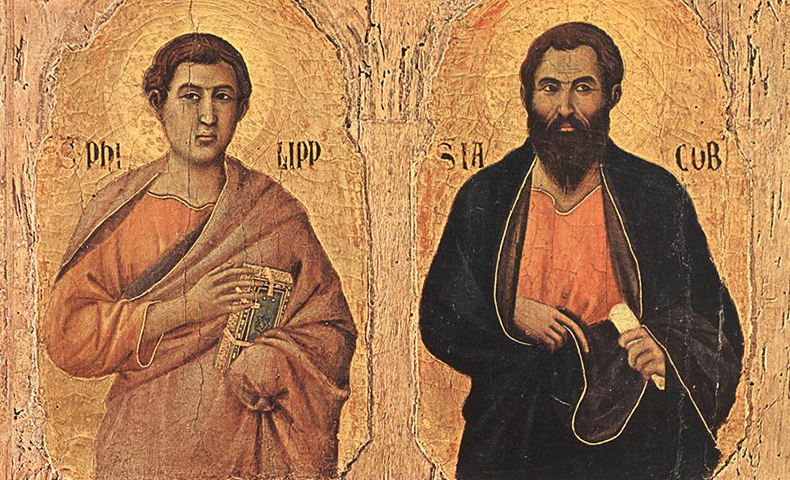
Philip and James: Apostles in Arms
Philip and James, Apostles, have been celebrated together on this third day in May since the revision of the calendar in 1969. They were originally commemorated on May 1st, the anniversary of the church dedicated to them in Rome, but that day was adopted as Saint Joseph the Worker by Pius XII in 1955, as an antidote to the communist ‘International Workers’ Day’. Hence, here we are, on the Tres de Mayo.
Philip appears a few times in the Gospels: He points out Nathaniel, ‘the man without guile’, to Christ; it is Philip whom Christ asks how they will feed the five thousand, ‘to test him’ and Philip replies that three hundred denarii – or days’ wages – wouldn’t be enough. And Philip, always the literalist, later asks, towards the close of our Lord’s life, to ‘show us the Father, and we will be satisfied’, to which Christ replies, ‘Have I been with you so long, and yet you do not know me, Philip? He who has seen me has seen the Father; how can you say, `Show us the Father’? Do you not believe that I am in the Father and the Father in me?
To Philip, therefore, Christ revealed that He and the Father ‘are one’, in nature, in substance, in divinity. Recall the homoousios for which Saint Athanasius fought. The Son, same in nature, is distinct in Person, in His relation to the Father. The Son is the perfect image of the Father, sent into the world for our redemption, and, as He Himself reminds us just prior to this exchange with Philip, the Son is the one and unique Way to the Father, the Truth and the Life.
A non-canonical tradition has it that Philip preached with Bartholomew (the new name of Nathaniel of Saint John’s Gospel, as above) to the Greeks in Asia Minor with much success, for which they were, like Saint Peter, eventually crucified upside down in the city of Hieropolis,
James, called the ‘lesser’ or the ‘minor’, for the simple reason that he seems to have been younger than the other James, the ‘greater’, or ‘major’ (whom we celebrate on July 25th).
The mediaeval Golden Legend, compiled by Jacob de Varagine (+1298), Archbishop of Genoa describes him thus:
James the Apostle is said the Less, how well that was the elder of age than was St. James the More. He was called also the brother of our Lord, because I have resembled much well our Lord in body, in visage, and of manner. He was called James the Just for his right great holiness. He was also called James the son of Alpheus. He sang in Jerusalem the first mass that ever was there, and he was first bishop of Jerusalem
As the first to hold the see of Jerusalem, and as bishop of the ancient city, James built up the Church, before he was put to death, again as tradition has it, by certain Jews inimical to the Faith in about 62 A.D., by being thrown off the roof of the Temple. This James is the author of the powerful, hard-hitting Letter that bears his name, the one that Luther described as that ‘epistle of straw’, due to its clear statement that ‘faith without works is dead’. Indeed.
The Letter of James is well worth a re-read, especially in these times. To get us started, here are the first few lines, upon which we could meditate for some time:
Count it all joy, my brethren, when you meet various trials, for you know that the testing of your faith produces steadfastness. And let steadfastness have its full effect, that you may be perfect and complete, lacking in nothing.
If any of you lacks wisdom, let him ask God, who gives to all men generously and without reproaching, and it will be given him.
But let him ask in faith, with no doubting, for he who doubts is like a wave of the sea that is driven and tossed by the wind. For that person must not suppose that a double-minded man, unstable in all his ways, will receive anything from the Lord.
Let the lowly brother boast in his exaltation, and the rich in his humiliation, because like the flower of the grass he will pass away. For the sun rises with its scorching heat and withers the grass; its flower falls, and its beauty perishes. So will the rich man fade away in the midst of his pursuits.
Blessed is the man who endures trial, for when he has stood the test he will receive the crown of life which God has promised to those who love him.
Sancti Philippe et Jacobi, orate pro nobis! +

Carney’s Amoral Majority
After five defections – euphemistically described as ‘crossing the floor’ – and three by-elections, Mark Carney and his Liberals how have their coveted majority. One wonders what bowls of pottage were offered in back-room deals. In the archaic monarchical system that is the Dominion of Canada, this majority allows the newly-minted Prime Minister to rule[…]Continue reading→

Saint Kateri , Canada’s Protectress
This was the title given to Saint Kateri Tekakwitha, by Pope Benedict XVI, when he canonized her on October 28th, 2012, along with six others, in Saint Peter’ Square (she had been beatified by Pope John Paul II back in 1980). With Saint Joseph as our protector, along with the Canadian martyrs, we seem to[…]Continue reading→
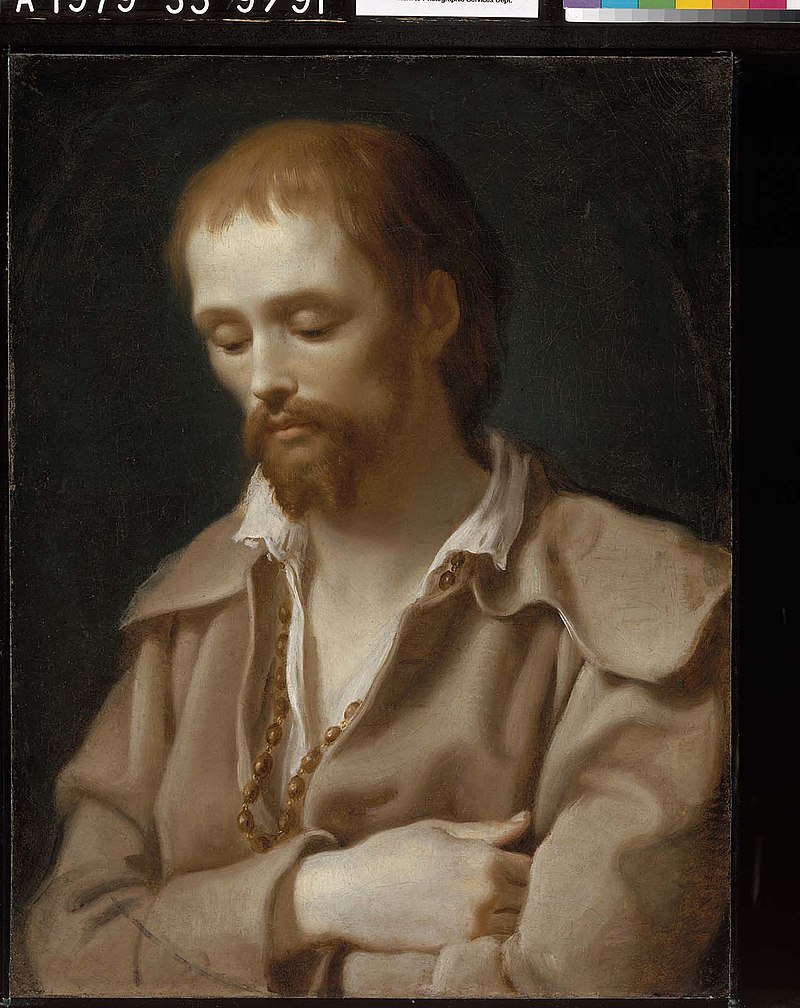
A Tale of Two Benedicts
A grace-filled Holy Week to all our readers! As we await and prepare for the Resurrection about to dawn upon us, we might keep in mind two Benedicts: Pope Emeritus Benedict XVI, requiescat in pace, elected on this day in 2005; and today’s commemoration of the mystic pilgrim, Benedict Joseph Labre, who died on this[…]Continue reading→

My Name is Bernadette
April 16th is a propitious day, for besides the anniversary of Father de Valk’s death, who founded Catholic Insight in its print form decades ago, and the commemoration of the ‘two Benedicts’, mentioned in accompanying posts, today we also recall Saint Bernadette Soubirous, the young visionary to whom the Virgin Mary appeared numerous times at[…]Continue reading→
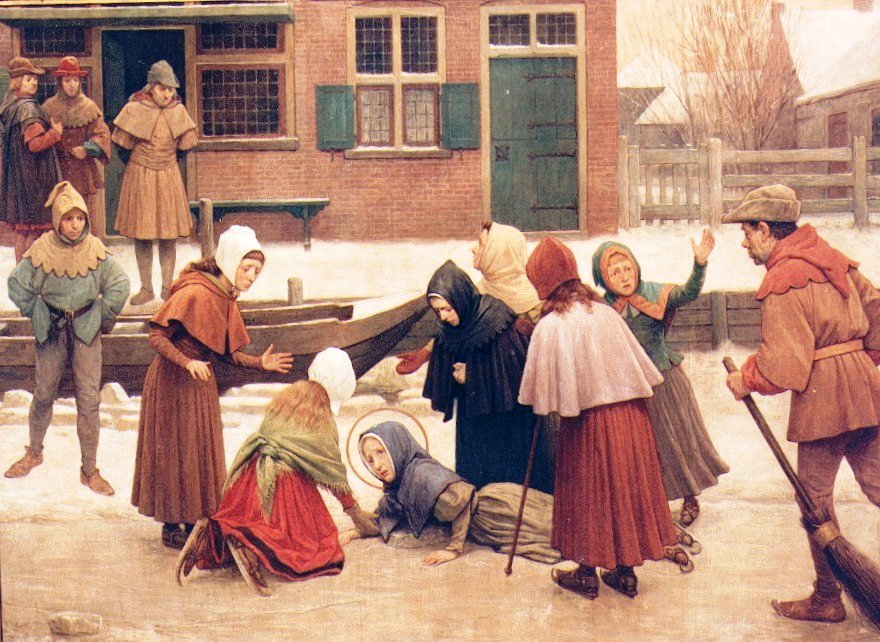
Saint Lydwina of Schiedam and Suffering Joyfully
Saint Lydwina of Schiedam (1380 – 1433) was one of the countless and glorious ‘victim souls’ in the history of the Church, those whose lives are filled with suffering, often of an unimaginable intensity, but who suffer joyfully. She was a fifteen-year old Dutch girl, out skating one day, when she fell and broke one[…]Continue reading→
The Glorious Martyrdoms of Martin and Maximus
As we enter into Eastertide, we recall on this 13th of April Pope Saint Martin I (+655), one of the noblest, if most tragic, of the successors of Saint Peter. Born in Umbria, Italy, he was of noble lineage, with great intelligence combined with charity and love of the poor and the Church. While still[…]Continue reading→

Canonizing Sister Faustina and Divine Mercy
HOMILY OF THE HOLY FATHER MASS IN ST PETER’S SQUARE FOR THE CANONIZATION OF SR MARY FAUSTINA KOWALSKA Sunday, 30 April 2000 1. “Confitemini Domino quoniam bonus, quoniam in saeculum misericordia eius”; “Give thanks to the Lord for he is good; his steadfast love endures for ever” (Ps 118: 1). So the Church sings on the Octave of[…]Continue reading→

Saint Stanislaus of Szczepanów
We celebrate Saint Stanislaus today (+ April 11, 1079), in light of this Easter Octave, a bishop and martyr who accepted the episcopacy only at the direct order of Pope Alexander II. He proved a wise and courageous leader of his flock, put to death by his own king, Boleslaus, for rebuking the monarch’s ‘immoral[…]Continue reading→
Saint Gemma Galgani
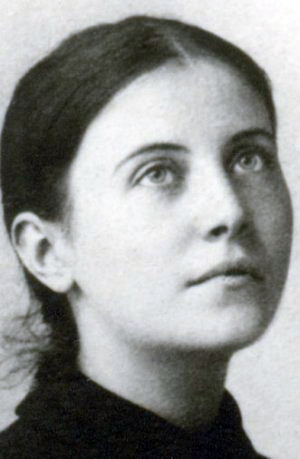
On this April 11th, in 1903 – the same year that the Italian Guiseppe Sarto was elected Pope later that summer as Pius X – a lovely, young Italian woman died, by the name of Gemma Galgani. She lived a brief life of 24 years, as did a number of other young saints, including Pier[…]Continue reading→
An Ideological and Improper Translation
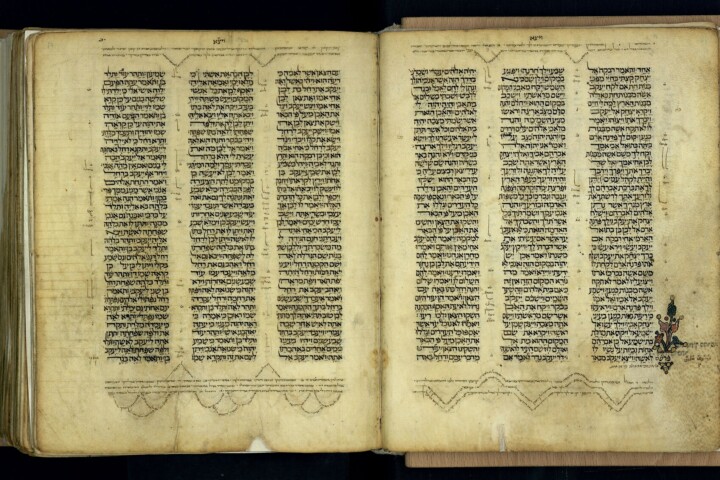
I noticed something odd with the psalm reading at Mass the other day. Our bishops’ conference here in Canada has decreed that the Mass in English – Novus Ordo – use the ‘NRSV’, the ‘New Revised Standard Version’, an ‘updated’ translation of the original RSV, first published in 1952. This ‘new translation’ has the tendency[…]Continue reading→