
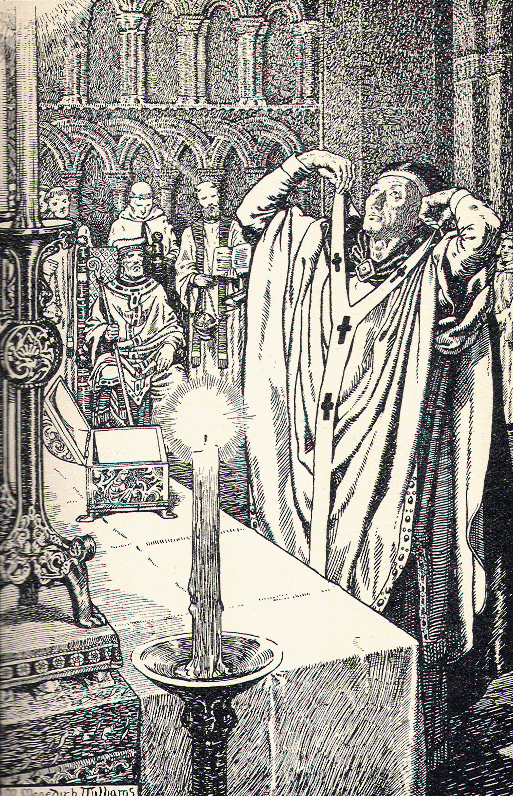
Pope Benedict and Saint Anselm
BENEDICT XVI
GENERAL AUDIENCE
Paul VI Audience Hall
Wednesday, 23 September 2009
[Video]
Saint Anselm
Dear Brothers and Sisters,
The Benedictine Abbey of Sant’Anselmo [St Anselm] is located on the Aventine Hill in Rome. As the headquarters of an academic institute of higher studies and of the Abbot Primate of the Confederated Benedictines it is a place that unites within it prayer, study and governance, the same three activities that were a feature of the life of the Saint to whom it is dedicated: Anselm of Aosta, the ninth anniversary of whose death occurs this year. The many initiatives promoted for this happy event, especially by the Diocese of Aosta, have highlighted the interest that this medieval thinker continues to rouse. He is also known as Anselm of Bec and Anselm of Canterbury because of the cities with which he was associated. Who is this figure to whom three places, distant from one another and located in three different nations Italy, France, England feel particularly bound? A monk with an intense spiritual life, an excellent teacher of the young, a theologian with an extraordinary capacity for speculation, a wise man of governance and an intransigent defender of libertas Ecclesiae, of the Church’s freedom, Anselm is one of the eminent figures of the Middle Ages who was able to harmonize all these qualities, thanks to the profound mystical experience that always guided his thought and his action.
St Anselm was born in 1033 (or at the beginning of 1034) in Aosta, the first child of a noble family. His father was a coarse man dedicated to the pleasures of life who squandered his possessions. On the other hand, Anselm’s mother was a profoundly religious woman of high moral standing (cf. Eadmer, Vita Sancti Anselmi, PL 159, col. 49). It was she, his mother, who saw to the first human and religious formation of her son whom she subsequently entrusted to the Benedictines at a priory in Aosta. Anselm, who since childhood as his biographer recounts imagined that the good Lord dwelled among the towering, snow-capped peaks of the Alps, dreamed one night that he had been invited to this splendid kingdom by God himself, who had a long and affable conversation with him and then gave him to eat “a very white bread roll” (ibid., col. 51). This dream left him with the conviction that he was called to carry out a lofty mission. At the age of 15, he asked to be admitted to the Benedictine Order but his father brought the full force of his authority to bear against him and did not even give way when his son, seriously ill and feeling close to death, begged for the religious habit as a supreme comfort. After his recovery and the premature death of his mother, Anselm went through a period of moral dissipation. He neglected his studies and, consumed by earthly passions, grew deaf to God’s call. He left home and began to wander through France in search of new experiences. Three years later, having arrived in Normandy, he went to the Benedictine Abbey of Bec, attracted by the fame of Lanfranc of Pavia, the Prior. For him this was a providential meeting, crucial to the rest of his life. Under Lanfranc’s guidance Anselm energetically resumed his studies and it was not long before he became not only the favourite pupil but also the teacher’s confidante. His monastic vocation was rekindled and, after an attentive evaluation, at the age of 27 he entered the monastic order and was ordained a priest. Ascesis and study unfolded new horizons before him, enabling him to rediscover at a far higher level the same familiarity with God which he had had as a child.
(To continue reading, please see here).

Saint Kateri , Canada’s Protectress
This was the title given to Saint Kateri Tekakwitha, by Pope Benedict XVI, when he canonized her on October 28th, 2012, along with six others, in Saint Peter’ Square (she had been beatified by Pope John Paul II back in 1980). With Saint Joseph as our protector, along with the Canadian martyrs, we seem to[…]Continue reading→

Remembering Father Alphonse de Valk
(Today marks the sixth anniversary of the death of Father Alphonse de Valk, C.S.B., a faithful, courageous and indefatigable Basilian priest, pro-life-and-family apostle, and the founder of Catholic Insight magazine. Here is what we wrote those on his entering into eternity five years ago, as we continue to remember him in our prayers and thoughts)[…]Continue reading→

A Tale of Two Benedicts
A grace-filled Holy Week to all our readers! As we await and prepare for the Resurrection about to dawn upon us, we might keep in mind two Benedicts: Pope Emeritus Benedict XVI, requiescat in pace, elected on this day in 2005; and today’s commemoration of the mystic pilgrim, Benedict Joseph Labre, who died on this[…]Continue reading→

My Name is Bernadette
April 16th is a propitious day, for besides the anniversary of Father de Valk’s death, who founded Catholic Insight in its print form decades ago, and the commemoration of the ‘two Benedicts’, mentioned in accompanying posts, today we also recall Saint Bernadette Soubirous, the young visionary to whom the Virgin Mary appeared numerous times at[…]Continue reading→

Saint Lydwina of Schiedam and Suffering Joyfully
Saint Lydwina of Schiedam (1380 – 1433) was one of the countless and glorious ‘victim souls’ in the history of the Church, those whose lives are filled with suffering, often of an unimaginable intensity, but who suffer joyfully. She was a fifteen-year old Dutch girl, out skating one day, when she fell and broke one[…]Continue reading→

The Glorious Martyrdoms of Martin and Maximus
As we enter into Eastertide, we recall on this 13th of April Pope Saint Martin I (+655), one of the noblest, if most tragic, of the successors of Saint Peter. Born in Umbria, Italy, he was of noble lineage, with great intelligence combined with charity and love of the poor and the Church. While still[…]Continue reading→

Canonizing Sister Faustina and Divine Mercy
HOMILY OF THE HOLY FATHER MASS IN ST PETER’S SQUARE FOR THE CANONIZATION OF SR MARY FAUSTINA KOWALSKA Sunday, 30 April 2000 1. “Confitemini Domino quoniam bonus, quoniam in saeculum misericordia eius”; “Give thanks to the Lord for he is good; his steadfast love endures for ever” (Ps 118: 1). So the Church sings on the Octave of[…]Continue reading→

Divine Mercy Sunday – An Echo of Every Mass
Reach out your hand and put it in my side. Do not doubt but believe’… ‘My Lord and my God!’ (Jn. 20:18)). Today is Divine Mercy Sunday, and as we celebrate the end of the Easter Octave, we contemplate the wounded side of our Saviour, the Church’s source of life. On Good Friday in the[…]Continue reading→

Saint Stanislaus of Szczepanów
We celebrate Saint Stanislaus today (+ April 11, 1079), in light of this Easter Octave, a bishop and martyr who accepted the episcopacy only at the direct order of Pope Alexander II. He proved a wise and courageous leader of his flock, put to death by his own king, Boleslaus, for rebuking the monarch’s ‘immoral[…]Continue reading→

Saint Gemma Galgani
On this April 11th, in 1903 – the same year that the Italian Guiseppe Sarto was elected Pope later that summer as Pius X – a lovely, young Italian woman died, by the name of Gemma Galgani. She lived a brief life of 24 years, as did a number of other young saints, including Pier[…]Continue reading→