
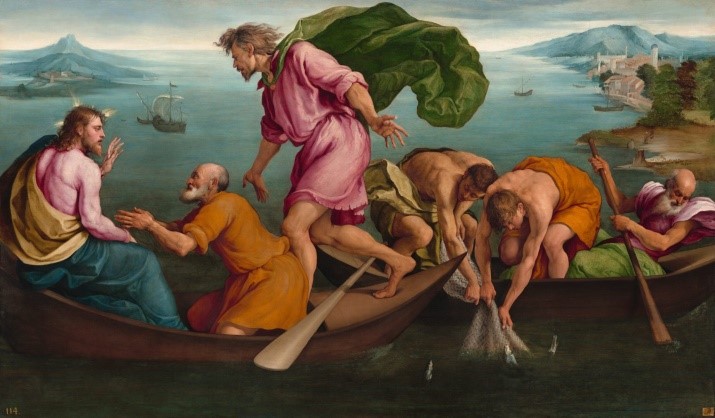
The Fall of Saint Peter
As Jesus was being interrogated by the High Priest, His disciples had been scattered. Only two remained to follow Him. The first was St. John the Evangelist. The other was St. Peter. When they arrived at the High Priest’s house, St. John entered, while Peter waited outside by a fire. When pressured about his identity and status as a follower of Christ, he denied Him and fulfilled what the Savior had said earlier at the Last Supper: “Jesus said to him, ‘Amen, I say to you, this very night before the cock crows, you will deny me three times.’” (Matthew 26:34) Fulton Sheen writes a great deal about this incident during the Passion. He notes that there are stages that can clearly be seen that led to the fall of St. Peter that we should be watchful for in our own lives. It should also be noted that these stages in the fall of St. Peter are not isolated to any single group. They can affect laity, religious, priests, bishops, etc. Sheen sees five stages in the fall of St. Peter:
First, the neglect of prayer.
Second, substitution of action for prayer.
Third, lukewarmness.
Fourth, satisfaction of material wants, feelings, and emotions.
Fifth, human respect.[1]
The first stage is the neglect of prayer. Jesus had commanded His disciples to watch and pray in Gethsemane but continually found them asleep:
When he returned to his disciples he found them asleep. He said to Peter, ‘So you could not keep watch with me for one hour? Watch and pray that you may not undergo the test. The spirit is willing, but the flesh is weak.’ (Matthew 26:41)
Prayer is essential to our life. It is how we communicate with God and how God communicates with us. Sheen also notes that this is a particular danger for the priest’s spiritual life:
A priest’s life spent so much in public must be fortified within with prayer and vigilance…The constant giving out of self needs replenishing from above. As the channel through which the waters of life pass to the people, the priest must devote unceasing care and prayer to keep himself clean and holy.[2]
This applies to all people. In order to keep ourselves “holy and clean” we must never fail to neglect prayer, especially when we are tired and exhausted by the burdens of our daily lives.
The second stage is the substitution of prayer for action. Sheen notes that Peter, who had first neglected prayer now jumps to action. He draws his sword and cuts off the ear of Malchus, the High Priest’s slave. Sheen further notes that at the beginning of Jesus’ Passion, He does not ask for an hour of activity but an hour of prayer. How often do we neglect our prayer with the excuse of doing work, even charitable work? We are fed by prayer in order to do the spiritual and corporal works of mercy. Without prayer they are meaningless. Again, St. Peter is the model of the failing priest:
Peter’s action that night symbolizes all priests who avoid the obligations of their priesthood by being busy. Some lose themselves in a passion for buildings; others, in organization; others, in an endless round of banquets and speeches, committee meetings and fund drives. Such are the ‘swords’ that take the place of prayer. Administration, long hours in offices, theatrical presentations, social evenings, parish feasts-they are marks of prosperity that can kill the Spirit.[3]
Sheen is not saying that priests or laity should not do charitable deeds, be present to their communities, or renovate churches. But all things must have a proper order – and God always comes first. If one is so busy that he is substituting action for prayer, he must reevaluate one’s priorities in life.
The third stage is lukewarmness. St. Matthew tells us that after Jesus had been arrested, Peter was following him at a distance as far as the high priest’s courtyard, and going inside he sat down with the servants to see the outcome. (Matthew 26:58) Earlier in the day Peter had promised to die for Christ. In the Garden he had drawn his sword in order to defend Christ. Now he follows, only at a distance. His zeal is gone. Sheen writes about this spiritual malaise: We still linger as from force of habit-or perhaps even from remorse of conscience-in the footsteps of the Master, but out of range of both His eyes and His voice. It is in such moments that souls say ‘God has forgotten me,’ when the truth is that it is not God who leaves us, it is we who stray on behind. [4]
When our zeal for God slowly dies due to our lack of prayer and substitution of prayer for action, we simply go through the motions of our Faith. We go to Church but only as a social event, we no longer see Mass as Calvary made present before us, our sins become of little consequence, and so on.
The fourth stage is the satisfaction of our material wants, feelings, and emotions. St. Mark adds these details about St. Peter’s loose following of Christ: “Peter followed him at a distance into the high priest’s courtyard and was seated with the guards, warming himself at the fire.” (Mark 14:54) Sheen notes two things. First, that Peter is sitting – he is getting comfortable – he doesn’t stand attentively nor does he kneel in prayer. Second, he is warming himself by the fire. Instead of trying to reach Christ, he falls short and stays by the fire to warm himself. How often do we substitute Christ for some creature comfort? When our spiritual lives have been declining by the previous stages, our material desires and pleasures become the primary driving force behind our actions.
The fifth and final stage is the desire for human respect: The last stage in the fall is human respect, when we deny our Faith or are ashamed of it under ridicule or scorn. Worldly religions will get on well with the world, but not a divine. [5] When Peter is pressed by those around him about his identity as a follower of Christ, he denies it three times and even curses that he does not know Him: As he went out to the gate, another girl saw him and said to those who were there, ‘This man was with Jesus the Nazorean.’ Again he denied it with an oath, ‘I do not know the man!’ (Matthew 26:71-72) How quick are we to hide the fact that we are Catholic in public, even in little ways? How often to we refrain from making the sign of the Cross or praying in public for fear of ridicule from those around us? This abandoning of our identity as a disciple of Jesus Christ is the final nail in the coffin for the fall from grace.
It is at this point that one may ask why St. Peter was chosen, out of all the Apostles, to be the leader. Would not St. John the Evangelist, the Beloved Disciple, who was entrusted with the care of our Blessed Mother, who leaned upon the Heart of the Savior, who followed Christ and stood at the foot of the Cross, be the ideal and better choice? Sheen writes, And yet, knowing all, the Son of God made Peter, who knew sin, and not John, the Rock upon which He built His Church that sinners and the weak might never despair. [6] To despair of the sins we have committed would be to become like Judas who repented unto himself, saw no future hope, and even killed himself. To be like Peter is to repent unto God of our sins and trust in His mercy: “He [Peter] went out and began to weep bitterly.” (Luke 22:62) John was in a sense too perfect – Christ chose the weak Peter that all sinners might be given hope for the forgiveness of their sins.
Endnotes:
[1]Fulton J. Sheen, Characters of the Passion (Angelico Press, 2015), 1.
[2]Fulton J. Sheen, The Priest is Not His Own (Ignatius Press, 2004), 176.
[3]Sheen, The Priest, 177-178.
[4]Sheen, Characters, 4.
[5]Sheen, Characters, 5.
[6]Fulton J. Sheen, Life of Christ (Image Books, 2008), 493.

Remembering Father Alphonse de Valk
(Today marks the sixth anniversary of the death of Father Alphonse de Valk, C.S.B., a faithful, courageous and indefatigable Basilian priest, pro-life-and-family apostle, and the founder of Catholic Insight magazine. Here is what we wrote those on his entering into eternity five years ago, as we continue to remember him in our prayers and thoughts)[…]Continue reading→

Divine Mercy Sunday – An Echo of Every Mass
Reach out your hand and put it in my side. Do not doubt but believe’… ‘My Lord and my God!’ (Jn. 20:18)). Today is Divine Mercy Sunday, and as we celebrate the end of the Easter Octave, we contemplate the wounded side of our Saviour, the Church’s source of life. On Good Friday in the[…]Continue reading→

Saint Stanislaus of Szczepanów
We celebrate Saint Stanislaus today (+ April 11, 1079), in light of this Easter Octave, a bishop and martyr who accepted the episcopacy only at the direct order of Pope Alexander II. He proved a wise and courageous leader of his flock, put to death by his own king, Boleslaus, for rebuking the monarch’s ‘immoral[…]Continue reading→
First Holy Communion: Sermon from May 16, 1943
Here is a sermon from the good old days by +Rev. Msgr. Vincent Nicholas Foy (August 14, 1915 – March 13, 2017), from 1943. Readers may recall that Pope Saint Pius X, by the decree Quam Singulari in 1910, lowered the customary age of reception of Holy Communion – after the rigours of the plague[…]Continue reading→
In the Glorious Light of Easter, Alleluia!
Set your minds on things that are above, not on things that are on earth, for you have died, and your life is hidden with Christ in God. When Christ who is your life is revealed, then you also will be revealed with him in glory (Col. 3:3-4). The Resurrection of Our Lord and Saviour[…]Continue reading→
An Ancient Homily for Holy Saturday
The time between Good Friday and Easter Sunday is one of waiting, in silence, as the world wonders – anticipates – what will happen, after the death of Christ. We re-live this time each year in the anamnesis of our liturgy, and in turn look forward to the glorious re-creation of all things at the[…]Continue reading→
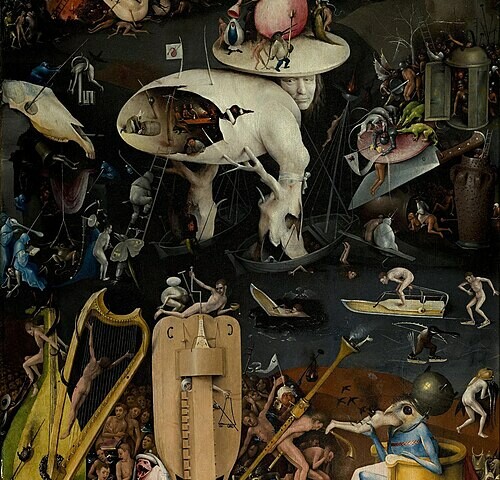
Europe’s Long Descent
(As we meditate on this day on Christ’s burial, and His descent into hell, it is fitting to ponder here with contributor Peter Marcus how the world seems to be heading there as well. The difference is that, although God cannot ‘redeem’ hell, nor those therein, He can and did redeem the world. There is[…]Continue reading→
Pope Saint John Paul II’s First Good Friday Homily
ADDRESS OF HIS HOLINESS JOHN PAUL II AT THE CONCLUSION OF THE STATIONS OF THE CROSS AT THE COLOSSEUM Good Friday, 13 April 1979 When we make the Way of the Cross from one station to the next, in spirit we are always at the spot wherethis journey had its “historical” place: where it[…]Continue reading→
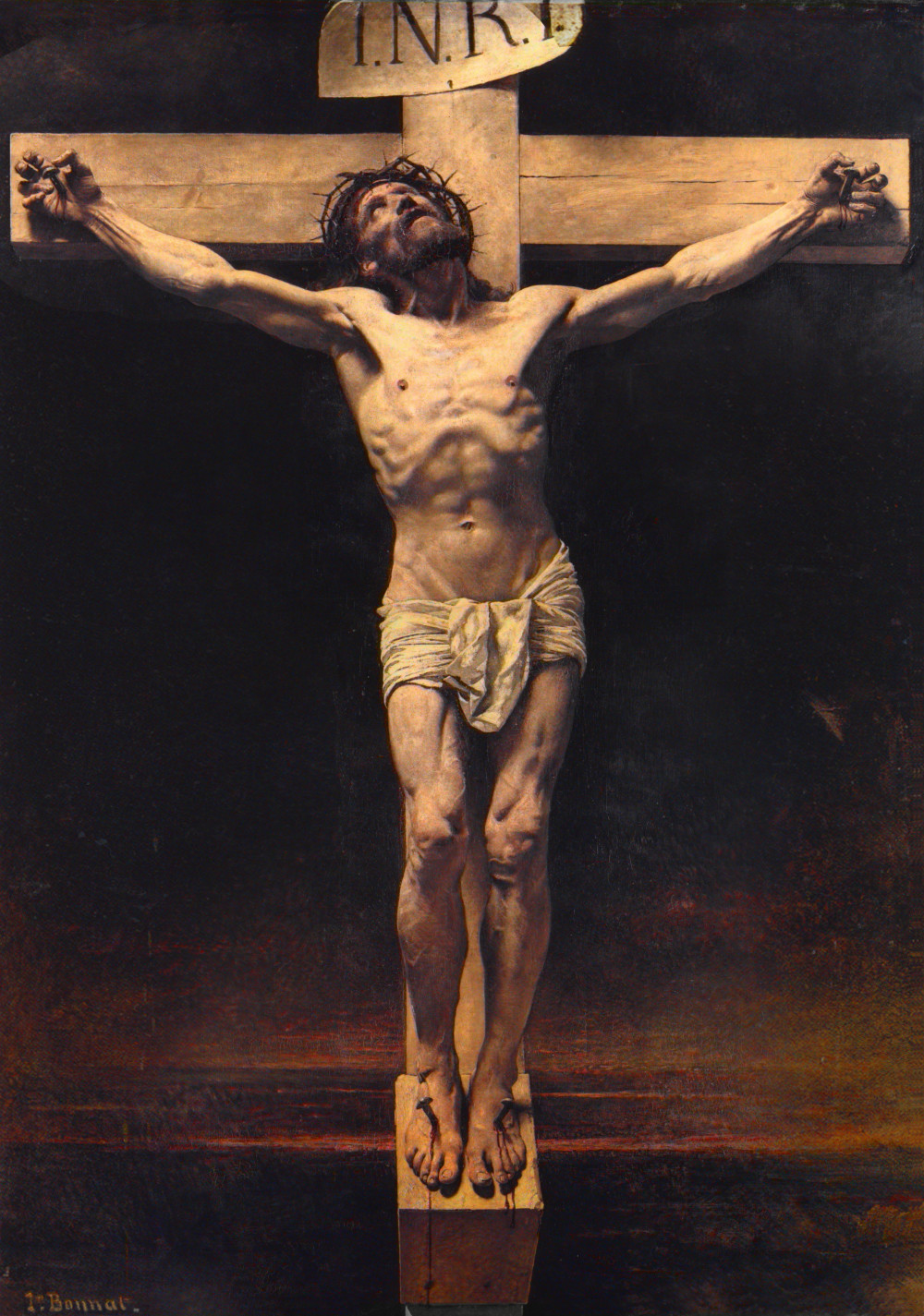
A Meditation for Good Friday: How To Undo the Effects of Sin?
Cardinal Newman, now Saint John Henry Newman, was a towering figure of nineteenth-century Catholicism who is almost universally admired. I say “almost” because not everyone likes him. I knew a priest once, Arthur Caulkins, who has become disenchanted with Newman. As an undergraduate Arthur had been enamoured of Newman, and this interest continued when he[…]Continue reading→
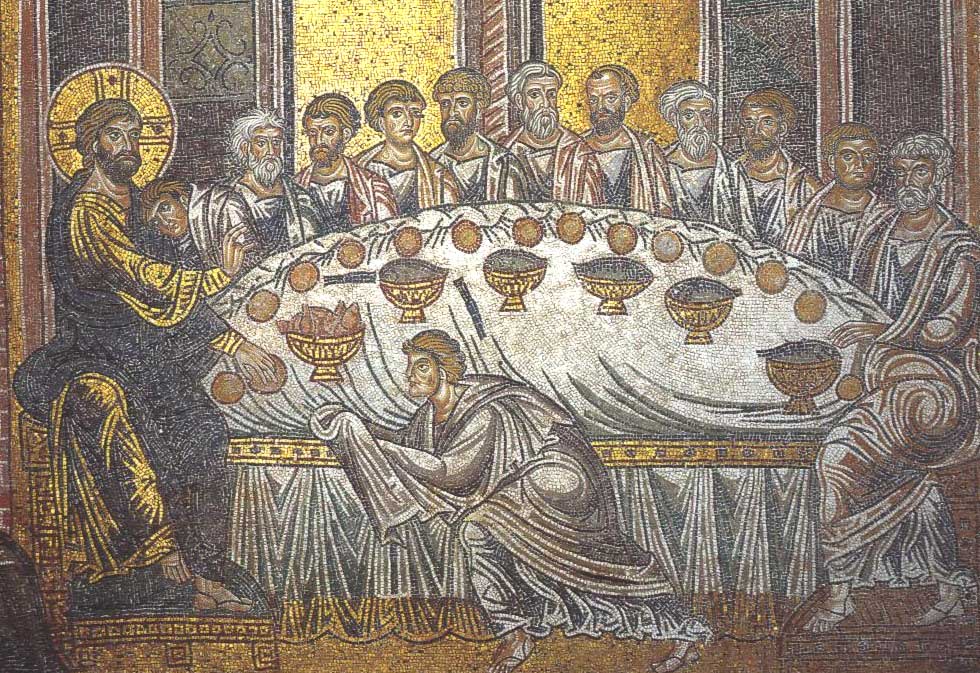
Pope Benedict’s Last Holy Thursday Homily
MASS OF THE LORD’S SUPPER HOMILY OF HIS HOLINESS BENEDICT XVI Basilica of St John Lateran Holy Thursday, 5 April 2012 Photo Gallery (Video) Dear Brothers and Sisters! Holy Thursday is not only the day of the institution of the Most Holy Eucharist, whose splendour bathes all else and in some ways draws it to[…]Continue reading→