
Unto Ash Thou Shalt Return? The Church and Cremation
A friend of mine asked me about the Church’s teaching on cremation, and to fulfil that request, I thought a few words in this venue might not be out of place. (For another take, see EWTN’s Father Saunders). Not least, since the practice is becoming ever-more widespread, even, perhaps, the norm, when previously it was ab-normal.
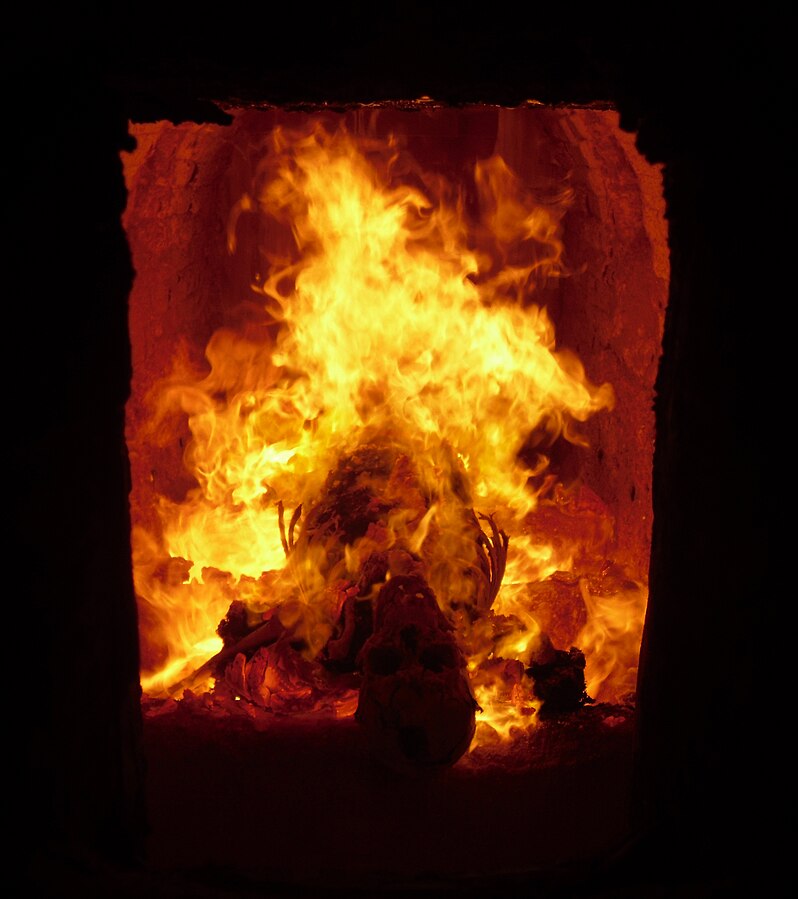
Burning a body – a dead body, that is – is not an intrinsic evil. There are cases when such happens accidentally, in fires. And the Church allowed it in times of plague and other emergencies. But it was generally a pagan practice, even if not all pagans practice it. The Vikings would set their dead onto boats and alight them; India had its funeral pyres, and the brutal custom of suttee, the widow of the deceased throwing herself – or being thrown – into the flames; others, such as the Mayans, would bury their dead in mounds, as would the ancient Irish before they all became Catholic.
Burial was certainly the custom of the ancient Israelites, and it was how Abraham got his foothold in the promised land. This was adopted by the Christians, and the Church has always advocated a proper funeral rites, replete with reverent burial of the body. With their sacramental theology, the relics of a human person are a kind of ‘sacred sign’, of one made in God’s image, awaiting their future resurrection. This has deep sacramental significance for our sake, in a similar way we might treasure anything of our dearly departed.
This was not superstitious. It’s not as though God needs an ‘intact’ body to resurrect at the end of time. All the atoms in the universe are His, which He can gather at will; He can resurrect a body even if it be completely destroyed or disintegrated. More to the point, the resurrected body will be a ‘spiritual’ one, in that wonderfully mysterious ‘new heavens and new earth’ we all await.
The Church did prohibit cremation in her 1917 Code of Canon Law, in large part as a response to the Masonic revolutionaries in Italy who advocated cremation as a specific denial of the resurrection. There was also a spirit of rationalism pervading the world, disbelieving anything beyond this world. Even Saint Paul was derided for preaching the resurrection, which is difficult to believe.
Times and customs change, and the new 1983 Code does permit cremation, but with some degree of caution, retaining an echo of the old Code’s proscription:
The Church earnestly recommends that the pious custom of burying the dead be observed; it does not, however, forbid cremation unless it has been chosen for reasons which are contrary to Christian teaching” (No. 1176, 3)
There are other difficulties with cremation. One wonders whether all the remains are gathered after the process, which requires at least 90 minutes of burning in a very hot oven (1600-1800 degrees Fahrenheit). Is it really possible to collect all that’s left over?
And what to do with the ashes? The ideal is to bury them, as one would do with any remains. But the Congregation for the Doctrine of the Faith in a reply of 2023 has given permission for some ‘small portion’ of the person’s remains to be kept in a ‘place of significance’:
- A) For the reasons listed above, a defined and permanent sacred place can be set aside for the commingled accumulation and preservation of the ashes of deceased baptized persons, indicating the identity of each person so as not to lose the memory of their names.
- B) In addition, the ecclesiastical authority, in compliance with current civil norms, may consider and evaluate a request by a family to preserve in an appropriate way a minimal part of the ashes of their relative in a place of significance for the history of the deceased person, provided that every type of pantheistic, naturalistic, or nihilistic misunderstanding is ruled out and also provided that the ashes of the deceased are kept in a sacred place.
Call me old school, but for those for whom I have any say in what happens after they die and go to God, I’m all for placing them in a solid pine box, preferably made by Trappists or some Catholic carpenter, and sending them off with a grand and solemn Irish wake, before lowering them slowly into the ground with a fine lament.
On that note, here is a traditional Celtic ballad, which I hope is not unfitting in this Lententide – after all, we’re still in the wake of Saint Patrick, if you’ll pardon the pun. Its theme is on death leading to a resurrection, of sorts. Just try to imagine Finnegan as an urn of ashes:
Whatever your take, and wherever our mortal coil ends up, may we all meet merrily in heaven, as Thomas More says, with those bodies that will never age and never die, but live with God in beatitude forever and ever. Amen.

Carney’s Amoral Majority
After five defections – euphemistically described as ‘crossing the floor’ – and three by-elections, Mark Carney and his Liberals how have their coveted majority. One wonders what bowls of pottage were offered in back-room deals. In the archaic monarchical system that is the Dominion of Canada, this majority allows the newly-minted Prime Minister to rule[…]Continue reading→

Saint Kateri , Canada’s Protectress
This was the title given to Saint Kateri Tekakwitha, by Pope Benedict XVI, when he canonized her on October 28th, 2012, along with six others, in Saint Peter’ Square (she had been beatified by Pope John Paul II back in 1980). With Saint Joseph as our protector, along with the Canadian martyrs, we seem to[…]Continue reading→

A Tale of Two Benedicts
A grace-filled Holy Week to all our readers! As we await and prepare for the Resurrection about to dawn upon us, we might keep in mind two Benedicts: Pope Emeritus Benedict XVI, requiescat in pace, elected on this day in 2005; and today’s commemoration of the mystic pilgrim, Benedict Joseph Labre, who died on this[…]Continue reading→

My Name is Bernadette
April 16th is a propitious day, for besides the anniversary of Father de Valk’s death, who founded Catholic Insight in its print form decades ago, and the commemoration of the ‘two Benedicts’, mentioned in accompanying posts, today we also recall Saint Bernadette Soubirous, the young visionary to whom the Virgin Mary appeared numerous times at[…]Continue reading→

Saint Lydwina of Schiedam and Suffering Joyfully
Saint Lydwina of Schiedam (1380 – 1433) was one of the countless and glorious ‘victim souls’ in the history of the Church, those whose lives are filled with suffering, often of an unimaginable intensity, but who suffer joyfully. She was a fifteen-year old Dutch girl, out skating one day, when she fell and broke one[…]Continue reading→

The Glorious Martyrdoms of Martin and Maximus
As we enter into Eastertide, we recall on this 13th of April Pope Saint Martin I (+655), one of the noblest, if most tragic, of the successors of Saint Peter. Born in Umbria, Italy, he was of noble lineage, with great intelligence combined with charity and love of the poor and the Church. While still[…]Continue reading→

Saint Stanislaus of Szczepanów
We celebrate Saint Stanislaus today (+ April 11, 1079), in light of this Easter Octave, a bishop and martyr who accepted the episcopacy only at the direct order of Pope Alexander II. He proved a wise and courageous leader of his flock, put to death by his own king, Boleslaus, for rebuking the monarch’s ‘immoral[…]Continue reading→

Saint Gemma Galgani
On this April 11th, in 1903 – the same year that the Italian Guiseppe Sarto was elected Pope later that summer as Pius X – a lovely, young Italian woman died, by the name of Gemma Galgani. She lived a brief life of 24 years, as did a number of other young saints, including Pier[…]Continue reading→

An Ideological and Improper Translation
I noticed something odd with the psalm reading at Mass the other day. Our bishops’ conference here in Canada has decreed that the Mass in English – Novus Ordo – use the ‘NRSV’, the ‘New Revised Standard Version’, an ‘updated’ translation of the original RSV, first published in 1952. This ‘new translation’ has the tendency[…]Continue reading→
Saint Jean-Baptiste de la Salle: A Teacher for Teachers
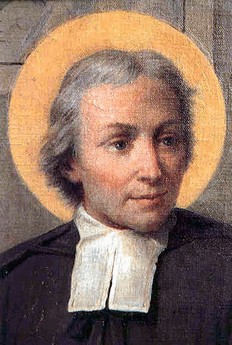
Jean-Baptiste de la Salle (1651 – 1719), a French nobleman, ordained a priest, founded the first order in the Church’s history entirely without priests, and this came about almost by accident. I say ‘almost’, for, of course, there are no accidents with God. Destined for ordination from an early age, Jean-Baptiste never looked back, even[…]Continue reading→