
The Real San Lázaro
As a first generation American born in the United States, I was introduced early in life to St. Lazarus by my family of Cuban heritage.
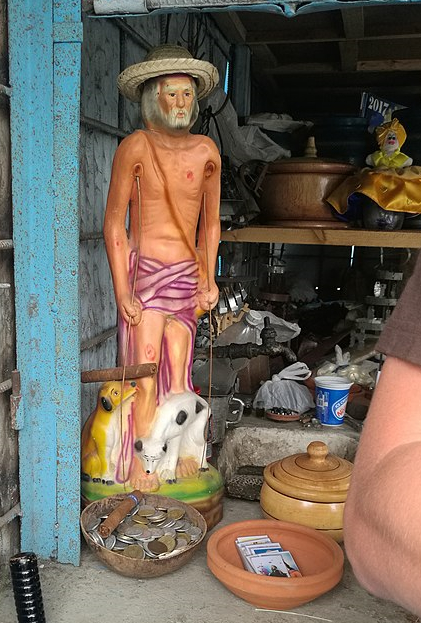
St. Lazarus is exceedingly popular within the Cuban community. Cubans have typically shown a special devotion to St. Lazarus as he is considered to be the patron saint of the poor and the sick. Many of my relatives’ homes had a small statue of the Saint, generally depicted walking with a staff and with two or three dogs following him. He seemed to be covered in sores and one had the impression that the dogs were licking and cleaning his wounds. There was often a cigar and a small jigger of rum placed before the statue as some type of offering. Some of the women, in particular, would often pray at the statue for whatever their special intention might be.
I was never personally engaged in this special devotion to St. Lazarus as my parents never maintained such a shrine in our home even though perhaps half of my many uncles, aunts, and grandparents did so.
We know of Lazarus primarily from the eleventh chapter of Saint John. Saint Lazarus lived in Bethany, the village of Mary and her sister Martha. This was the Mary that washed Jesus’ feet with perfume.
Lazarus, who was Martha’s brother, was taken ill and died. He had been in the tomb four days when Jesus arrived. Jesus went on to raise Lazarus from the dead and this is where we hear one of His best-known promises: “I am the resurrection. Anyone who believes in me, even though that person dies, will live and whoever lives and believes in me will never die…” (John 11: 25-26).
In Cuba he is known as San Lázaro and is popularly called “the one on crutches” and by his devoted followers as the old Lázaro.
However, this special relationship between ethnic Cubans and St. Lazarus is not without conflict.
In southern Florida, particularly the Miami area, there is a group called “El Ricón de San Lázaro (RSL), a group that is not part of the Holy, Catholic, Apostolic Church under the authority of the Holy See. This has been emphatically reiterated by the Archbishop of Miami. Diocesan courts, both in the Diocese of Miami and Venice (Florida), have agreed.
In spite of this, the RSL, in their liturgies claim to be in communion with the Catholic Church and with the Holy See.
The RSL exists primarily as a religious group devoted to San Lázaro. Among its members, known as the santeros orishas, San Lázaro is identified with Babalú-Ayé, a deity in the Santeria religion. The orishas are powerful spirits in the Santería religion of African origin that act as intermediaries between humans and the supreme god, Olodumare. Santería practitioners believe that the orishas help people achieve their destiny and that humans must worship the orishas in return. Babalú-Ayé and Saint Lazarus are both deities associated with health and healing. Babalú-Ayé is an orisha in the Santería religion and Saint Lazarus is a Catholic saint.
The Santeria religion is old with many myths and legends. This disordered devotion to St. Lazarus arises from the religious syncretism of African origin identifying the orishas with the saints of the Catholic Church through attributes that represent them. This gives rise to a system of religious beliefs that combine Christianity with pan-African identity and Caribbean slave religious practices.
This is without doubt due to the poly-theistic religion of the African slaves, in turn influenced by Christian beliefs brought to the New World by Catholic missionaries, primarily from Spain.
The history of this Old World theology entangled with New World Missionary Catholicism is explored in the book, Los orishas en Cuba) by Natalia Bolivar Arostegui – January 1, 1995. Unfortunately, it is available only in Spanish.

Saint Kateri , Canada’s Protectress
This was the title given to Saint Kateri Tekakwitha, by Pope Benedict XVI, when he canonized her on October 28th, 2012, along with six others, in Saint Peter’ Square (she had been beatified by Pope John Paul II back in 1980). With Saint Joseph as our protector, along with the Canadian martyrs, we seem to[…]Continue reading→

Remembering Father Alphonse de Valk
(Today marks the sixth anniversary of the death of Father Alphonse de Valk, C.S.B., a faithful, courageous and indefatigable Basilian priest, pro-life-and-family apostle, and the founder of Catholic Insight magazine. Here is what we wrote those on his entering into eternity five years ago, as we continue to remember him in our prayers and thoughts)[…]Continue reading→

My Name is Bernadette
April 16th is a propitious day, for besides the anniversary of Father de Valk’s death, who founded Catholic Insight in its print form decades ago, and the commemoration of the ‘two Benedicts’, mentioned in accompanying posts, today we also recall Saint Bernadette Soubirous, the young visionary to whom the Virgin Mary appeared numerous times at[…]Continue reading→
Canonizing Sister Faustina and Divine Mercy
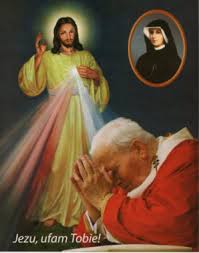
HOMILY OF THE HOLY FATHER MASS IN ST PETER’S SQUARE FOR THE CANONIZATION OF SR MARY FAUSTINA KOWALSKA Sunday, 30 April 2000 1. “Confitemini Domino quoniam bonus, quoniam in saeculum misericordia eius”; “Give thanks to the Lord for he is good; his steadfast love endures for ever” (Ps 118: 1). So the Church sings on the Octave of[…]Continue reading→

Divine Mercy Sunday – An Echo of Every Mass
Reach out your hand and put it in my side. Do not doubt but believe’… ‘My Lord and my God!’ (Jn. 20:18)). Today is Divine Mercy Sunday, and as we celebrate the end of the Easter Octave, we contemplate the wounded side of our Saviour, the Church’s source of life. On Good Friday in the[…]Continue reading→

Saint Stanislaus of Szczepanów
We celebrate Saint Stanislaus today (+ April 11, 1079), in light of this Easter Octave, a bishop and martyr who accepted the episcopacy only at the direct order of Pope Alexander II. He proved a wise and courageous leader of his flock, put to death by his own king, Boleslaus, for rebuking the monarch’s ‘immoral[…]Continue reading→
First Holy Communion: Sermon from May 16, 1943
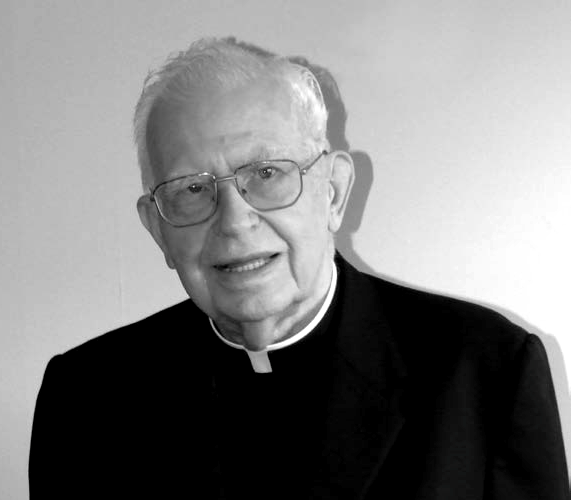
Here is a sermon from the good old days by +Rev. Msgr. Vincent Nicholas Foy (August 14, 1915 – March 13, 2017), from 1943. Readers may recall that Pope Saint Pius X, by the decree Quam Singulari in 1910, lowered the customary age of reception of Holy Communion – after the rigours of the plague[…]Continue reading→

In the Glorious Light of Easter, Alleluia!
Set your minds on things that are above, not on things that are on earth, for you have died, and your life is hidden with Christ in God. When Christ who is your life is revealed, then you also will be revealed with him in glory (Col. 3:3-4). The Resurrection of Our Lord and Saviour[…]Continue reading→

An Ancient Homily for Holy Saturday
The time between Good Friday and Easter Sunday is one of waiting, in silence, as the world wonders – anticipates – what will happen, after the death of Christ. We re-live this time each year in the anamnesis of our liturgy, and in turn look forward to the glorious re-creation of all things at the[…]Continue reading→
Europe’s Long Descent
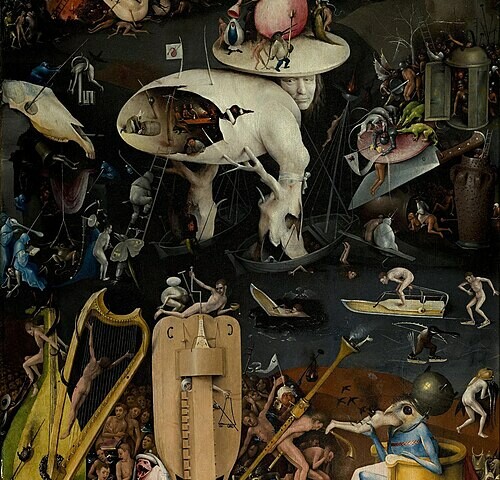
(As we meditate on this day on Christ’s burial, and His descent into hell, it is fitting to ponder here with contributor Peter Marcus how the world seems to be heading there as well. The difference is that, although God cannot ‘redeem’ hell, nor those therein, He can and did redeem the world. There is[…]Continue reading→