
Saint Anthony the Great’s Wisdom and Guidance
On January 17th, the universal Church celebrated the liturgical memorial of St Anthony the Great or as is commonly known, St Anthony of Egypt. This father of all monks and of Christian monasticism has much to say to our own troubling times we are living in.
He was born around the year 251 AD at Coma, near Heracleopolis Magna in Fayum, more or less 15 km west of the modern city of Beni Suef, in the Beni Suef Governorate of Egypt. Anthony was an illiterate son of wealthy parents. At the age of twenty, upon his parents’ death, they left him a large inheritance. In the words of Saint Athanasius, his biographer, here is how he answered to Christ’s call and followed him completely :
“Now it was not six months after the death of his parents, and going according to custom into the Lord’s House, he communed with himself and reflected as he walked how the Apostles (Matt 4:20) left all and followed the Savior; and how they in the Acts (Acts 4:35) sold their possessions and brought and laid them at the Apostles’ feet for distribution to the needy, and what and how great a hope was laid up for them in heaven. Pondering over these things he entered the church, and it happened the Gospel was being read, and he heard the Lord saying to the rich man (Matt 19:21), ‘If you wish to be perfect, go, sell what you have and give to [the] poor, and you will have treasure in heaven. Then come, follow me.’ Antony, as though God had put him in mind of the Saints, and the passage had been read on his account, went out immediately from the church, and gave the possessions of his forefathers to the villagers … that they should be no more a clog upon himself and his sister. And all the rest that was movable he sold, and having got together much money he gave it to the poor, reserving a little however for his sister’s sake.
Upon doing this heroic thing, Anthony left to lead an ascetic life, putting his sister into a convent to be brought up with known and faithful virgins.
In those days it has been a custom among Christians to adopt an ascetical life, abstain from marriage and practice self-denial, fasting, prayer, and works of piety, within the family milieu. As time passed by, in Egypt, similar ascetics dwelt in huts, on the fringes of the towns and villages. As we know, this was the prevalent custom in the late third century, when Anthony left the world. He started practicing ascetical life in this way without leaving his native place. He visited different ascetics, pondered upon their lives, and try to learn from each of them the virtue in which he saw they excelled.
Later on made as his dwelling place one of the tombs near his native village. It was precisely here that, as we find in Athanasius’ Life speaks about strange conflicts with demons in the form of wild beasts who inflicted blows upon him and sometimes left him almost dead. According to Athanasius, the devil fought Anthony by afflicting him with boredom, laziness, and the phantoms of women. However, Anthony overcame the devil’s attacks thanks to the power of prayer.
After living fifteen years of this life, at thirty-five, Anthony withdrew resolutely from the habitations of men and went into absolute solitude. Thus, he crossed the Nile, and on a mountain near the east bank, then called Pispir, now Deir el Memum, across from Faiyum, he found an old fort and lived in it for twenty years away from people. His life story tells us that food was thrown to him over the wall. Slowly slowly, a group of ascetics came to him and begged Anthony to be their spiritual guide. Around the year 305, Anthony yielded to their requests
For five or six years he Anthony dedicated himself to the instruction and organization of the great body of monks that grew around him. Nevertheless he then once more retired into the inner desert that lay between the Nile and the Red Sea, near the shore of which he fixed his dwelling on a mountain where today is the monastery that carries his name, Deir Mar Antonios, the Monastery of St. Anthony. In this place, Anthony spent the last forty-five years of his life, in a seclusion, not as strict as Pispir, because he intentionally saw his visitors.
Anthony died at the age of a hundred and five. It was St Jerome who placed his death in 356-357. Following his wish, his grave was kept secret by the two disciples who buried him, lest his body should become an object of reverence.
This great humble monk left us an impressive corpus of spiritual wisdom and knowledge which still has much to say to us today. I would like to share with you some of his spiritual pearls, the first fruits of his spiritual and life experience with God. We are going to limit ourselves to some of these gems.
St Anthony teaches us of the immense power of prayer, sacrifices, humility and the making of the Sign of the Cross to overcome devil’s temptations. He said: The devil is afraid of us when we pray and make sacrifices. He is also afraid when we are humble and good. He is especially afraid when we love Jesus very much. He runs away when we make the Sign of the Cross.
Humility is the leading virtue to God’s heart. This applies to everyone, including, and first and foremost, to those in authority. He used to say: Learn to love humility, for it will cover all your sins. All sins are repulsive before God, but the most repulsive of all is pride of the heart. Do not consider yourself learned and wise; otherwise, all your efforts will be destroyed, and your boat will reach the harbor empty. If you have great authority, do not threaten anyone with death. Know that, according to nature, you too are susceptible to death, and that every soul sheds its body as its final garment.
For Anthony, if we really want to know who we are let us know ourselves before God. Anthony tells us: One who knows oneself, knows God: and one who knows God is worthy to worship Him as is right. Therefore, my beloveds in the Lord, know yourselves.
Anthony’s prophetic insight was remarkable. Already from the third century he was able to read our times. This is so true in this quote: A time is coming when men will go mad, and when they see someone who is not mad, they will attack him, saying, ‘You are mad; you are not like us.
Finally, Anthony was well aware that to enter the Kingdom of Heaven we need to pass from the narrow gate. Before his eyes he had this Matthean text when Jesus said: The gate is narrow and the way is hard, that leads to life, and those who find it are few (Matt 7:14). That is why he told us: Whoever has not experienced temptation cannot enter into the Kingdom of Heaven. Without temptations no-one can be saved.
O God, who brought the Abbot St Anthony to serve you by a wondrous way of life in the desert, grant, through his intercession, that, denying ourselves, we may always love you above all things. Through our Lord Jesus Christ, your Son, who lives and reigns with you in the unity of the Holy Spirit, one God, for ever and ever. Amen.
A Closed, Unsustainable, Descending Loop
As a follow-up to my thoughts on Payette’s payout, here be a stark image of where are here in Canada. As the graph shows in, well, graphic terms, since 2025, the public sector has contributed to 95.5% of economic growth. The private sector – which funds the public sector, or is supposed to – has[…]Continue reading→
Presidential Pardon of Weronika Krawczyk
As a good news, follow-up to our story from Poland, of the persecution of Weronika Krawczyk for her pro-life views, we heard that she has been granted a presidential pardon. One might still wonder why one needs a presidential pardon for simply holding the long-held belief that the child within the womb is a child,[…]Continue reading→
Pope Leo and a Rosary for Peace
Pope Leo XIV has asked Catholics across the world to join him in a Rosary for peace today, at 18:00 Rome time (6 pm), which would be noon from where I write (EST). If you are able, whether at that time or another, and in whatever way you pray, to join in intercession with the[…]Continue reading→
Payette’s Payout
I was glancing through some headlines, and noticed a mention of Julie Payette – engineer and astronaut and sometime the Queen’s representative in Canada – which brought back vague memories. She was appointed Governor-General by Justin Trudeau in 2017. Ms. Payette resigned in 2021, amidst claims that she created a ‘toxic work environment’, with allegations[…]Continue reading→
Weronika Krawczyk and Injustice in Poland
Catholic Action in Poland has issued a formal statement appealing to the President of the Republic of Poland to pardon Weronika Krawczyk—convicted for warning other women against an abortion-performing gynaecologist. Catholic Action (AK) emphasizes that no apology is owed to a doctor who has performed numerous abortions and proposed others; furthermore, the organization considers the[…]Continue reading→
Saint Isidore of Seville, the Internet and Industriousness
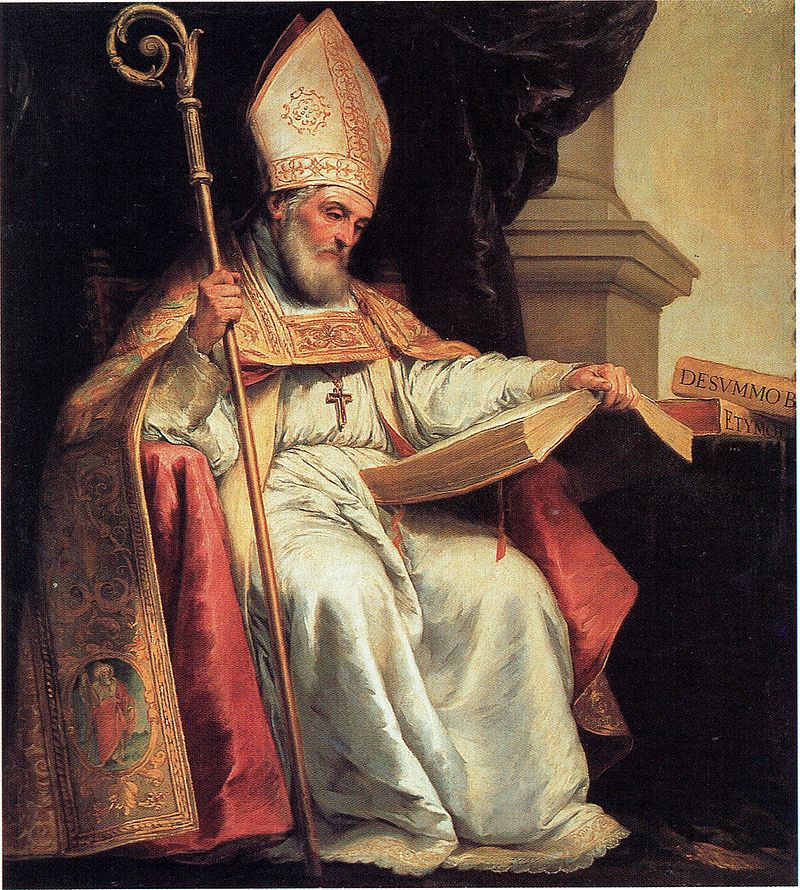
Today, April 4th, muted this year by Holy Saturday, is the commemoration of Saint Isidore of Seville (560-636) a bishop and doctor of the Church during a tumultuous age, when civilization was crumbling, coming apart at its very seams, which may sound sort of au courant. Then again, the form of this world has always[…]Continue reading→
Bishop Fulton Sheen’s 58th Good Friday Reflection
Incredible, at the beginning of this reflection, that the Venerable Bishop Sheen declares that he has given nearly 58 Good Friday reflections – this, as far as I can gather, was his final one, and he seems in full vigour in mind and body. The good bishop and evangelist died in his 84th year on[…]Continue reading→
A Minimal Friar and the Death of a Great Pope
This April the second- overshadowed by Holy Thursday this year – marks the memorial of Saint Francis of Paola (1417-1507), founder of the ‘Minim’ friars, so called for their humility and poverty, who interpreted the rule of Saint Francis of Assisi in quite a literal sense: extreme poverty, trust in God, foregoing all animal and[…]Continue reading→
Woven versus Seamless Garments
The reflection on the worthy project by Magie Dominic was intriguing, and I thought I would offer a brief follow-up commentary. The garment woven out of many pieces is a poignant symbol, even a ‘sacramental’, inspired by prayer and grace. We are all united in some way, and should strive for such unity, wherever we[…]Continue reading→
Bill C-9: Prelude to Persecution?
Well, it happened, as I suppose was inevitable, at least in a secular sense (from God’ perspective, there’s always hope). Bill C-9, the ironically named ‘Combatting Hate Act’ passed the House of Commons with a 186-137 vote. Look on the good side – there’s still over a hundred sane people in parliament who believe in[…]Continue reading→