
The Cappadocians and the Last Days
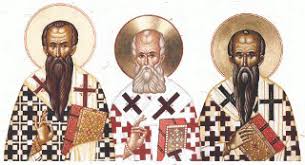
Today’s fourth-century saints, Saints Basil of Caesarea (+379) and Gregory of Nazianzen (+389), comprise, together with Basil’s brother Gregory of Nyssa (+395), the trio known as the Cappadocian Fathers, from the region now in modern Turkey whence they hailed. Gregory’s sister Macrina had turned the family estate into a monastery, and they dedicated their lives and their profound theological and spiritual writings – some of the most profound and rich in the whole patristic tradition – to the truths of God, as Trinity, and to the Word made flesh, most pointedly against the heresy of Arius, who denied that Christ was truly divine and truly God. See Pope Benedict’s excellent summary of the lives of these two Fathers and Doctors of the Church.
The first two ecumenical councils, at Nicaea (325) and Constantinople (381), clarified, and declared dogmatically that Christ was homoousios with the Father, consubstantial, the ‘same substance, being, nature’, God from God, Light from Light, true God from true God.
Everything really hinges upon this truth, for without Christ, we are without faith, without hope, without charity, without music, without joy. The world would be in the fearful and oppressive grip of the Antichrist, as much of it already is; and his reign is extending.
The birth of the Saviour on Christmas morn is also the ushering in of the ‘last days’, however long these last days last – so far, two millennia, two decades and counting; for even though a thousand years is as a day to God, the world is moving inexorably towards its final and definitive apocalypse, or, as the Greek term implies, an unveiling, revelation, of God’s final purpose.
That is why the Christmas readings from Saint John’s letters emphasize this apocalyptic struggle between good and evil, both in the exterior sense but, more importantly, in our own hearts and souls. Will we have faith and hope, and will we show charity to God and to each other? As Christ predicted, towards the end, charity will grow cold, people will even begin to hate each other, and He even asks whether He will find any faith at all on earth….
The three theological virtues stand or fall together, and I would recommend Josef Pieper’s excellent treatise. Their basis and unity are found in Christ, the way, the truth and the life. As the declaration from the Congregation of the Doctrine of the Faith, Dominus Jesus reminds us (published quite fittingly in the millennial year, August 6, 2000) He, the historical, real Jesus Christ, is the only path to heaven, outside of Whom there is no salvation.
Hence, Saint John warns us of the spirit of Antichrist, whose central heresy is that the Christ did not come in the flesh, that God did not become Man. But if there is no Incarnation, then there is no link between heaven and earth, and no salvation, at least none outside of this world. We would be stuck in a secular ‘Truman show’, with despair the order of the day. If that is the case, as Saint Paul writes, manducemus et bibamus, cras enim moriemur – Let us eat and drink, for tomorrow we may die.
That is why the Catechism teaches that the Antichrist will offer us a very tempting ‘secular messianism’, a false redemption that fulfils only the desires, one might says the lusts, of this ‘age’ (saecula), food, drink, sex, peace and an easy and soft retirement – no, forget retirement, which is too expensive, and who wants all those useless eaters around? Just an easy and soft death by euthanasia, after surfeit ceases to satisfy, if not before. Of course, there will be conditions: Just sign right here, renounce your faith in that whole God-become-Man Christ myth, and all manner of things will be well…
Saint John also writes that just as the definitive, and rather mysterious, Antichrist will come, ushering in the final battle between light and darkness, and the “final unleashing of evil”, so too many antichrists have already come, every time one denies Christ and the truth He has revealed. In fact, each sin is a manifestation of these little ‘antichrists’, lurking like an incipient spiritual cancer within all our hearts.
Whatever virtues one may want to ascribe to other non-Christian religions, and the Vatican declaration Nostrae Aetate teaches they all have some truth and goodness, they are all rather clear that, whatever else He was, Christ was and is not God. Islam, paganism, socialism, communism, secularism, atheism, agnosticism, relativism, scientism, materialism, hedonism, nazism, all have the ‘spirit of antichrist’ lurking within their limited and limiting weltenschauungs.
We are made for so much more! The full and liberating spirit of Christ, immersing ourselves in the truth, in prayer, in hope and charity and good works, in following the Master, even if all seems dark, oppressive and contrary to the many good things the world offers; even if we have to give up everything, including our lives; for the Antichrist will demand many sacrifices in his own self-worship, in contradistinction to the self-gift of the true Christ. Types of this embodiment of the evil one have already done so in their slaughter of myriads of martyrs.
But the light shines in the darkness. In these Christmas days, peruse the Gospel and the letters of the beloved Apostle, renew your faith in Christ, in His Church, in all that it means to be Christian and Catholic. For the spirit of Antichrist can only seduce us if we let go of Christ, and we turn away from the very face of God.
With the psalmist, cry out, Let your face shine upon us, O Lord, for we have put our trust in thee.
For if Christ is for us, who can be against?

Carney’s Amoral Majority
After five defections – euphemistically described as ‘crossing the floor’ – and three by-elections, Mark Carney and his Liberals how have their coveted majority. One wonders what bowls of pottage were offered in back-room deals. In the archaic monarchical system that is the Dominion of Canada, this majority allows the newly-minted Prime Minister to rule[…]Continue reading→

Saint Kateri , Canada’s Protectress
This was the title given to Saint Kateri Tekakwitha, by Pope Benedict XVI, when he canonized her on October 28th, 2012, along with six others, in Saint Peter’ Square (she had been beatified by Pope John Paul II back in 1980). With Saint Joseph as our protector, along with the Canadian martyrs, we seem to[…]Continue reading→

A Tale of Two Benedicts
A grace-filled Holy Week to all our readers! As we await and prepare for the Resurrection about to dawn upon us, we might keep in mind two Benedicts: Pope Emeritus Benedict XVI, requiescat in pace, elected on this day in 2005; and today’s commemoration of the mystic pilgrim, Benedict Joseph Labre, who died on this[…]Continue reading→

My Name is Bernadette
April 16th is a propitious day, for besides the anniversary of Father de Valk’s death, who founded Catholic Insight in its print form decades ago, and the commemoration of the ‘two Benedicts’, mentioned in accompanying posts, today we also recall Saint Bernadette Soubirous, the young visionary to whom the Virgin Mary appeared numerous times at[…]Continue reading→

Saint Lydwina of Schiedam and Suffering Joyfully
Saint Lydwina of Schiedam (1380 – 1433) was one of the countless and glorious ‘victim souls’ in the history of the Church, those whose lives are filled with suffering, often of an unimaginable intensity, but who suffer joyfully. She was a fifteen-year old Dutch girl, out skating one day, when she fell and broke one[…]Continue reading→

The Glorious Martyrdoms of Martin and Maximus
As we enter into Eastertide, we recall on this 13th of April Pope Saint Martin I (+655), one of the noblest, if most tragic, of the successors of Saint Peter. Born in Umbria, Italy, he was of noble lineage, with great intelligence combined with charity and love of the poor and the Church. While still[…]Continue reading→

Saint Stanislaus of Szczepanów
We celebrate Saint Stanislaus today (+ April 11, 1079), in light of this Easter Octave, a bishop and martyr who accepted the episcopacy only at the direct order of Pope Alexander II. He proved a wise and courageous leader of his flock, put to death by his own king, Boleslaus, for rebuking the monarch’s ‘immoral[…]Continue reading→
Saint Gemma Galgani
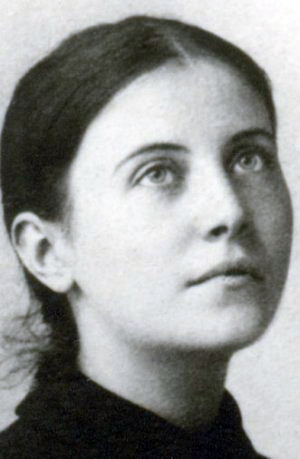
On this April 11th, in 1903 – the same year that the Italian Guiseppe Sarto was elected Pope later that summer as Pius X – a lovely, young Italian woman died, by the name of Gemma Galgani. She lived a brief life of 24 years, as did a number of other young saints, including Pier[…]Continue reading→
An Ideological and Improper Translation
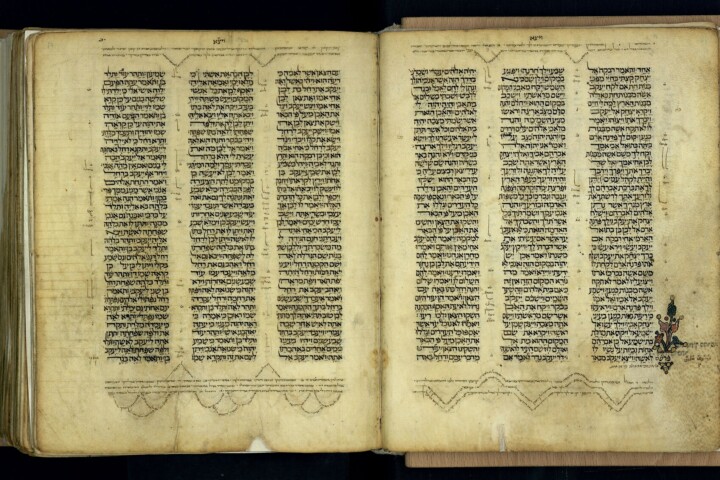
I noticed something odd with the psalm reading at Mass the other day. Our bishops’ conference here in Canada has decreed that the Mass in English – Novus Ordo – use the ‘NRSV’, the ‘New Revised Standard Version’, an ‘updated’ translation of the original RSV, first published in 1952. This ‘new translation’ has the tendency[…]Continue reading→
Saint Jean-Baptiste de la Salle: A Teacher for Teachers
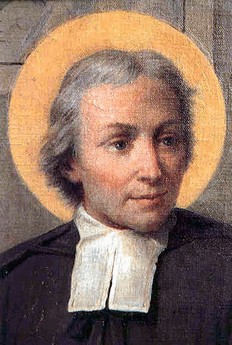
Jean-Baptiste de la Salle (1651 – 1719), a French nobleman, ordained a priest, founded the first order in the Church’s history entirely without priests, and this came about almost by accident. I say ‘almost’, for, of course, there are no accidents with God. Destined for ordination from an early age, Jean-Baptiste never looked back, even[…]Continue reading→