
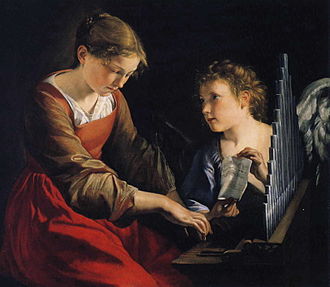
Saint Caecelia and What Church Music Should Be
As the patroness of Church music, and music in general, Saint Caeceilia has her work cut out for her. A young virgin martyr in Rome, put to death either in the late second or early third century, she was married, against her will, during which ceremony she ‘sang in her heart to the Lord‘. For that one phrase, she was adopted as the patroness of music. Her husband, by the way, according to the tradition, respected her wish to remain a virgin, and was himself baptized after a vision of the angel protecting Caecelia was granted to him.
So the story goes, which may or may not be historical. What is historical and real is her patronage of Church music, which, alas, is now much needed, as it is in a sad, even in too many places deplorable, condition.
This is not the fruit of Vatican II, which had this to say about Church music in its Constitution on the Sacred Liturgy (Sacrosanctum Concilium):
The musical tradition of the universal Church is a treasure of inestimable value (pretii inaestimabilis), greater even than that of any other art.
That is saying something, given the ‘inestimable value’ of all the rest of the Church’s art, paintings, cathedrals, sculptures, mosaics, sumptuous vestments, golden chalices and so on and on, ad maiorem Dei gloriam. Yet how much of that ‘musical treasure’ remains locked away, all the chants, the motets, the glorious traditional hymns, with their rhythmical and deeply theological Latin poetry, gathering dust as the ages go by?
The main reason for this pre-eminence is that, as sacred song united to the words, it forms a necessary or integral part of the solemn liturgy.
The value of the Church’s music is not something it holds on its own, but rather as part of the public worship of God in the Liturgy. Without music, such worship is lessened and attenuated; with tawdry, discordant or just downright banal music, liturgy is in proximate danger of being distorted, even vitiated.
Therefore sacred music is to be considered the more holy in proportion as it is more closely connected with the liturgical action, whether it adds delight to prayer, fosters unity of minds, or confers greater solemnity upon the sacred rites.
There is a gradation in ‘good’ Church music, from the most perfect, to the lesser so, to the stuff that should never be heard anywhere near a Church. Ecclesiastical music should be ‘holy’, should lift our hearts and minds above and beyond the secular world, into the consecrated spiritual oasis that is the Liturgy, and especially the Holy Mass. God in His wisdom and providence has given us a music set aside for such a purpose that goes back to the very dawn of the Church:
The Church acknowledges Gregorian chant as specially suited to the Roman liturgy (ut liturgiae romanae proprium): therefore, other things being equal, it should be given pride of place (principem locum) in liturgical services
Notice the term ‘specially suited’, which in the original Latin is ‘proprium‘: Gregorian chant is proper to the Roman liturgy, which means it belongs there as part of its very nature, and something is sorely missing without it.
Of course, other music adds also to the splendour of the Liturgy, “especially polyphony” as the document states, with composers such as Palestrina, Bach, Mozart, Tallis, Byrd, whose music is heard, sadly, now by and large only in secular concert halls, or in churches outside of Liturgy.
And what of instruments?
In the Latin Church the pipe organ is to be held in high esteem (magno in honore habeatur), for it is the traditional musical instrument which adds a wonderful splendor to the Church’s ceremonies and powerfully lifts up man’s mind to God and to higher things.
I have had the pleasure and honour of hearing many fine organs, but, alas, too many churches have either ripped them out, or let them languish, unplayed. As the great J. S. Bach put it, a Lutheran, but in many fundamental ways with more Catholic sensibilities than most in that age of religious strife, the organ is the ‘instrument of instruments’, requiring years of dedication to play to full effect. Yet how many churches pay their secretaries and maintenance men well, with full benefits, but hire no one to direct music? Or employ someone whose ‘skill set’ extends to four or five chords on a guitar, perhaps a few minor falls and a major lift or two, belting out emotional ballads, making up in volume and angst for whatever else is lacking?
If music really is the most important accoutrement to Liturgy, should we not devote more time and effort and, yes, money, to it? Speaking as one of ‘limited talent’, we should have done with volunteers-only music at Mass. ‘At least they’re doing something’ should not excuse tawdry or kitsch or discordant music. If someone cannot sing or play well, then they should not. There are many other charisms in the Church besides music, and glorious silence, following a recent exhortation by Cardinal Sarah, is better than listening to cacophany.
There is a phrase attributed to Saint Augustine, which he seems not to have said exactly, ‘qui bene cantat, bis orat‘, he who sings well, prays twice. (What the great bishop really said was something to the effect that he who sings with love… but the gist is there, for to love is to will the good of the other, including the good of good music).
The Constitution does admit that “other instruments also may be admitted for use in divine worship”, but “only on condition that the instruments are suitable, or can be made suitable, for sacred use, accord with the dignity of the temple, and truly contribute to the edification of the faithful“.
Ah, there we are again, with the ‘apt for sacred use’. Such ‘other instruments’ should not be those we hear in the secular realm, banjos, bongos, drums and guitars (and there is indeed nothing wrong with them in their own right time and place).
Rather, music and its instruments should be ‘liminal’, allowing us, the listeners, to transcend the ‘threshold’ of the passing form of this world, giving us a brief auditory glimpse into heaven, fitting for the dignity of God’s temple, leading us to holiness. How often have we left Mass unedified, emotionally drained, and all-too-un-exalted, forced to discern with the sheer force of our intellect and will the great beauty of the Liturgy hiding and obscured behind such banality, or at least secularity, that often passes for modern Church music? As one musician recently put it, and I paraphrase, we are leaving the expensive china and silverware in the cupboard, and serving up the best dishes to God and His people on musical styrofoam and paper plates.
So, dear reader, please do strive in your own way to re-appropriate the great and inestimable musical treasure of the Church, by attending good Liturgy, getting involved yourself, learning how to sing and play, and at least learning to appreciate all that is true, good and beautiful in the music handed down to us through the ages of the Church. Doing so is a bit of work at first, but one that is well, well worth the cost. In fact, I am not sure how far we will get without it.
Saint Caecelia, ora pro nobis!

Carney’s Amoral Majority
After five defections – euphemistically described as ‘crossing the floor’ – and three by-elections, Mark Carney and his Liberals how have their coveted majority. One wonders what bowls of pottage were offered in back-room deals. In the archaic monarchical system that is the Dominion of Canada, this majority allows the newly-minted Prime Minister to rule[…]Continue reading→

Saint Kateri , Canada’s Protectress
This was the title given to Saint Kateri Tekakwitha, by Pope Benedict XVI, when he canonized her on October 28th, 2012, along with six others, in Saint Peter’ Square (she had been beatified by Pope John Paul II back in 1980). With Saint Joseph as our protector, along with the Canadian martyrs, we seem to[…]Continue reading→

Remembering Father Alphonse de Valk
(Today marks the sixth anniversary of the death of Father Alphonse de Valk, C.S.B., a faithful, courageous and indefatigable Basilian priest, pro-life-and-family apostle, and the founder of Catholic Insight magazine. Here is what we wrote those on his entering into eternity five years ago, as we continue to remember him in our prayers and thoughts)[…]Continue reading→
A Tale of Two Benedicts
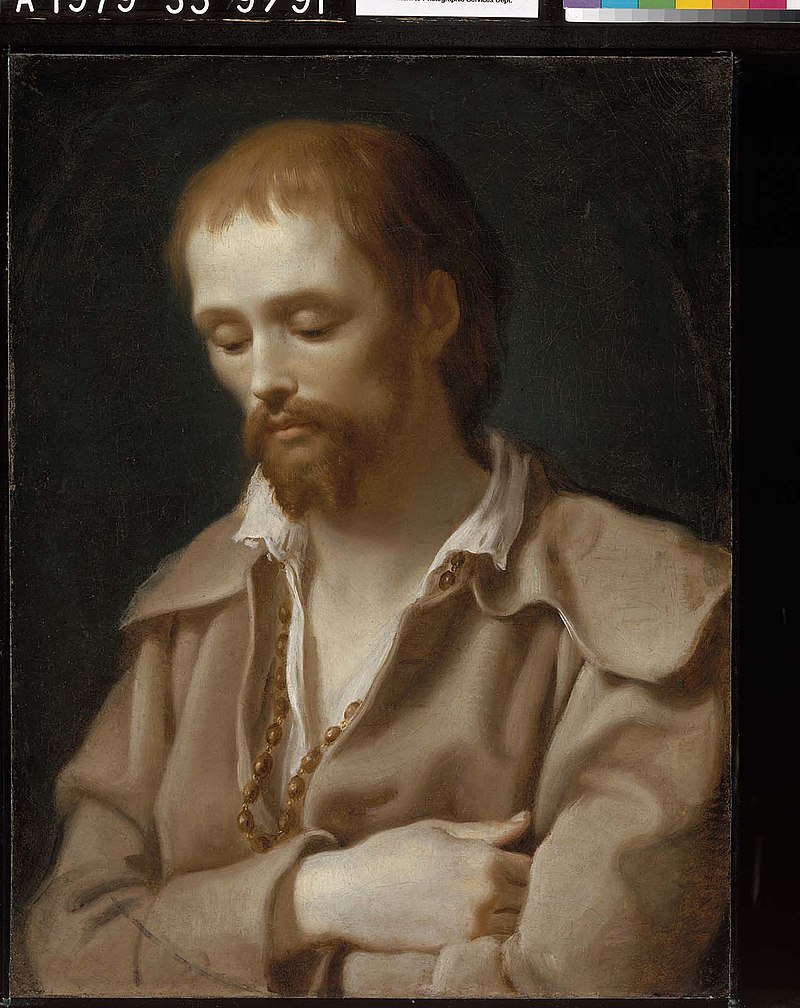
A grace-filled Holy Week to all our readers! As we await and prepare for the Resurrection about to dawn upon us, we might keep in mind two Benedicts: Pope Emeritus Benedict XVI, requiescat in pace, elected on this day in 2005; and today’s commemoration of the mystic pilgrim, Benedict Joseph Labre, who died on this[…]Continue reading→

My Name is Bernadette
April 16th is a propitious day, for besides the anniversary of Father de Valk’s death, who founded Catholic Insight in its print form decades ago, and the commemoration of the ‘two Benedicts’, mentioned in accompanying posts, today we also recall Saint Bernadette Soubirous, the young visionary to whom the Virgin Mary appeared numerous times at[…]Continue reading→
Saint Lydwina of Schiedam and Suffering Joyfully
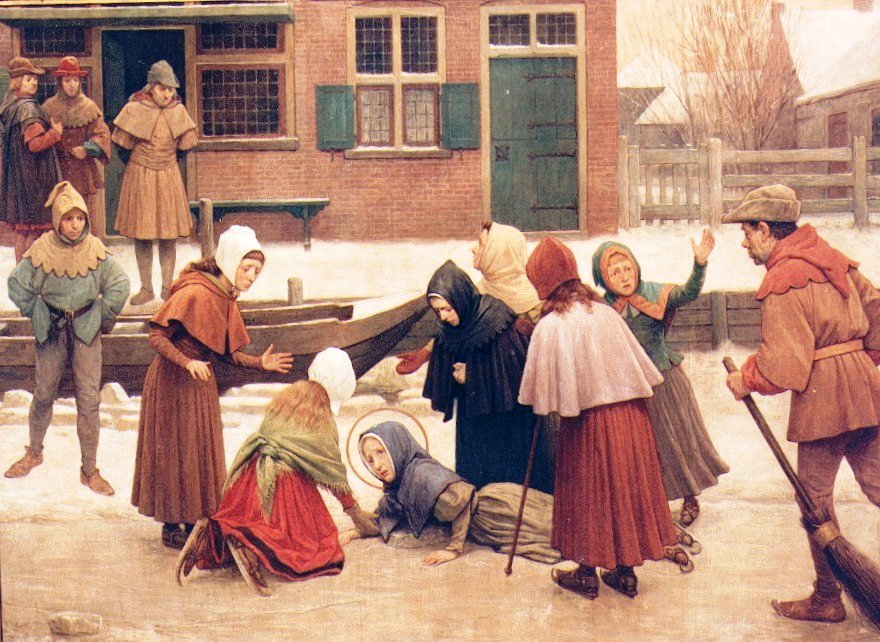
Saint Lydwina of Schiedam (1380 – 1433) was one of the countless and glorious ‘victim souls’ in the history of the Church, those whose lives are filled with suffering, often of an unimaginable intensity, but who suffer joyfully. She was a fifteen-year old Dutch girl, out skating one day, when she fell and broke one[…]Continue reading→
The Glorious Martyrdoms of Martin and Maximus
As we enter into Eastertide, we recall on this 13th of April Pope Saint Martin I (+655), one of the noblest, if most tragic, of the successors of Saint Peter. Born in Umbria, Italy, he was of noble lineage, with great intelligence combined with charity and love of the poor and the Church. While still[…]Continue reading→

Divine Mercy Sunday – An Echo of Every Mass
Reach out your hand and put it in my side. Do not doubt but believe’… ‘My Lord and my God!’ (Jn. 20:18)). Today is Divine Mercy Sunday, and as we celebrate the end of the Easter Octave, we contemplate the wounded side of our Saviour, the Church’s source of life. On Good Friday in the[…]Continue reading→

Saint Stanislaus of Szczepanów
We celebrate Saint Stanislaus today (+ April 11, 1079), in light of this Easter Octave, a bishop and martyr who accepted the episcopacy only at the direct order of Pope Alexander II. He proved a wise and courageous leader of his flock, put to death by his own king, Boleslaus, for rebuking the monarch’s ‘immoral[…]Continue reading→

Saint Gemma Galgani
On this April 11th, in 1903 – the same year that the Italian Guiseppe Sarto was elected Pope later that summer as Pius X – a lovely, young Italian woman died, by the name of Gemma Galgani. She lived a brief life of 24 years, as did a number of other young saints, including Pier[…]Continue reading→
One thought on “Saint Caecelia and What Church Music Should Be”
Comments are closed.
“How shall we sing the song of the Lord in strange land? If I forget thee, O Jerusalem, let my right hand be forgotten”
Yes, but I would add the absence of the psalms, or even the secularization of the psalms through current forms of music (By the Rivers of Babylon, etc.), is a major problem. Too often people want to “get something out of the Liturgy,” or in other words, seek pleasure and enjoyment from the Liturgy. With this view of the liturgy instead of a recognition of the Liturgy as submission to God through worship as He revealed fitting, music naturally goes downhill. You cannot sing the songs of the Lord in a strange land, and so that which is sacred is replaced by that which is more pleasing to us. I think we must turn back to a recognition of the proper place of the psalms in the Liturgy and these inspired songs will reform our intellects to recognize music which is fitting to the Liturgy, and, for that matter, will someday bring about the reformation of the Liturgy in general which the Church has long been awaiting. I guess, for now, many of us will have to seek the psalms in the Liturgy of the hours while we are awaiting there proper revival in the Mass, and perhaps attend the Traditional Liturgy as possible.