
Saint Brigdet of Sweden: Co-Patroness of Europe
Saint Brigdet of Sweden was born in 1303 at Finsta in the Swedish region of Uppland, from an aristocratic family. This great medieval mystic of the Church and foundress of the Order of the Most Holy Saviour, teaches us that family life and marriage lived in Christ are paths to holiness, the first cradle wherein one is taught the lesson of conforming oneself to the Lord. For this very reason Pope Saint John Paul II purposely chose Saint Bridget of Sweden as one the three Co-Patroness of Europe because in her life in the world as a married woman and a mother of eight children she undertook with great commitment her calling for holiness.
In his apostolic letter issued as motu proprio proclaiming Saint Bridget of Sweden, Saint Catherine of Siena and Saint Teresa Benedicta of the Cross as Co-Patronesses of Europe on October 1, 1999, Spes Aedificandi, Pope Wojtyla wrote:
In naming her a Co-Patroness of Europe, I would hope that not only those who have received a vocation to the consecrated life but also those called to the ordinary occupations of the life of the laity in the world, and especially to the high and demanding vocation of forming a Christian family, will feel that she is close to them. Without abandoning the comfortable condition of her social status, she and her husband Ulf enjoyed a married life in which conjugal love was joined to intense prayer, the study of Sacred Scripture, mortification and charitable works. Together they founded a small hospital, where they often attended the sick. Bridget was in the habit of serving the poor personally. At the same time, she was appreciated for her gifts as a teacher, which she was able to use when she was required to serve at Court in Stockholm. This experience was the basis of the counsel which she would later give from time to time to princes and rulers concerning the proper fulfilment of their duties. But obviously the first to benefit from these counsels were her children, and it is not by chance that one of her daughters, Catherine, is venerated as a Saint (no.4).
Certainly such a holy example given to us by Saint Bridget acts as a powerful and persuasive invitation to families to let God’s Spirit sanctify them. In his post-synodal apostolic exhortation on Jesus Christ alive in his Church the Source of Hope for Europe, Ecclesia in Europa, of 28 June 2003, Pope Saint John Paul II wrote: Families should be encouraged to make time to pray together, and thus to interpret the whole of marriage and family life in the light of the Gospel. In this way, starting in the family and in hearing the word of God, a domestic liturgy will gradually emerge, which will then mark every event in the life of the family (no.78).
In her second part of her life, Saint Brigdet had the grace of pursuing her calling to consecrated life. In fact, right after that she made her pilgrimage to Santiago de Compostela in 1341, accompanied with her husband, unwittingly she was introduced to another vocation, or a vocation within a vocation. At the shrine, Brigdet heard Christ’s voice, recognized it and believed in the mission he laid before her, gradually leading her through a series of mystical graces. After her husband Ulf died she left Sweden in 1349 and settled in Rome, wherein she kept evolving not merely culturally or geographically but, and most of all, spiritually. Brigdet understood that her mystical journey needed to be nourished by the profound love he had for Christ as a person and the mystical Christ as present in his Church.
In his apostolic letter Spes Aedificandi, Pope Saint John Paul II tells us: In her desire to venerate the relics of saints, she went on pilgrimage to many places in Italy. She visited Milan, Pavia, Assisi, Ortona, Bari, Benevento, Pozzuoli, Naples, Salerno, Amalfi and the Shrine of Saint Michael the Archangel on Mount Gargano. Her last pilgrimage, made between 1371 and 1372, took her across the Mediterranean to the Holy Land, enabling her to embrace spiritually not only the many holy places of Catholic Europe but also the wellsprings of Christianity in the places sanctified by the life and death of the Redeemer (no. 5).
In his catechesis on Saint Briget of Sweden on Wednesday 27 October 2010, Pope Benedict XVI gave us an interesting summary of this Scandinavian saint and mystic’s Revelations.
St Bridget’s Revelationshave a very varied content and style. At times the revelations are presented in the form of dialogues between the divine Persons, the Virgin, the Saints and even demons; they are dialogues in which Bridget also takes part. At other times, instead, a specific vision is described; and in yet others what the Virgin Mary reveals to her concerning the life and mysteries of the Son. The value of St Bridget’s Revelations, sometimes the object of criticism Venerable John Paul II explained in his Letter Spes Aedificandi: “The Church, which recognized Bridget’s holiness without ever pronouncing on her individual revelations, has accepted the overall authenticity of her interior experience” (n. 5). Indeed, reading these Revelations challenges us on many important topics. For example, the description of Christ’s Passion, with very realistic details, frequently recurs. Bridget always had a special devotion to Christ’s Passion, contemplating in it God’s infinite love for human beings. She boldly places these words on the lips of the Lord who speaks to her: “O my friends, I love my sheep so tenderly that were it possible I would die many other times for each one of them that same death I suffered for the redemption of all” (Revelationes, Book I, c. 59). The sorrowful motherhood of Mary, which made her Mediatrix and Mother of Mercy, is also a subject that recurs frequently in the Revelations.
Let us cherish some powerful quotations from Saint Bridget of Sweden’s Revelations:
First, the source of justice is not vengeance but charity. Second, the world would have peace if only men of politics would follow the Gospels. Third, there is no sinner in the world, however much at enmity with God, who cannot recover God’s grace by recourse to Mary, and by asking her assistance. Fourth, to write well and speak well is mere vanity if one does not live well. Fifth, Mary is the lily in God’s garden. Sixth, let everyone who has the grace of intelligence fear that, because of it, he will be judged more heavily if he is negligent. Seven, O Mary, you give assistance to everyone endeavoring to rise to God! Eighth, let a man fear, above all, me, his God, and so much the gentler will he become toward my creatures and animals, on whom, on account of me, their Creator, he ought to have compassion. Nineth, For since mankind sinned in all limbs, my Son made atonement in all his limbs. His hair was pulled out, his sinews extended, his joints were dislocated, his bones mangled, and his hands and feet were pierced through. His mind was saddened, his heart afflicted by sorrow, his intestines was forced in toward his back, for mankind had sinned in all limbs.
If it is true that Bridget, as we find in the First Book of Revelations, truly lived Jesus’s calling to her when he told her:
My Daughter, I have chosen you for myself, love me with all your heart… more than all that exists in the world (c. 1) it is equally true that she lovingly shared these mystical revelations with a loving and respectful heart for the Church’s benefit and reform. As Pope Benedict rightly tells us in his catechesis: For this very reason many of her revelations were addressed in the form of admonishments, even severe ones, to the believers of her time, including the Religious and Political Authorities, that they might live a consistent Christian life; but she always reprimanded them with an attitude of respect and of full fidelity to the Magisterium of the Church and in particular to the Successor of the Apostle Peter.
May the holy life of Saint Bridget of Sweden help Europe and the entire world grow in holiness. Pope Saint John Paul II said it so well in Spes Aedificandi: Thus may Europe grow! May it grow as a Europe of the spirit, in continuity with the best of its history, of which holiness is the highest expression (no.10).
Let us pray with Saint Bridget for the peace of our hearts which all of us direly need.
O Lord, make haste and illumine the night. Say to my soul that nothing happens without You permitting it, and that nothing of what You permit is without comfort. O Jesus, Son of God, You Who were silent in the presence of Your accusers, restrain my tongue until I find what I should say and how to say it. Show me the way and make me ready to follow it. It is dangerous to delay, yet perilous to go forward. Answer my petition and show me the way. As the wounded go to the doctor in search of aid, so do I come to You. O Lord, give Your peace to my heart. Amen.
A Closed, Unsustainable, Descending Loop
As a follow-up to my thoughts on Payette’s payout, here be a stark image of where are here in Canada. As the graph shows in, well, graphic terms, since 2025, the public sector has contributed to 95.5% of economic growth. The private sector – which funds the public sector, or is supposed to – has[…]Continue reading→
Presidential Pardon of Weronika Krawczyk
As a good news, follow-up to our story from Poland, of the persecution of Weronika Krawczyk for her pro-life views, we heard that she has been granted a presidential pardon. One might still wonder why one needs a presidential pardon for simply holding the long-held belief that the child within the womb is a child,[…]Continue reading→
Pope Leo and a Rosary for Peace
Pope Leo XIV has asked Catholics across the world to join him in a Rosary for peace today, at 18:00 Rome time (6 pm), which would be noon from where I write (EST). If you are able, whether at that time or another, and in whatever way you pray, to join in intercession with the[…]Continue reading→
Payette’s Payout
I was glancing through some headlines, and noticed a mention of Julie Payette – engineer and astronaut and sometime the Queen’s representative in Canada – which brought back vague memories. She was appointed Governor-General by Justin Trudeau in 2017. Ms. Payette resigned in 2021, amidst claims that she created a ‘toxic work environment’, with allegations[…]Continue reading→
Weronika Krawczyk and Injustice in Poland
Catholic Action in Poland has issued a formal statement appealing to the President of the Republic of Poland to pardon Weronika Krawczyk—convicted for warning other women against an abortion-performing gynaecologist. Catholic Action (AK) emphasizes that no apology is owed to a doctor who has performed numerous abortions and proposed others; furthermore, the organization considers the[…]Continue reading→
Saint Isidore of Seville, the Internet and Industriousness
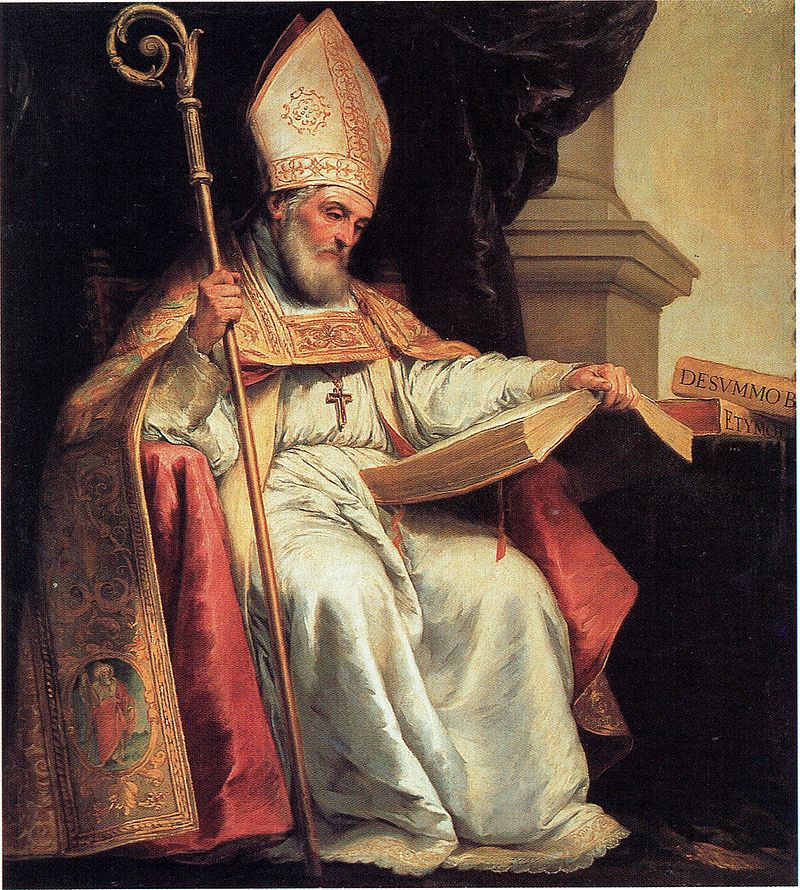
Today, April 4th, muted this year by Holy Saturday, is the commemoration of Saint Isidore of Seville (560-636) a bishop and doctor of the Church during a tumultuous age, when civilization was crumbling, coming apart at its very seams, which may sound sort of au courant. Then again, the form of this world has always[…]Continue reading→
Bishop Fulton Sheen’s 58th Good Friday Reflection
Incredible, at the beginning of this reflection, that the Venerable Bishop Sheen declares that he has given nearly 58 Good Friday reflections – this, as far as I can gather, was his final one, and he seems in full vigour in mind and body. The good bishop and evangelist died in his 84th year on[…]Continue reading→
A Minimal Friar and the Death of a Great Pope
This April the second- overshadowed by Holy Thursday this year – marks the memorial of Saint Francis of Paola (1417-1507), founder of the ‘Minim’ friars, so called for their humility and poverty, who interpreted the rule of Saint Francis of Assisi in quite a literal sense: extreme poverty, trust in God, foregoing all animal and[…]Continue reading→
Woven versus Seamless Garments
The reflection on the worthy project by Magie Dominic was intriguing, and I thought I would offer a brief follow-up commentary. The garment woven out of many pieces is a poignant symbol, even a ‘sacramental’, inspired by prayer and grace. We are all united in some way, and should strive for such unity, wherever we[…]Continue reading→
Bill C-9: Prelude to Persecution?
Well, it happened, as I suppose was inevitable, at least in a secular sense (from God’ perspective, there’s always hope). Bill C-9, the ironically named ‘Combatting Hate Act’ passed the House of Commons with a 186-137 vote. Look on the good side – there’s still over a hundred sane people in parliament who believe in[…]Continue reading→