
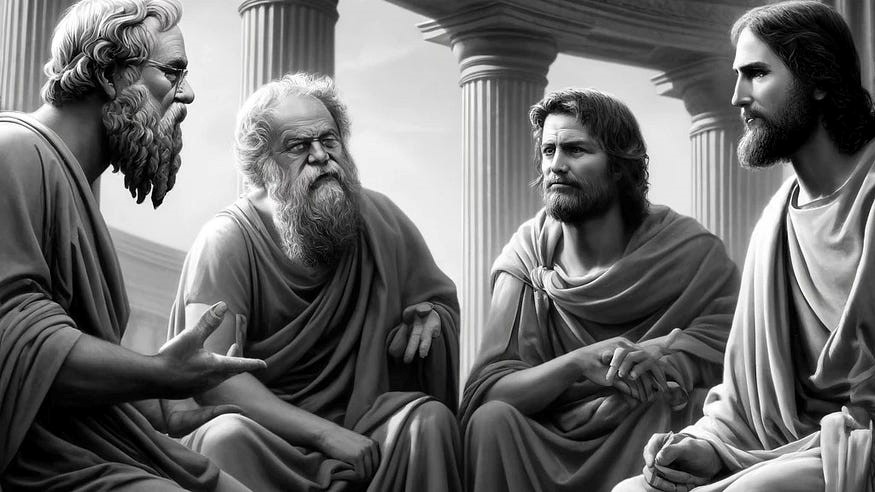
Briefly Testing Aristotle’s Golden Mean
“Virtue is the golden mean between two vices, the one of excess and the other of deficiency.” Aristotle
Scripture is full of exhortations to avoid all kinds of excesses. The Greek philosopher Aristotle (384-322 BC) who did not know scripture, authored the ethical notion called the golden mean, by which he argued that we should exercise moderation in all things. One should not eat or drink too much or too little. One should not work too hard or not at all. One should not love everyone or no one. Somewhere in the middle of all things is to be found our happiness. So far as this principle applies to how much or too little we should do things in the normal course of our lives, it is an adequate notion, yet it seems not to be a complete one.
For example, when it comes to deciding whether an act is intrinsically right or wrong, the principle of moderation is quite limited in application. Whether or not we should keep a promise, for example, does not depend on consulting the golden mean. There is no middle ground between keeping a promise and not keeping a promise. In this sense, Aristotle was not so great a moral philosopher as Jesus, whose simple “Do unto others as you would have them do unto you” applies to every possible moral act. We should keep our promises to others just as we would like them to keep their promises to us.
Another problem with the golden mean is that at times we might justifiably defy it with one excess or another. For example, if social unrest exists because social injustice is rampant, it is sometimes difficult to find a middle course for correcting the conditions that lead to unrest. A tyranny must sometimes be toppled with bloodshed, or it will not be toppled at all. As Thomas Jefferson liked to put it, “The tree of liberty must be refreshed from time to time, with the blood of patriots and tyrants.”
Perhaps Aristotle would reply, “Yes, but blood in moderation.” Then we have to ask, were the atomic bombs dropped on Hiroshima and Nagasaki dropped in a spirit of moderate bloodshed? Would those two atomic bombs have been the golden mean between four bombs and none? Or, more to the point if we are thinking as Jesus taught us to think, could we approve it as just warfare if Russia did to New York and Boston what America did to Hiroshima and Nagasaki?
Another flaw in Aristotle’s rule of the golden mean is that everything is subject to excessive desire that must be avoided. There can actually be a condition of excessive desire for some things. There are people who are by temperament inclined not to moderation, but to excess. Excess is built into their character for a variety of reasons, and the scope of such a person’s desires can hardly be limited without suppressing a natural and justifiable passion.
For example, a long time ago two brothers at Kitty Hawk, North Carolina desired to build an instrument that would make it possible to fly from one place to another. For most people in those days that dream was considered a preposterous (excessive) pursuit. If God wanted us to fly, many would say, He would have given us wings. So a judgment of moral fault is rendered against the men who have a passion for flying, or for traveling to the moon and even beyond. Therefore it seems a passion for moderation can put an immoderate damper on other passions that might pass for righteous, such as the desired goal preached by Jesus: “Be you perfect, even as your heavenly Father, which is in heaven, is perfect.” (Matthew 5:48)
Here is a sample of what others have said.
“A thing moderately good is not so good as it ought to be. Moderation in temper is always a virtue; but moderation in principle is always a vice.” Thomas Paine
“A wise man is superior to any insults which can be put upon him, and the best reply to unseemly behavior is patience and moderation.” Moliere
“Complete abstinence is easier than perfect moderation.” Saint Augustine
“Overstep the bounds of moderation and the greatest pleasures cease to please.” Epictetus
“There is moderation, even in excess.” Benjamin Disraeli
“Moderation is a fatal thing. Nothing succeeds like excess.” Oscar Wilde
“One can surely be far too evil. One can never be far too good.” Anonymous
“Don’t be too sweet, lest you be eaten up; don’t be too bitter, lest you be spewed out.” Jewish Proverb
“When the sword is once drawn, the passions of men observe no bounds of moderation.” Alexander Hamilton
“Everything in moderation, including moderation.” Anonymous

Saint Kateri , Canada’s Protectress
This was the title given to Saint Kateri Tekakwitha, by Pope Benedict XVI, when he canonized her on October 28th, 2012, along with six others, in Saint Peter’ Square (she had been beatified by Pope John Paul II back in 1980). With Saint Joseph as our protector, along with the Canadian martyrs, we seem to[…]Continue reading→

Remembering Father Alphonse de Valk
(Today marks the sixth anniversary of the death of Father Alphonse de Valk, C.S.B., a faithful, courageous and indefatigable Basilian priest, pro-life-and-family apostle, and the founder of Catholic Insight magazine. Here is what we wrote those on his entering into eternity five years ago, as we continue to remember him in our prayers and thoughts)[…]Continue reading→

My Name is Bernadette
April 16th is a propitious day, for besides the anniversary of Father de Valk’s death, who founded Catholic Insight in its print form decades ago, and the commemoration of the ‘two Benedicts’, mentioned in accompanying posts, today we also recall Saint Bernadette Soubirous, the young visionary to whom the Virgin Mary appeared numerous times at[…]Continue reading→

Canonizing Sister Faustina and Divine Mercy
HOMILY OF THE HOLY FATHER MASS IN ST PETER’S SQUARE FOR THE CANONIZATION OF SR MARY FAUSTINA KOWALSKA Sunday, 30 April 2000 1. “Confitemini Domino quoniam bonus, quoniam in saeculum misericordia eius”; “Give thanks to the Lord for he is good; his steadfast love endures for ever” (Ps 118: 1). So the Church sings on the Octave of[…]Continue reading→

Divine Mercy Sunday – An Echo of Every Mass
Reach out your hand and put it in my side. Do not doubt but believe’… ‘My Lord and my God!’ (Jn. 20:18)). Today is Divine Mercy Sunday, and as we celebrate the end of the Easter Octave, we contemplate the wounded side of our Saviour, the Church’s source of life. On Good Friday in the[…]Continue reading→

Saint Stanislaus of Szczepanów
We celebrate Saint Stanislaus today (+ April 11, 1079), in light of this Easter Octave, a bishop and martyr who accepted the episcopacy only at the direct order of Pope Alexander II. He proved a wise and courageous leader of his flock, put to death by his own king, Boleslaus, for rebuking the monarch’s ‘immoral[…]Continue reading→

First Holy Communion: Sermon from May 16, 1943
Here is a sermon from the good old days by +Rev. Msgr. Vincent Nicholas Foy (August 14, 1915 – March 13, 2017), from 1943. Readers may recall that Pope Saint Pius X, by the decree Quam Singulari in 1910, lowered the customary age of reception of Holy Communion – after the rigours of the plague[…]Continue reading→

In the Glorious Light of Easter, Alleluia!
Set your minds on things that are above, not on things that are on earth, for you have died, and your life is hidden with Christ in God. When Christ who is your life is revealed, then you also will be revealed with him in glory (Col. 3:3-4). The Resurrection of Our Lord and Saviour[…]Continue reading→

An Ancient Homily for Holy Saturday
The time between Good Friday and Easter Sunday is one of waiting, in silence, as the world wonders – anticipates – what will happen, after the death of Christ. We re-live this time each year in the anamnesis of our liturgy, and in turn look forward to the glorious re-creation of all things at the[…]Continue reading→

Europe’s Long Descent
(As we meditate on this day on Christ’s burial, and His descent into hell, it is fitting to ponder here with contributor Peter Marcus how the world seems to be heading there as well. The difference is that, although God cannot ‘redeem’ hell, nor those therein, He can and did redeem the world. There is[…]Continue reading→