
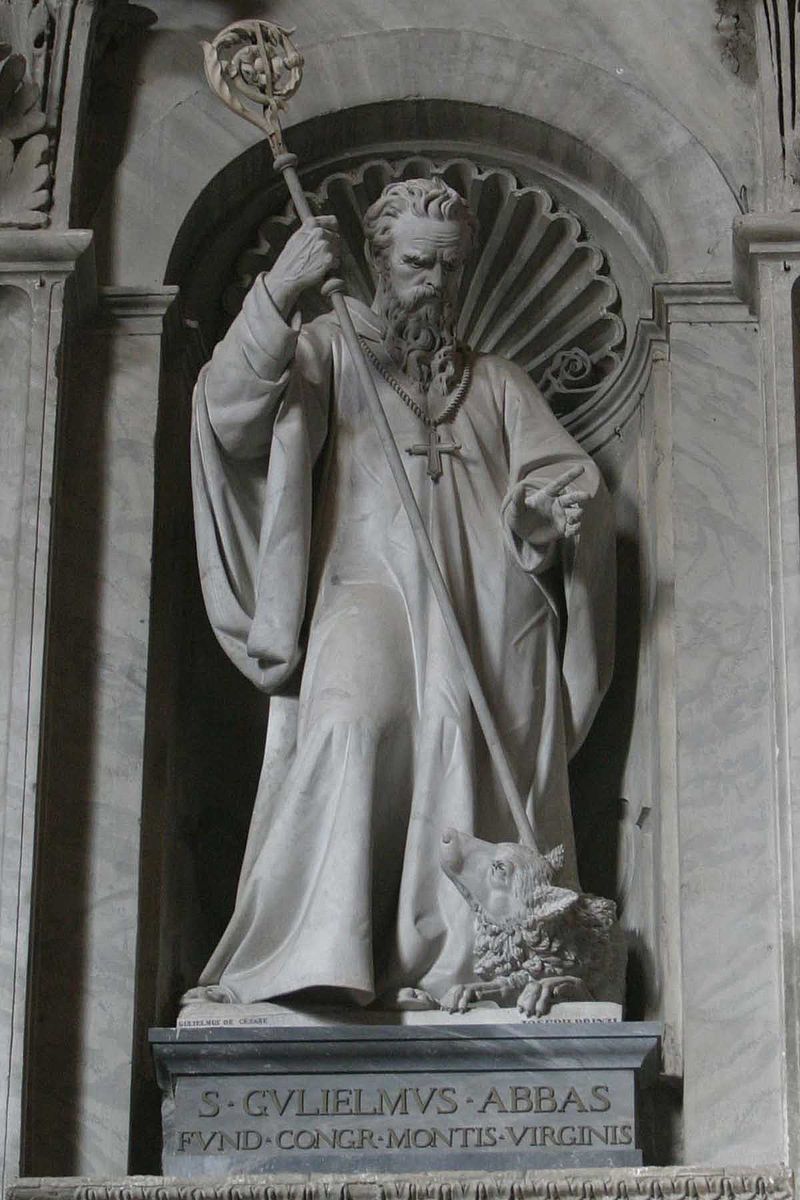
Saint William of Monte Vergine
William of Vercelli (1085 -1142) was a tenth-century hermit, and almost-accidental founder of an Order, the Congregation of Monte Vergine, also called the ‘Williamites’. He sometimes takes his name from the mountain on which he set up his monastery. Two things we may draw from his hidden life, which ended up shining like the proverbial lamp. (He must have had quite the following at some point, even if now mostly forgotten, for his statue resides in Saint Peter’s Basilica).
First, William discovered his vocation while on pilgrimage to the shrine of Saint James in Compostela, the famous, and now even more famous, pilgrimage route from the south of France, across the Pyrenees, to the west coast of Spain, to the cathedral housing the relics of the great Apostle. We need time ‘away’ from the world to hear the voice of God, deep within our hearts, like the prophet Elijah and the still small voice. A retreat, or a pilgrimage, or a bit of both. Leave the electronics, the music and podcasts and all the rest of it, behind. Second, Frater William was renowned, and criticized, for his severely penitential life – before going on pilgrimage for weeks on end, covering hundreds of miles, he had a blacksmith forge an iron contraption he wore under his tunic, as an extra penance. For most, the blisters, the heat, the fatigue, hunger, thirst, the joint pains, and all the other privations would be more than enough!
I say ‘accidental’ founder, for he went up that mountain in the south of Italy as a solitary hermit, after an attempt to reach Jerusalem, which he had to give up after getting beaten and robbed. But, like Saint Benedict centuries before, others soon followed him, even if some had to depart, William’s way of life was so strict. He chose the narrowest of the narrow ways, just to be sure. Some aspects of the lives of saints are more to be admired than imitated. We should keep in mind that, like the love of a mother or father, what we give up or take on in life should always be motivated by love, which spurs us on to great things, even what in the world’s eyes may seem foolish and absurd. Our ways are not God’s ways, nor our thoughts, His.
As we say in accompanying post, we are not made for this world, but for a far, far greater one and some are given the grace to see that more clearly than others. The pearl of great price is what it’s all about; buy the field. Whatever you put on that field, is secondary. +
Carney’s Amoral Majority
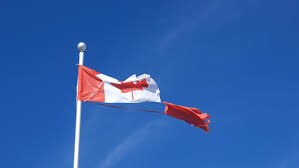
After five defections – euphemistically described as ‘crossing the floor’ – and three by-elections, Mark Carney and his Liberals how have their coveted majority. One wonders what bowls of pottage were offered in back-room deals. In the archaic monarchical system that is the Dominion of Canada, this majority allows the newly-minted Prime Minister to rule[…]Continue reading→

Saint Kateri , Canada’s Protectress
This was the title given to Saint Kateri Tekakwitha, by Pope Benedict XVI, when he canonized her on October 28th, 2012, along with six others, in Saint Peter’ Square (she had been beatified by Pope John Paul II back in 1980). With Saint Joseph as our protector, along with the Canadian martyrs, we seem to[…]Continue reading→
A Tale of Two Benedicts
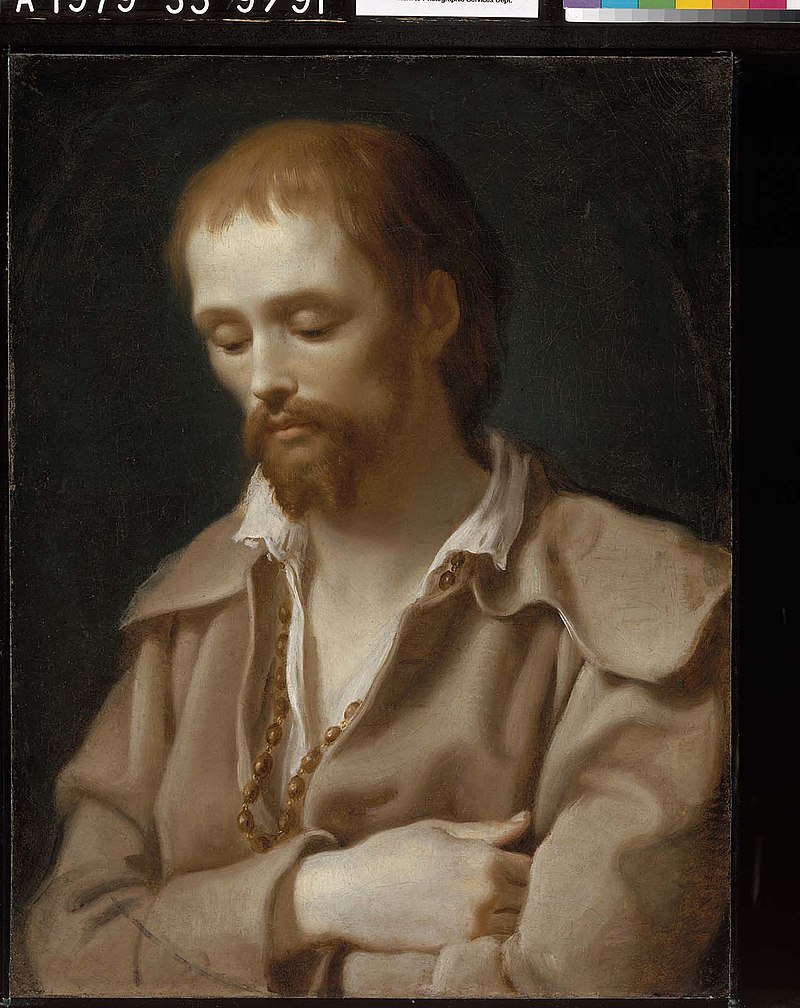
A grace-filled Holy Week to all our readers! As we await and prepare for the Resurrection about to dawn upon us, we might keep in mind two Benedicts: Pope Emeritus Benedict XVI, requiescat in pace, elected on this day in 2005; and today’s commemoration of the mystic pilgrim, Benedict Joseph Labre, who died on this[…]Continue reading→

My Name is Bernadette
April 16th is a propitious day, for besides the anniversary of Father de Valk’s death, who founded Catholic Insight in its print form decades ago, and the commemoration of the ‘two Benedicts’, mentioned in accompanying posts, today we also recall Saint Bernadette Soubirous, the young visionary to whom the Virgin Mary appeared numerous times at[…]Continue reading→
Saint Lydwina of Schiedam and Suffering Joyfully
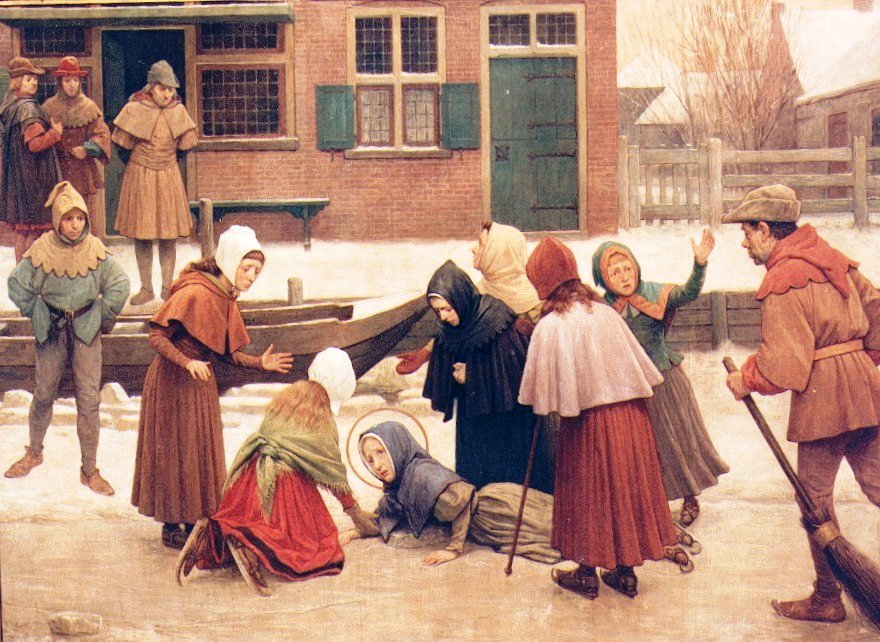
Saint Lydwina of Schiedam (1380 – 1433) was one of the countless and glorious ‘victim souls’ in the history of the Church, those whose lives are filled with suffering, often of an unimaginable intensity, but who suffer joyfully. She was a fifteen-year old Dutch girl, out skating one day, when she fell and broke one[…]Continue reading→
The Glorious Martyrdoms of Martin and Maximus
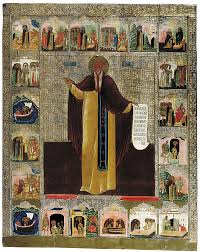
As we enter into Eastertide, we recall on this 13th of April Pope Saint Martin I (+655), one of the noblest, if most tragic, of the successors of Saint Peter. Born in Umbria, Italy, he was of noble lineage, with great intelligence combined with charity and love of the poor and the Church. While still[…]Continue reading→
Canonizing Sister Faustina and Divine Mercy
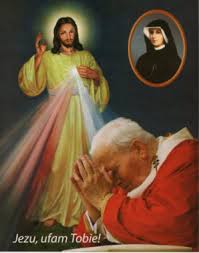
HOMILY OF THE HOLY FATHER MASS IN ST PETER’S SQUARE FOR THE CANONIZATION OF SR MARY FAUSTINA KOWALSKA Sunday, 30 April 2000 1. “Confitemini Domino quoniam bonus, quoniam in saeculum misericordia eius”; “Give thanks to the Lord for he is good; his steadfast love endures for ever” (Ps 118: 1). So the Church sings on the Octave of[…]Continue reading→

Saint Stanislaus of Szczepanów
We celebrate Saint Stanislaus today (+ April 11, 1079), in light of this Easter Octave, a bishop and martyr who accepted the episcopacy only at the direct order of Pope Alexander II. He proved a wise and courageous leader of his flock, put to death by his own king, Boleslaus, for rebuking the monarch’s ‘immoral[…]Continue reading→
Saint Gemma Galgani
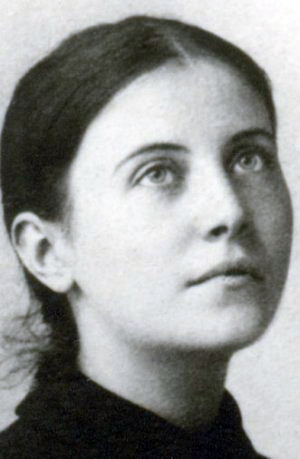
On this April 11th, in 1903 – the same year that the Italian Guiseppe Sarto was elected Pope later that summer as Pius X – a lovely, young Italian woman died, by the name of Gemma Galgani. She lived a brief life of 24 years, as did a number of other young saints, including Pier[…]Continue reading→
An Ideological and Improper Translation
I noticed something odd with the psalm reading at Mass the other day. Our bishops’ conference here in Canada has decreed that the Mass in English – Novus Ordo – use the ‘NRSV’, the ‘New Revised Standard Version’, an ‘updated’ translation of the original RSV, first published in 1952. This ‘new translation’ has the tendency[…]Continue reading→