
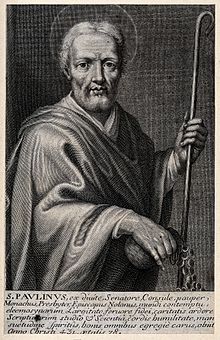
Saint Paulinus of Nola
BENEDICT XVI
GENERAL AUDIENCE
Paul VI Audience Hall
Wednesday, 12 December 2007
Saint Paulinus of Nola
Dear Brothers and Sisters,
The Father of the Church to whom we turn our attention today is St Paulinus of Nola. Paulinus, a contemporary of St Augustine to whom he was bound by a firm friendship, exercised his ministry at Nola in Campania, where he was a monk and later a priest and a Bishop. However, he was originally from Aquitaine in the South of France, to be precise, Bordeaux, where he was born into a high-ranking family. It was here, with the poet Ausonius as his teacher, that he received a fine literary education. He left his native region for the first time to follow his precocious political career, which was to see him rise while still young to the position of Governor of Campania. In this public office he attracted admiration for his gifts of wisdom and gentleness. It was during this period that grace caused the seed of conversion to grow in his heart. The incentive came from the simple and intense faith with which the people honoured the tomb of a saint, Felix the Martyr, at the Shrine of present-day Cimitile. As the head of public government, Paulinus took an interest in this Shrine and had a hospice for the poor built and a road to facilitate access to it for the many pilgrims.
While he was doing his best to build the city on earth, he continued discovering the way to the city in Heaven. The encounter with Christ was the destination of a laborious journey, strewn with ordeals. Difficult circumstances which resulted from his loss of favour with the political Authorities made the transience of things tangible to him. Once he had arrived at faith, he was to write: “The man without Christ is dust and shadow” (Carm. X, 289). Anxious to shed light on the meaning of life, he went to Milan to attend the school of Ambrose. He then completed his Christian formation in his native land, where he was baptized by Bishop Delphinus of Bordeaux. Marriage was also a landmark on his journey of faith. Indeed, he married Therasia, a devout noblewoman from Barcelona, with whom he had a son. He would have continued to live as a good lay Christian had not the infant’s death after only a few days intervened to rouse him, showing him that God had other plans for his life. Indeed, he felt called to consecrate himself to Christ in a rigorous ascetic life.
(To continue reading, please follow the link the to Vatican webpage here)

Saint Kateri , Canada’s Protectress
This was the title given to Saint Kateri Tekakwitha, by Pope Benedict XVI, when he canonized her on October 28th, 2012, along with six others, in Saint Peter’ Square (she had been beatified by Pope John Paul II back in 1980). With Saint Joseph as our protector, along with the Canadian martyrs, we seem to[…]Continue reading→
A Closed, Unsustainable, Descending Loop
As a follow-up to my thoughts on Payette’s payout, here be a stark image of where are here in Canada. As the graph shows in, well, graphic terms, since 2025, the public sector has contributed to 95.5% of economic growth. The private sector – which funds the public sector, or is supposed to – has[…]Continue reading→

A Tale of Two Benedicts
A grace-filled Holy Week to all our readers! As we await and prepare for the Resurrection about to dawn upon us, we might keep in mind two Benedicts: Pope Emeritus Benedict XVI, requiescat in pace, elected on this day in 2005; and today’s commemoration of the mystic pilgrim, Benedict Joseph Labre, who died on this[…]Continue reading→

My Name is Bernadette
April 16th is a propitious day, for besides the anniversary of Father de Valk’s death, who founded Catholic Insight in its print form decades ago, and the commemoration of the ‘two Benedicts’, mentioned in accompanying posts, today we also recall Saint Bernadette Soubirous, the young visionary to whom the Virgin Mary appeared numerous times at[…]Continue reading→
Presidential Pardon of Weronika Krawczyk
As a good news, follow-up to our story from Poland, of the persecution of Weronika Krawczyk for her pro-life views, we heard that she has been granted a presidential pardon. One might still wonder why one needs a presidential pardon for simply holding the long-held belief that the child within the womb is a child,[…]Continue reading→

Saint Lydwina of Schiedam and Suffering Joyfully
Saint Lydwina of Schiedam (1380 – 1433) was one of the countless and glorious ‘victim souls’ in the history of the Church, those whose lives are filled with suffering, often of an unimaginable intensity, but who suffer joyfully. She was a fifteen-year old Dutch girl, out skating one day, when she fell and broke one[…]Continue reading→

The Glorious Martyrdoms of Martin and Maximus
As we enter into Eastertide, we recall on this 13th of April Pope Saint Martin I (+655), one of the noblest, if most tragic, of the successors of Saint Peter. Born in Umbria, Italy, he was of noble lineage, with great intelligence combined with charity and love of the poor and the Church. While still[…]Continue reading→

Canonizing Sister Faustina and Divine Mercy
HOMILY OF THE HOLY FATHER MASS IN ST PETER’S SQUARE FOR THE CANONIZATION OF SR MARY FAUSTINA KOWALSKA Sunday, 30 April 2000 1. “Confitemini Domino quoniam bonus, quoniam in saeculum misericordia eius”; “Give thanks to the Lord for he is good; his steadfast love endures for ever” (Ps 118: 1). So the Church sings on the Octave of[…]Continue reading→
Pope Leo and a Rosary for Peace
Pope Leo XIV has asked Catholics across the world to join him in a Rosary for peace today, at 18:00 Rome time (6 pm), which would be noon from where I write (EST). If you are able, whether at that time or another, and in whatever way you pray, to join in intercession with the[…]Continue reading→
Payette’s Payout
I was glancing through some headlines, and noticed a mention of Julie Payette – engineer and astronaut and sometime the Queen’s representative in Canada – which brought back vague memories. She was appointed Governor-General by Justin Trudeau in 2017. Ms. Payette resigned in 2021, amidst claims that she created a ‘toxic work environment’, with allegations[…]Continue reading→