
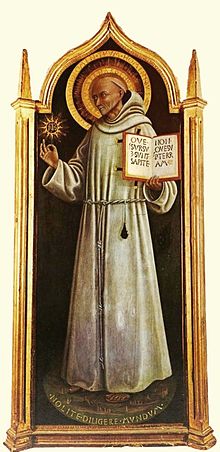
Bernardine, Usury and the Holy Name
(The saint today get muted, due to the memorial of Mary, Mother of the Church, on the Monday after Pentecost, in the Novus Ordo. Still, it’s good to remind ourselves yearly of the great Saint Bernardine. As far as the days following Whit Sunday go, the story has it that Pope Paul VI signed the decree abolishing the octave of Pentecost, when all eight days were a solemnity, just like Easter. The Pope was surprised when he went into the sacristy on Monday morning, and saw green vestments laid out – he asked why, and then was reminded of his own decision. Apocryphal? Perhaps. Still, we celebrate, one way or the other, the Holy Ghost, and all the saints that He inspires and sanctifies).
Saint Bernardine of Siena (+1444) lived through a tumultuous time in the Church’s history (but, then, what time is not?). The Great Western Schism had begun in 1378, two years before his birth, with the election of an anti-pope; eventually there were three rival claimants to the papacy, all with their various supporters, even amongst faithful Catholics. And the effects of the Black Death were still ravaging Europe.
Left orphaned at six years old, Bernardine was raised by a pious aunt, and grew in devotion to God, Our Lady, and the Church. Caring for the plague stricken in 1401 taught him the brevity of human life, and that our thoughts should primarily be about preparing for eternity. Memento mori. He joined the Observant branch of the Orders of Friars Minor (the strict reform of the Franciscans), and spent his life preaching across Italy – not just within churches and convents and at liturgies, but in the open air before thousands, like his near-contemporary Dominican, Vincent Ferrer, who prophesied Bernardine’s vocation. One wonders how they projected their words without amplified sound systems; but, then, natural virtue, elevated by God’s grace, can do wonders.
Even though Bernardine had a naturally raspy voice, he was one of the most successful preachers of his day, converting untold numbers as he crisscrossed the countryside, inveighing against vices, with his exhortations sometimes ending with a ‘bonfire of the vanities’, the townspeople casting into the flames all those occasions of sin, hand-held mirrors, high-heeled shoes, perfumes, dice and decks of cards (gambling was an inveterate vice ruining many). We, with our more modern and tolerant views, might demur; but still, I wonder what our saint would say of today’s smartphones, porno mags, yoga pants, birth control pills and, say, condoms?
Bernardine is described on his Wikipedia page as being ‘homophobic’ for his insistent condemnation of ‘sodomy’. We should be aware that sodomy for the scholastic mind means any sexual act that is deliberately dissociated from its procreative signification and purpose, that is, one sought only for illicit pleasure: Thus, sodomy included not only homosexual liaisons, so to speak, but any misuse of the sacredness of sex, including contraception, masturbation and other such deviancies, of varying degrees of moral gravity. Hence, Bernardine’s warning to the people could be applied today with even greater relevance:
You don’t understand that [sodomy] is the reason you have lost half your population over the last twenty-five years.
It’s worse than the plague.
We’ve lost a lot more than half of our own population over the past fifty or so years, due to various widespread practices of ‘sodomy’, to which we have now added widespread abortion. Ponder the precipitously low birthrate of the United States (which had been holding its own until recently), now joining the demographic death spiral across the globe, with a few exceptions (almost all in Africa, where fervent religion is also booming – only those who believe in the future will have children).
Bernardine also helped found the Church’s social doctrine, expounding the scholastic principles of socio-economics, not least the evil of usury, which, in its essence, is an attempt to make money from nothing. Reflect upon the causes of the Great Depression, as well as our current woes: immoral speculation on the stock market; printing money without any value; sub-prime mortgages, reckless loans, and consequent runaway inflation…well, we all get some idea of the economic ruin he was predicting – and we still haven’t learned much. (Even if we may be about to)
Both sex and money must, in a deep sense, be productive of their purposes. For enclosed in upon themselves for our own solipsistic pleasure, they will lead to our ruin, in this life and the next.
In all, Bernardine, ascetic, holy, prayerful, gave himself completely to God, and, besides the ferverino of his sermons, or perhaps because of them, was known for his kindness and charity. He is most famed nowadays for propagating devotion to the Holy Name of Jesus which, as Scripture reminds us more than once, has great power and reverence, to which ‘every knee must bend, in heaven, on earth and under the earth’.
As the Catechism puts it:
Jesus’ Resurrection glorifies the name of the Saviour God, for from that time on it is the name of Jesus that fully manifests the supreme power of the “name which is above every name”. The evil spirits fear his name; in his name his disciples perform miracles, for the Father grants all they ask in this name. (#434)
To remind his listeners, he also spread devotion to the monogram IHS, which are the first three letters in Greek of the Holy Name – IHS – as well as evoking the acronym revealed to Emperor Constantine before that fateful battle on the Milvian bridge, ‘in hoc signo’, – in this sign, you will conquer.

And what was true then, is true now, for only in the name of the Holy One will we overcome the evil one, who still, perhaps more than ever, prowls the world seeking the ruin of souls.
Sancte Bernardinus, ora pro nobis.

Carney’s Amoral Majority
After five defections – euphemistically described as ‘crossing the floor’ – and three by-elections, Mark Carney and his Liberals how have their coveted majority. One wonders what bowls of pottage were offered in back-room deals. In the archaic monarchical system that is the Dominion of Canada, this majority allows the newly-minted Prime Minister to rule[…]Continue reading→

Saint Kateri , Canada’s Protectress
This was the title given to Saint Kateri Tekakwitha, by Pope Benedict XVI, when he canonized her on October 28th, 2012, along with six others, in Saint Peter’ Square (she had been beatified by Pope John Paul II back in 1980). With Saint Joseph as our protector, along with the Canadian martyrs, we seem to[…]Continue reading→

A Tale of Two Benedicts
A grace-filled Holy Week to all our readers! As we await and prepare for the Resurrection about to dawn upon us, we might keep in mind two Benedicts: Pope Emeritus Benedict XVI, requiescat in pace, elected on this day in 2005; and today’s commemoration of the mystic pilgrim, Benedict Joseph Labre, who died on this[…]Continue reading→

My Name is Bernadette
April 16th is a propitious day, for besides the anniversary of Father de Valk’s death, who founded Catholic Insight in its print form decades ago, and the commemoration of the ‘two Benedicts’, mentioned in accompanying posts, today we also recall Saint Bernadette Soubirous, the young visionary to whom the Virgin Mary appeared numerous times at[…]Continue reading→

Saint Lydwina of Schiedam and Suffering Joyfully
Saint Lydwina of Schiedam (1380 – 1433) was one of the countless and glorious ‘victim souls’ in the history of the Church, those whose lives are filled with suffering, often of an unimaginable intensity, but who suffer joyfully. She was a fifteen-year old Dutch girl, out skating one day, when she fell and broke one[…]Continue reading→

The Glorious Martyrdoms of Martin and Maximus
As we enter into Eastertide, we recall on this 13th of April Pope Saint Martin I (+655), one of the noblest, if most tragic, of the successors of Saint Peter. Born in Umbria, Italy, he was of noble lineage, with great intelligence combined with charity and love of the poor and the Church. While still[…]Continue reading→

Canonizing Sister Faustina and Divine Mercy
HOMILY OF THE HOLY FATHER MASS IN ST PETER’S SQUARE FOR THE CANONIZATION OF SR MARY FAUSTINA KOWALSKA Sunday, 30 April 2000 1. “Confitemini Domino quoniam bonus, quoniam in saeculum misericordia eius”; “Give thanks to the Lord for he is good; his steadfast love endures for ever” (Ps 118: 1). So the Church sings on the Octave of[…]Continue reading→

Saint Stanislaus of Szczepanów
We celebrate Saint Stanislaus today (+ April 11, 1079), in light of this Easter Octave, a bishop and martyr who accepted the episcopacy only at the direct order of Pope Alexander II. He proved a wise and courageous leader of his flock, put to death by his own king, Boleslaus, for rebuking the monarch’s ‘immoral[…]Continue reading→

Saint Gemma Galgani
On this April 11th, in 1903 – the same year that the Italian Guiseppe Sarto was elected Pope later that summer as Pius X – a lovely, young Italian woman died, by the name of Gemma Galgani. She lived a brief life of 24 years, as did a number of other young saints, including Pier[…]Continue reading→

An Ideological and Improper Translation
I noticed something odd with the psalm reading at Mass the other day. Our bishops’ conference here in Canada has decreed that the Mass in English – Novus Ordo – use the ‘NRSV’, the ‘New Revised Standard Version’, an ‘updated’ translation of the original RSV, first published in 1952. This ‘new translation’ has the tendency[…]Continue reading→