
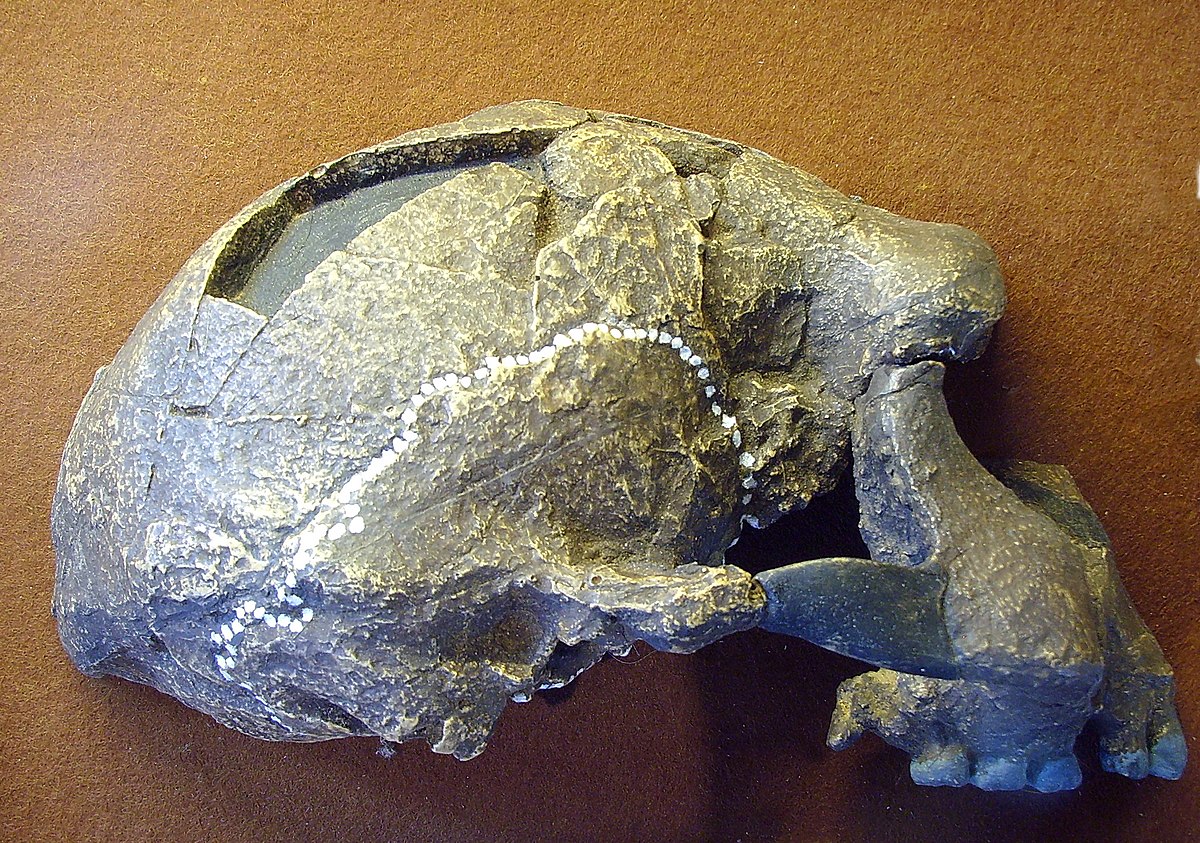
One Species of Human?
I’m not sure how much of Dr. Robin May’s presentation (posted below) of the human fossil record is science, or fiction – like most hypothetical theories without a whole lot of evidence, probably a bit of both, and I would tend more heavily towards the latter than the former. The bones, when one delves into what they actually have, are rather scanty, and open to various interpretations, to say the least. Were these partial-skeletons and bone fragments ‘human’ at all? There have been frauds and false hypotheses before.
The notion of a ‘species’ is itself a fraught one, especially as it applies to humans. In Linnaeus’ classification of the animal kingdom – kingdom, phylum, class, order, family, genus, species – the last category, the most ‘specific’ one, is delineated by those who could inter-breed and produce viable offspring. If early humans could all interbreed, then they were all the same species. Applying Linnaeus’ classfication, there would be the genus of ‘Homo’, then various species – Homo Habilis, Homo Neanderthalensis, and so on – with ourselves being, of course, the most recent iteration: Homo Sapiens, ‘wise man’, no irony intended.
Dr. Robin May, in the video below, is at great pains not to imply any sense that one species was ‘better’ than another, far less any notion of current gradations of being more, or less, human. Perhaps he is not aware that the one most famous for developing the notion of the evolution of humans from non-human creatures, the old boy Charles Darwin himself, was a dyed-in-the-wool racist. Darwin believed, and his theory implies, that evolution is always happening, as organisms develop from the ‘less fit’ to the ‘more fit’, or, in his word, more ‘civilized’, which one would think were a moral evolution, not a physiological one.
Whatever the case, the implication is that organisms – including humans – are gradually getting more perfect and genetically superior.
Here are Darwin’s own words:
At some future period, not very distant as measured by centuries, the civilized races of man will almost certainly exterminate and replace throughout the world the savage races. At the same time the anthropomorphous apes [that is, the ones which look most like the savages in structure] … will no doubt be exterminated. The break will then be rendered wider, for it will intervene between man in a more civilized state, as we may hope … the Caucasian, and some ape as low as a baboon, instead of as at present between the negro or Australian and the gorilla. (The Descent of Man, p. 105)
There are no ‘species’, in the strict and stable sense, in Darwin’s theory, for evolution is always happening – it is fluid, like the river of Heraclitus. Underlying Darwin’s vague, undigested metaphysics is rank nominalism and monism – just matter under random forces and pressures, ever-changing and morphing. What we call ‘species’ are simply semi-stable organisms happening to find a temporary niche. Hence, Darwin’s theory does not necessarily imply racism, or any implied growth in objective, a priori notions of ‘perfection’ – only that an animal is better adapted to its environment, and more able to get food and reproduce, which is a purely practical affair, which may imply any number of things, and in many cases is unpredictable. In our own current human ecological niche, a pencil-necked computer coder can access more food and funds, live in a bigger house, and drive a nicer car, than a musclebound brute who’s real good at haulin’ lumber around.
Being human is not really about that though, is it? The Church has cut through this nonsense, with Pius XII in his 1950 encyclical Humani Generis, declaring that all humans descend, by natural generation, from Adam and Eve. This is the doctrine of monogenesis:
When, however, there is question of another conjectural opinion, namely polygenism, the children of the Church by no means enjoy such liberty. For the faithful cannot embrace that opinion which maintains that either after Adam there existed on this earth true men who did not take their origin through natural generation from him as from the first parent of all, or that Adam represents a certain number of first parents. Now it is in no way apparent how such an opinion can be reconciled with that which the sources of revealed truth and the documents of the Teaching Authority of the Church propose with regard to original sin, which proceeds from a sin actually committed by an individual Adam and which, through generation, is passed on to all and is in everyone as his own. (#36)
That is, there’s only one ‘species’ of Man, within the genus ‘Homo’ – the sapiens sort, if you want to us that term. We are all one kind and race, always have been, always will be; all of us are created by God in His image, an image that has been compromised by original sin; but we are all destined, if we live a life of virtue and cooperate with His grace, to spend eternal life in His presence in beatitude.
So, to answer Dr. Robin May’s question, the reason there is only one kind of human is that God made us that way, and His Christ took that nature to redeem us. So we will remain, our human nature immutable, until the same Christ returns in glory, to bring that nature to its full supernatural perfection.
Carney’s Amoral Majority
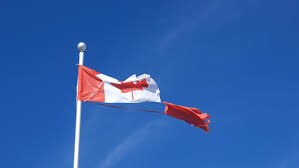
After five defections – euphemistically described as ‘crossing the floor’ – and three by-elections, Mark Carney and his Liberals how have their coveted majority. One wonders what bowls of pottage were offered in back-room deals. In the archaic monarchical system that is the Dominion of Canada, this majority allows the newly-minted Prime Minister to rule[…]Continue reading→

Saint Kateri , Canada’s Protectress
This was the title given to Saint Kateri Tekakwitha, by Pope Benedict XVI, when he canonized her on October 28th, 2012, along with six others, in Saint Peter’ Square (she had been beatified by Pope John Paul II back in 1980). With Saint Joseph as our protector, along with the Canadian martyrs, we seem to[…]Continue reading→

Remembering Father Alphonse de Valk
(Today marks the sixth anniversary of the death of Father Alphonse de Valk, C.S.B., a faithful, courageous and indefatigable Basilian priest, pro-life-and-family apostle, and the founder of Catholic Insight magazine. Here is what we wrote those on his entering into eternity five years ago, as we continue to remember him in our prayers and thoughts)[…]Continue reading→
A Tale of Two Benedicts
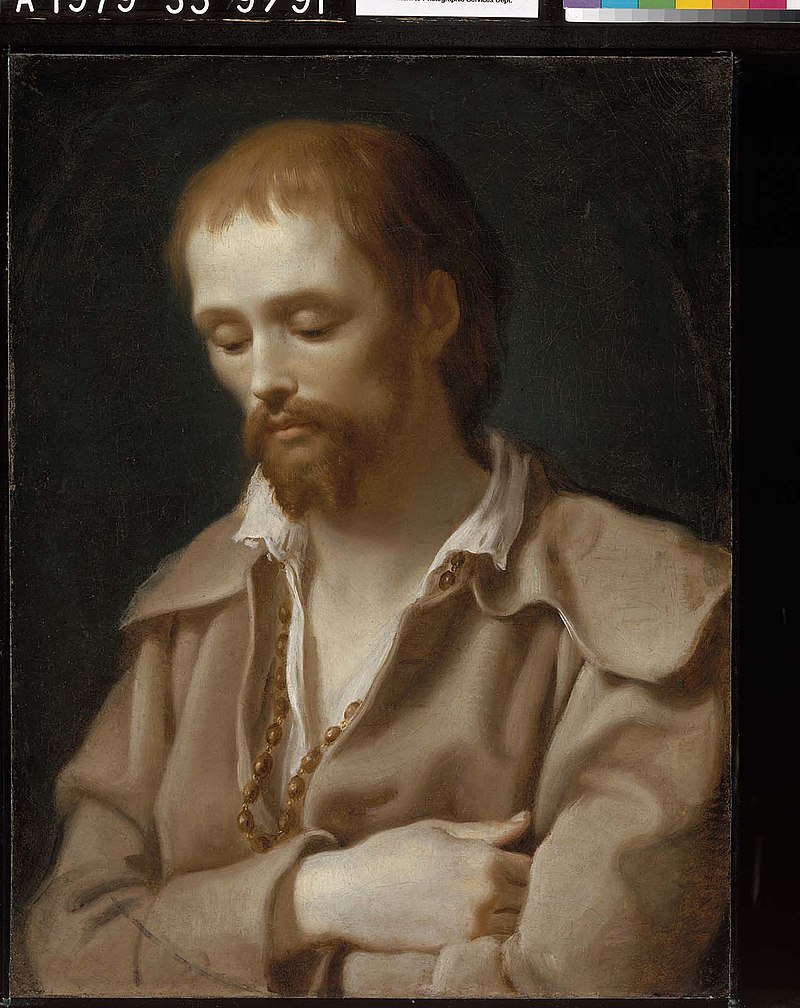
A grace-filled Holy Week to all our readers! As we await and prepare for the Resurrection about to dawn upon us, we might keep in mind two Benedicts: Pope Emeritus Benedict XVI, requiescat in pace, elected on this day in 2005; and today’s commemoration of the mystic pilgrim, Benedict Joseph Labre, who died on this[…]Continue reading→

My Name is Bernadette
April 16th is a propitious day, for besides the anniversary of Father de Valk’s death, who founded Catholic Insight in its print form decades ago, and the commemoration of the ‘two Benedicts’, mentioned in accompanying posts, today we also recall Saint Bernadette Soubirous, the young visionary to whom the Virgin Mary appeared numerous times at[…]Continue reading→
Saint Lydwina of Schiedam and Suffering Joyfully
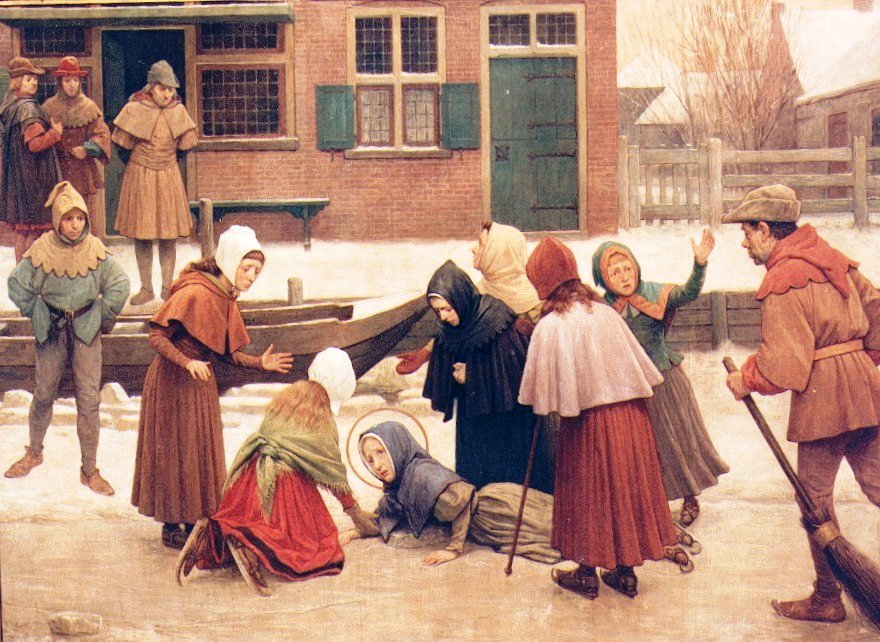
Saint Lydwina of Schiedam (1380 – 1433) was one of the countless and glorious ‘victim souls’ in the history of the Church, those whose lives are filled with suffering, often of an unimaginable intensity, but who suffer joyfully. She was a fifteen-year old Dutch girl, out skating one day, when she fell and broke one[…]Continue reading→
The Glorious Martyrdoms of Martin and Maximus
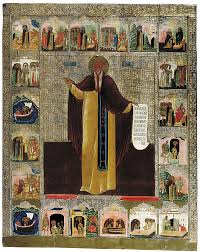
As we enter into Eastertide, we recall on this 13th of April Pope Saint Martin I (+655), one of the noblest, if most tragic, of the successors of Saint Peter. Born in Umbria, Italy, he was of noble lineage, with great intelligence combined with charity and love of the poor and the Church. While still[…]Continue reading→

Canonizing Sister Faustina and Divine Mercy
HOMILY OF THE HOLY FATHER MASS IN ST PETER’S SQUARE FOR THE CANONIZATION OF SR MARY FAUSTINA KOWALSKA Sunday, 30 April 2000 1. “Confitemini Domino quoniam bonus, quoniam in saeculum misericordia eius”; “Give thanks to the Lord for he is good; his steadfast love endures for ever” (Ps 118: 1). So the Church sings on the Octave of[…]Continue reading→

Divine Mercy Sunday – An Echo of Every Mass
Reach out your hand and put it in my side. Do not doubt but believe’… ‘My Lord and my God!’ (Jn. 20:18)). Today is Divine Mercy Sunday, and as we celebrate the end of the Easter Octave, we contemplate the wounded side of our Saviour, the Church’s source of life. On Good Friday in the[…]Continue reading→

Saint Stanislaus of Szczepanów
We celebrate Saint Stanislaus today (+ April 11, 1079), in light of this Easter Octave, a bishop and martyr who accepted the episcopacy only at the direct order of Pope Alexander II. He proved a wise and courageous leader of his flock, put to death by his own king, Boleslaus, for rebuking the monarch’s ‘immoral[…]Continue reading→