
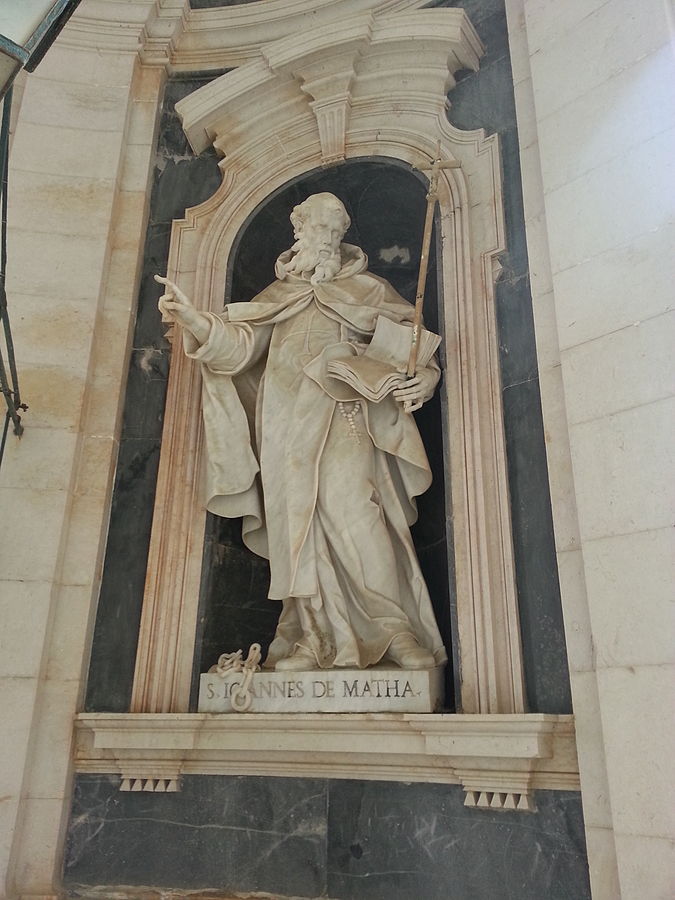
St. John de Matha, the Forgotten Friar
Every year on December 17 the church intones the ‘O antiphons’ the joyous canticles in anticipation of the coming of Christ. But on the same day, the Church also commemorates the memorial of a seemingly forgotten friar, John de Matha, father of the Trinitarians (Order of the Most Holy Trinity and of the Captives) and one of the key figures in leading the movement of liberating captive Christians from the hands of the Moors. So as the Church honors and joyously awaits the coming of Jesus through the singing of the O antiphon, let us, in anticipation, take a quick look at the life of John de Matha and the family established the Trinitarians.
Born around 1154 and raised in Barcelonnette, not much is written about this pious man. Surviving references in the late 17th century by Robert Gaguin mention his parents as Eufeme (father) from the noble family of Catalan and Martha Visconti Fenouillet. (mother) His early childhood, as you might have guessed, was not documented either. Some records would attest that he attended Faucon and Marseille in his early years, probably his primary education, and later the University of Paris, the leading university at that time, to pursue liberal arts and theology. It was there in Paris that the young John was first introduced to the divine sciences under Prevostin.
Receiving his “Master Theologiae”, he taught at the same university for seven years lecturing on the sentences of Peter Lombard and commenting on the Holy Scriptures before becoming a priest in 1193.
Life in Paris is far more than instructing and preaching. As a professor, John witnessed the captivity caused by the Third Crusade and the eventual fall of Jerusalem at the hands of Saladin in 1187. Troubled by this reality, John felt the need to do something more than teaching theology – actualizing it. So, after discerning to enter the priesthood and start a missionary life, John asked God for a sign which eventually led to the founding of the Order of the Most Holy Trinity and of the Captives with its unique charism of liberating Christians in bondage.
The Vision and Mission
So, it was on the day of his first mass in 1193 at the elevation of the host that God granted John the vision he ardently sought. Looking up in the heavens as he murmured “hoc est enim corpus meum” saw Christ between two captives holding their hands a Christian identified by the red and blue cross he holds and a Moor. Struck by what he saw, he stumbled for a moment. Then with another glance at the seemingly unreal, it vanished. Convinced that the vision was the answer to his prayers, John retreats to a forest about 80 kilometers from Paris to a secluded location known as Cerfroid and contemplates the revelation he received. In his solitude, he met a group of 6 hermits led by Felix de Valois and affirmed the vision by interpreting it as “natus Dei” (a sign of God) for captivus libertas (Liberation of captives). The hermits then join John in establishing the Order and it is here in the remote area of France, in a secluded place, far from the noise of the city, that the first house of brothers – Domus Trinitatis, is founded. From 1194 onwards, John and Felix worked together in drafting the Rule of the Order. A unique combination of the active life as pursued by John’s desire for mission and the contemplative life patterned on the eremitical way of Felix. After 4 years of careful consultation, John receives the approval of the Order of the Most Holy Trinity and Liberation of Captives from Innocent III and sets out to Morocco to inaugurate his mission.
The forgotten Rule
The Rule of St. John de Matha, which exists to this day, is a unique form of religious life. It is one of the 4 major rules approved by the Holy See together with the Rules of Basil, Augustine, and Benedict. Unlike the other three, the Rule of St. John de Matha contains elements of eremitical life. This is seen in their monastic ways of prayer and active life as mirrored in their missionary activity of liberating the captives. It is the first rule to specify the unicity of missio et contemplatio. It is also the first rule that mentions the three evangelical vows of Poverty, Chastity, and Obedience, paving the way for the priority of evangelical counsels in the religious life. Though these are implied in the other three major rules, it is only in the rule of John that the evangelical counsels were clearly specified.
Moreover, the Rule of St. John de Matha mentions the liberation of captives as its primary role. Thus, all of its activity must be directed and dedicated to liberating the captives. This mission of redemption is so central to the Trinitarian rule that even donations must be used (with the consent of the donor) for the purpose of redeeming the captives.
In the later development of the Order’s Constitutions, it mentions the 4th vow which talks about the prohibition of canvassing for any office in the Church. The Order believes that every Trinitarian must dedicate themselves solely to the missionary activity of the Order in which it is originally founded. This specification was even added to the formula of the Solemn Profession of Vows of every brother to serve as a reminder for the Brothers of the Most Holy Trinity of the vocation they responded.
The Trinitarian Family
John went from place to place founding houses and gathering money for the redemption of captives. In 1199, a year after the Order was approved, he sailed to his first mission of redemption in Morocco where he was well received. He preached to the community about the dangers of slavery and emphasized the dignity of the human person beyond color, race, or religion. He established hospitals and institutes taking care of the poor and the sick regardless of their religion showing a true image of Christ the Redeemer. After this successful missionary work, John set foot in Castile, Spain where Christians were being attacked by Moors, and effectively carried out the redemptive mission of his Order.
His fame spread throughout Europe and John served as a living witness of the Order he founded. After some years, more and more young people entered the Order which eventually led to more and more missionary and redemptive work. Trinitarian houses expanded from Rome to France to Spain and to North of Africa resonating Gloria Tibi Trinitas et Captivus Libertas – Glory be to you Trinity and Liberty to the Captives.
The Death of the Founder
John’s vision was indeed a “natus Dei” a sign from God, as seen from the success of his missionary work. God blessed this man with the wisdom and courage to step out of his comfort zone, leave everything behind, and set out for the work of redeeming those who are in captivity. John died on December 17, 1213, and was buried four days later in Thomas in Formis, a Trinitarian house in Rome. His original feast day was February 8, but at the revision of the Roman Calendar, it was moved to December 17 following the revisions in the Liturgy of the Second Vatican Council coinciding with what we mentioned earlier about the celebration of the O Antiphons.
The Legacy
John might be today a forgotten saint, a forgotten brother of the Trinitarians, but his witness to living out his Christian life and his contributions to the Church is tremendous. To this day, Trinitarians continue their founder’s work through works of redemption and corporal works of mercy. Though small in number, the Trinitarians are at the forefront of this battle by imitating the life and work of their founder, John de Matha. As of the moment, The Trinitarians also have its active missions in the Middle East, the Philippines, Vietnam, South Korea, Madagascar, and India providing spiritual nourishment to those Christians who were persecuted because of their faith and giving physical sustenance to every people of every walk of life through hospital ministries and institutions focusing on various works of mercy.
Sanctus Iohannes Mathae!
Ora pro nobis!
Sources:
Order of the Most Holy Trinity and of the Captives. Trinitarian Rule and Constitutions. Baltimore: Trinitarian Publications, 1989.
General Secretariat of the Trinitarians. Trinitarian Meditations. Rome: Trinitarian Publications, 2005.
D’errico, Anthony, O.SS.T. The Trinitarians An Overview of their Eight Hundred Year Service to God and Humaniy. Baltimore: Trinitarian Publications, 2008.
Witko, Andrew. The Order of the Holy Trinity and Captives. Trans. Ewa Swidzinska Lay, O.SS.T., Ter. And Kevin R. Lay, O.SS.T., Ter. Krakow: Wydawnictwo AA: 2009.

Saint Kateri , Canada’s Protectress
This was the title given to Saint Kateri Tekakwitha, by Pope Benedict XVI, when he canonized her on October 28th, 2012, along with six others, in Saint Peter’ Square (she had been beatified by Pope John Paul II back in 1980). With Saint Joseph as our protector, along with the Canadian martyrs, we seem to[…]Continue reading→

Remembering Father Alphonse de Valk
(Today marks the sixth anniversary of the death of Father Alphonse de Valk, C.S.B., a faithful, courageous and indefatigable Basilian priest, pro-life-and-family apostle, and the founder of Catholic Insight magazine. Here is what we wrote those on his entering into eternity five years ago, as we continue to remember him in our prayers and thoughts)[…]Continue reading→

A Tale of Two Benedicts
A grace-filled Holy Week to all our readers! As we await and prepare for the Resurrection about to dawn upon us, we might keep in mind two Benedicts: Pope Emeritus Benedict XVI, requiescat in pace, elected on this day in 2005; and today’s commemoration of the mystic pilgrim, Benedict Joseph Labre, who died on this[…]Continue reading→

My Name is Bernadette
April 16th is a propitious day, for besides the anniversary of Father de Valk’s death, who founded Catholic Insight in its print form decades ago, and the commemoration of the ‘two Benedicts’, mentioned in accompanying posts, today we also recall Saint Bernadette Soubirous, the young visionary to whom the Virgin Mary appeared numerous times at[…]Continue reading→

Saint Lydwina of Schiedam and Suffering Joyfully
Saint Lydwina of Schiedam (1380 – 1433) was one of the countless and glorious ‘victim souls’ in the history of the Church, those whose lives are filled with suffering, often of an unimaginable intensity, but who suffer joyfully. She was a fifteen-year old Dutch girl, out skating one day, when she fell and broke one[…]Continue reading→

The Glorious Martyrdoms of Martin and Maximus
As we enter into Eastertide, we recall on this 13th of April Pope Saint Martin I (+655), one of the noblest, if most tragic, of the successors of Saint Peter. Born in Umbria, Italy, he was of noble lineage, with great intelligence combined with charity and love of the poor and the Church. While still[…]Continue reading→

Canonizing Sister Faustina and Divine Mercy
HOMILY OF THE HOLY FATHER MASS IN ST PETER’S SQUARE FOR THE CANONIZATION OF SR MARY FAUSTINA KOWALSKA Sunday, 30 April 2000 1. “Confitemini Domino quoniam bonus, quoniam in saeculum misericordia eius”; “Give thanks to the Lord for he is good; his steadfast love endures for ever” (Ps 118: 1). So the Church sings on the Octave of[…]Continue reading→

Divine Mercy Sunday – An Echo of Every Mass
Reach out your hand and put it in my side. Do not doubt but believe’… ‘My Lord and my God!’ (Jn. 20:18)). Today is Divine Mercy Sunday, and as we celebrate the end of the Easter Octave, we contemplate the wounded side of our Saviour, the Church’s source of life. On Good Friday in the[…]Continue reading→

Saint Stanislaus of Szczepanów
We celebrate Saint Stanislaus today (+ April 11, 1079), in light of this Easter Octave, a bishop and martyr who accepted the episcopacy only at the direct order of Pope Alexander II. He proved a wise and courageous leader of his flock, put to death by his own king, Boleslaus, for rebuking the monarch’s ‘immoral[…]Continue reading→

Saint Gemma Galgani
On this April 11th, in 1903 – the same year that the Italian Guiseppe Sarto was elected Pope later that summer as Pius X – a lovely, young Italian woman died, by the name of Gemma Galgani. She lived a brief life of 24 years, as did a number of other young saints, including Pier[…]Continue reading→