

Blessed John Duns Scotus, the Great Defender of the Immaculate Conception of Mary
The 8th of November is the liturgical memorial of Blessed John Duns Scotus. In his apostolic letter on the occasion of the seventh century of the Death of Blessed John Duns Scotus, given in Rome on October 28, 2008, Pope Benedict XVI described him as a most learned and devout man.
He was born in Duns in the Scottish Borders, in late 1265 or early 1266. His name signifies that he was John, the Scot from Duns, the son of Ninian of Duns. He started his excellent education in the monastic abbeys of Melrose and Dryburgh whereas at 13 years of age, then at the friary school in Haddington in Berwickshire. His paternal uncle Elias of Duns in 1278 was elected Custos of Newcastle, which Custody contained all of Scotland. As a 15 year-old, John was admitted to the Franciscan Order in Dumfries thanks to his uncle, even if he was well below the canonical age of 18.
Traditionally it is said of him that on Christmas night in 1281, as he was preparing for his religious profession, John had a vision of the Child Jesus appearing in his arms, reflecting and firing his love for Jesus and his Blessed Mother. When he completed his studies, John was ordained a priest at the age of 25, on March 17th, 1291 by Oliver Sutton, the Bishop of Lincoln in the Church of St. Andrew in Northampton. Due to his apt preparation he was immediately given the faculties to hear confession, which in those days were not given automatically but were given to those trusted for their sound doctrine and good advice.
After his ordination he went to study in Oxford as well as Paris and should have earned his promotion as Regent Master in 1303. However, he was prevented from this position due to his support for Pope Boniface VIII in his conflict with King Philip the Fair of France. John’s name is 19th on the list of “non-appellants” who sided with the Pope. John left Paris until the death of Pope Boniface weakened the dispute between the French monarch and the Papacy.
In November 1304 Gonsalvo of Spain, John’s former teacher, wrote recommending him to be sent to the Friars in Paris. John was received back to studies, and the 26th of March 1305 he finally and rightfully became Regent Master of the Franciscan school at the university of Paris, where John wrote extensively on his Christocentric theology, in which the Incarnation of the Word is presented as the highest of God’s works (summum opus Dei), willed from the beginning of creation, and not merely as a remedy for sin. It needs to be said that his famous defence of the doctrine of the Immaculate Conception of Mary, is a the result of this central position of Christ in creation. Hence, for Christ to be the perfect mediator of redemption, he must have mediated that redemption perfectly to at least one person. Indeed Christ did, to his Mother, whom he protected from all stain of sin, even original sin, since it is more perfect to protect from sin altogether than it is to free from sin after it has been contracted. This doctrine John staunchly defended in Paris in the first months of 1307.
In order to appreciate John’s singular contribution on this point let us cherish what he wrote in his Lectura III Sent., 123: Christ was the most perfect mediator. Therefore he exercised the highest degree of mediation in favour of another person. Now he could not be a most perfect mediator and could not repair the effects of sin to the highest degree if he did not preserve his Mother from original sin (as we shall prove). Therefore, since he was the most perfect mediator regarding the person of his Mother, from this it follows that he preserved her from original sin.
In July of 1307 John left Paris for Cologne to reorganise the Friars’ studium there, as well as to confront heresy. Due to the effort he exerted on himself, he became so vulnerable tat he succumbed to disease on 8th November 1308, just 43 years old. Pope John Paul II confirmed the cult of Blessed John Duns Scotus on 20th March 1993.
This great theologian teaches us how important it is to be faithful to the Bible and the authority of the Church. When referring to the teaching of the Immaculate Conception, which Duns Scotus defended with his utmost force, Pope Benedict tells us in his his apostolic letter marking the occasion of the seventh century of the Death of Blessed John:
After having proven with various arguments taken from theological reason, the very fact that the Blessed Virgin Mary was preserved from original sin, he was absolutely ready also to reject this conviction should it not be in harmony with the authority of the Church, saying: “We can with probability attribute to Mary all that has the greatest perfection, provided it is not opposed to the authority of the Church or the Scriptures.
Let us pray to Doctor subtilis, “Subtle Doctor”, as Blessed John Duns Scotus is known:
Blessed John Duns Scotus, you strove to understand, explain, and defend the truths of the holy Christian Faith in the light of human reason. For all truths, natural and supernatural, are from one and the same Source: the eternal God who is truth and light and love. And so you proposed and expounded the perfect purity and holiness of the Blessed Virgin Mary in the first moment of her Immaculate Conception. By her intercession and yours, may the Most Holy Trinity grant the conversion of sinners and the favor of: [add your request] Amen.

Saint Kateri , Canada’s Protectress
This was the title given to Saint Kateri Tekakwitha, by Pope Benedict XVI, when he canonized her on October 28th, 2012, along with six others, in Saint Peter’ Square (she had been beatified by Pope John Paul II back in 1980). With Saint Joseph as our protector, along with the Canadian martyrs, we seem to[…]Continue reading→

Remembering Father Alphonse de Valk
(Today marks the sixth anniversary of the death of Father Alphonse de Valk, C.S.B., a faithful, courageous and indefatigable Basilian priest, pro-life-and-family apostle, and the founder of Catholic Insight magazine. Here is what we wrote those on his entering into eternity five years ago, as we continue to remember him in our prayers and thoughts)[…]Continue reading→
A Tale of Two Benedicts
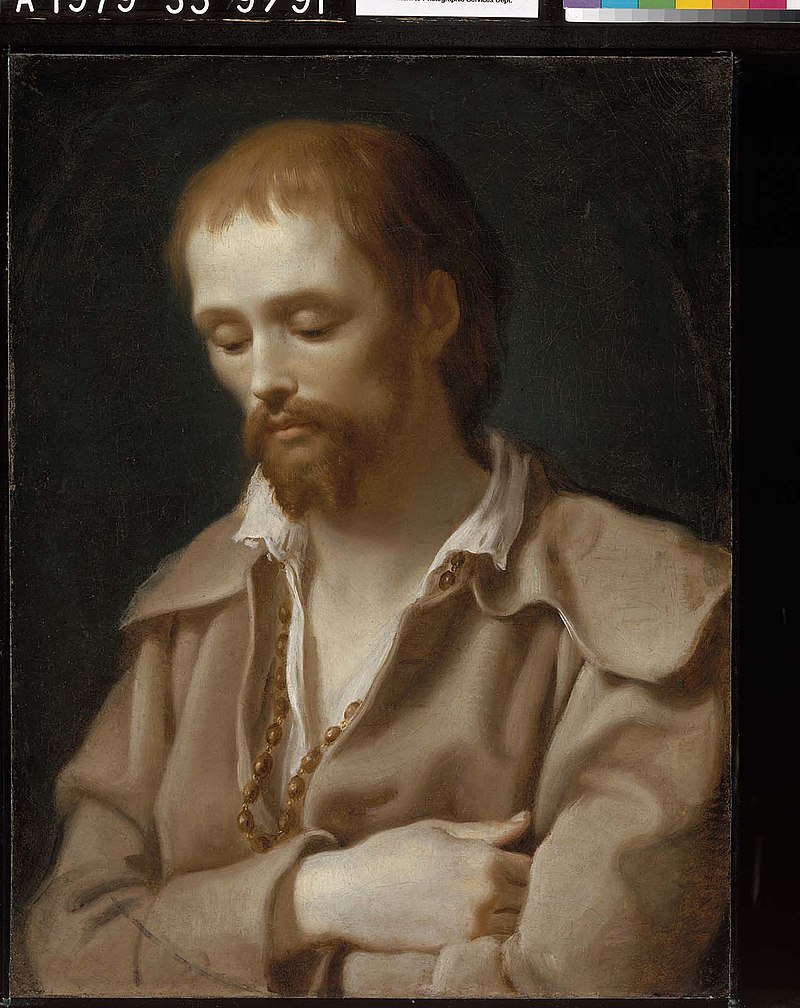
A grace-filled Holy Week to all our readers! As we await and prepare for the Resurrection about to dawn upon us, we might keep in mind two Benedicts: Pope Emeritus Benedict XVI, requiescat in pace, elected on this day in 2005; and today’s commemoration of the mystic pilgrim, Benedict Joseph Labre, who died on this[…]Continue reading→

My Name is Bernadette
April 16th is a propitious day, for besides the anniversary of Father de Valk’s death, who founded Catholic Insight in its print form decades ago, and the commemoration of the ‘two Benedicts’, mentioned in accompanying posts, today we also recall Saint Bernadette Soubirous, the young visionary to whom the Virgin Mary appeared numerous times at[…]Continue reading→
Saint Lydwina of Schiedam and Suffering Joyfully
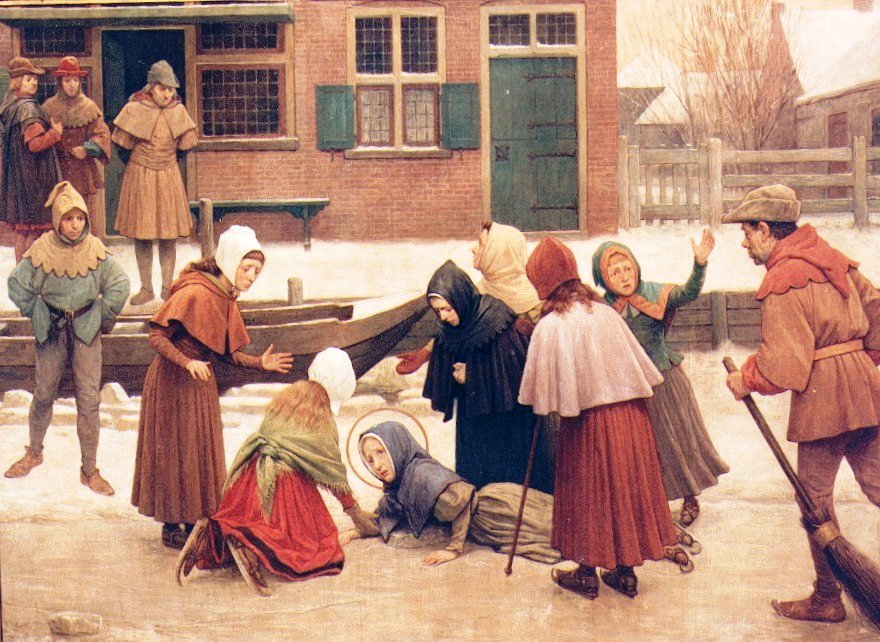
Saint Lydwina of Schiedam (1380 – 1433) was one of the countless and glorious ‘victim souls’ in the history of the Church, those whose lives are filled with suffering, often of an unimaginable intensity, but who suffer joyfully. She was a fifteen-year old Dutch girl, out skating one day, when she fell and broke one[…]Continue reading→
The Glorious Martyrdoms of Martin and Maximus
As we enter into Eastertide, we recall on this 13th of April Pope Saint Martin I (+655), one of the noblest, if most tragic, of the successors of Saint Peter. Born in Umbria, Italy, he was of noble lineage, with great intelligence combined with charity and love of the poor and the Church. While still[…]Continue reading→
Canonizing Sister Faustina and Divine Mercy
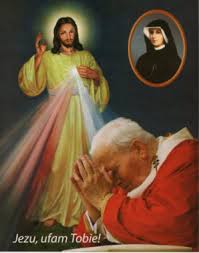
HOMILY OF THE HOLY FATHER MASS IN ST PETER’S SQUARE FOR THE CANONIZATION OF SR MARY FAUSTINA KOWALSKA Sunday, 30 April 2000 1. “Confitemini Domino quoniam bonus, quoniam in saeculum misericordia eius”; “Give thanks to the Lord for he is good; his steadfast love endures for ever” (Ps 118: 1). So the Church sings on the Octave of[…]Continue reading→

Divine Mercy Sunday – An Echo of Every Mass
Reach out your hand and put it in my side. Do not doubt but believe’… ‘My Lord and my God!’ (Jn. 20:18)). Today is Divine Mercy Sunday, and as we celebrate the end of the Easter Octave, we contemplate the wounded side of our Saviour, the Church’s source of life. On Good Friday in the[…]Continue reading→

Saint Stanislaus of Szczepanów
We celebrate Saint Stanislaus today (+ April 11, 1079), in light of this Easter Octave, a bishop and martyr who accepted the episcopacy only at the direct order of Pope Alexander II. He proved a wise and courageous leader of his flock, put to death by his own king, Boleslaus, for rebuking the monarch’s ‘immoral[…]Continue reading→
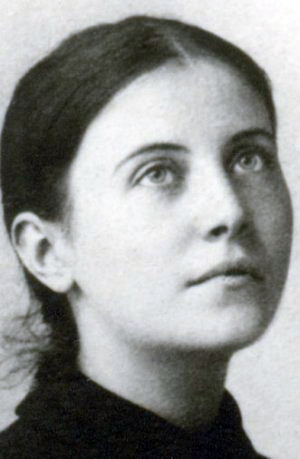
Saint Gemma Galgani
On this April 11th, in 1903 – the same year that the Italian Guiseppe Sarto was elected Pope later that summer as Pius X – a lovely, young Italian woman died, by the name of Gemma Galgani. She lived a brief life of 24 years, as did a number of other young saints, including Pier[…]Continue reading→