

‘Our Lady of Public Health’
On this feast of Saint Luke, physician and healer, it is a propos that we post a link to a series of insightful and intriguing essays on our health-and-safety obsessed world, by the doughty Douglas Farrow, professor of theology and ethics at McGill university. In his vivid words, he sums up our current, and very unhealthy, approach to health, under the title of ‘Our Lady of Public Health’, and please don’t get the wrong idea: This is a parody of the true Alma Mater Dei – nourishing Mother of God – and rather a distorted ‘devotion’, akin to the goddess of reason worshiped in those first heady days of the French Revolution – and the reader may refresh his memory of what happened afterwards – a bloody, top-down persecution by the state upon all who disagreed or were ‘anti-revolutionary’.
As Dr. Farrow implies, we can avoid such a fate, by getting back to reality, to the solid Catholic notion of subsidiarity, that health does not belong to the state, and that a one-size-fits-all, imposed from the top down, is a recipe for disaster. Treating everyone as a leper and pariah of everyone else is, by definition, in-sane – unhealthy in the extreme. And this is before we get to more malevolent theories of what is going on.
This fight isn’t over, even if we lost most of our bodily right and autonomy with the misguided notion of ‘universal health care’ for all. Keep in mind that whatever your views, there is still ‘vaxx-apartheid’ here in Canada. You cannot work in a hospital, nor adopt a child nor, apparently, even receive an organ donation – a death sentence for many – unless you are boosted up with the genetic mRNA therapy that they have taken to call a ‘vaccine’. And the evidence seems at this point well beyond any reasonable doubt that not only does this ‘therapy’ not seem to work, but is and has been harmful to many, even ad mortem:
Exhibit A, amongst untold others: The poster child for the ‘vaxx’ in Israel, Yonatan Moshe Erlichman, has just died of a heart attack – at the age of 8. And this after Argentina’s own poster child, Santino Godoy Blanco, ‘died suddenly‘ last year of double pneumonia.
We should not take schadenfreude at such dark and bitter ironies – this is a tragedy beyond such, and physicians and politicians will pay for whatever willful and culpable malfeasance, in this world, or the next. What is particularly disconcerting is the insouciance, if not outright compliance, of Catholics which, in the face of growing evidence, becoming ever-more difficult to justify and exculpate.
The first principle of medicine and all healing arts, bodily and spiritual – primum non nocere – seems to have been lost somewhere along the way, and we pray that in the path ahead they find it again.
At the very least, we should have the right to make up our own minds about our own bodies and health care, not least for our children, and not dictated to by some distant and faceless bureaucrat at an even more faceless organization called WHO – if said bureaucrat is even human, and not some AI cipher.
Truth and freedom – they go together in glory, or perish together in misery. The choice is yours, and all of ours.

Carney’s Amoral Majority
After five defections – euphemistically described as ‘crossing the floor’ – and three by-elections, Mark Carney and his Liberals how have their coveted majority. One wonders what bowls of pottage were offered in back-room deals. In the archaic monarchical system that is the Dominion of Canada, this majority allows the newly-minted Prime Minister to rule[…]Continue reading→

Saint Kateri , Canada’s Protectress
This was the title given to Saint Kateri Tekakwitha, by Pope Benedict XVI, when he canonized her on October 28th, 2012, along with six others, in Saint Peter’ Square (she had been beatified by Pope John Paul II back in 1980). With Saint Joseph as our protector, along with the Canadian martyrs, we seem to[…]Continue reading→

A Tale of Two Benedicts
A grace-filled Holy Week to all our readers! As we await and prepare for the Resurrection about to dawn upon us, we might keep in mind two Benedicts: Pope Emeritus Benedict XVI, requiescat in pace, elected on this day in 2005; and today’s commemoration of the mystic pilgrim, Benedict Joseph Labre, who died on this[…]Continue reading→

My Name is Bernadette
April 16th is a propitious day, for besides the anniversary of Father de Valk’s death, who founded Catholic Insight in its print form decades ago, and the commemoration of the ‘two Benedicts’, mentioned in accompanying posts, today we also recall Saint Bernadette Soubirous, the young visionary to whom the Virgin Mary appeared numerous times at[…]Continue reading→

Saint Lydwina of Schiedam and Suffering Joyfully
Saint Lydwina of Schiedam (1380 – 1433) was one of the countless and glorious ‘victim souls’ in the history of the Church, those whose lives are filled with suffering, often of an unimaginable intensity, but who suffer joyfully. She was a fifteen-year old Dutch girl, out skating one day, when she fell and broke one[…]Continue reading→

The Glorious Martyrdoms of Martin and Maximus
As we enter into Eastertide, we recall on this 13th of April Pope Saint Martin I (+655), one of the noblest, if most tragic, of the successors of Saint Peter. Born in Umbria, Italy, he was of noble lineage, with great intelligence combined with charity and love of the poor and the Church. While still[…]Continue reading→

Saint Stanislaus of Szczepanów
We celebrate Saint Stanislaus today (+ April 11, 1079), in light of this Easter Octave, a bishop and martyr who accepted the episcopacy only at the direct order of Pope Alexander II. He proved a wise and courageous leader of his flock, put to death by his own king, Boleslaus, for rebuking the monarch’s ‘immoral[…]Continue reading→

Saint Gemma Galgani
On this April 11th, in 1903 – the same year that the Italian Guiseppe Sarto was elected Pope later that summer as Pius X – a lovely, young Italian woman died, by the name of Gemma Galgani. She lived a brief life of 24 years, as did a number of other young saints, including Pier[…]Continue reading→

An Ideological and Improper Translation
I noticed something odd with the psalm reading at Mass the other day. Our bishops’ conference here in Canada has decreed that the Mass in English – Novus Ordo – use the ‘NRSV’, the ‘New Revised Standard Version’, an ‘updated’ translation of the original RSV, first published in 1952. This ‘new translation’ has the tendency[…]Continue reading→
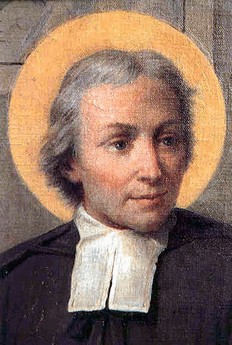
Saint Jean-Baptiste de la Salle: A Teacher for Teachers
Jean-Baptiste de la Salle (1651 – 1719), a French nobleman, ordained a priest, founded the first order in the Church’s history entirely without priests, and this came about almost by accident. I say ‘almost’, for, of course, there are no accidents with God. Destined for ordination from an early age, Jean-Baptiste never looked back, even[…]Continue reading→