
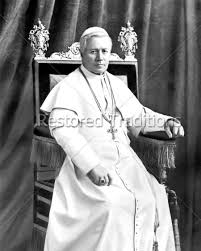
Pope Benedict and Pope Pius X
BENEDICT XVI
GENERAL AUDIENCE
Papal Summer Residence, Castel Gandolfo
Wednesday, 18 August 2010
Dear Brothers and Sisters,
Today I would like to reflect on my Predecessor, St Pius X whose liturgical Memorial we shall be celebrating next Saturday and to underline certain features that may be useful to both Pastors and faithful also in our time.
Giuseppe Sarto, that was his name, was born into a peasant family in Riese, Treviso, in 1835. After studying at the Seminary in Padua he was ordained a priest when he was 23 years old. He was first curate in Tombolo, then parish priest at Salzano and then canon of the Cathedral of Treviso with the offices of episcopal chancellor and spiritual director of the Diocesan Seminary. In these years of rich and generous pastoral experience, the future Pontiff showed that deep love for Christ and for the Church, that humility and simplicity and great charity to the needy which characterized his entire life. In 1884 he was appointed Bishop of Mantua, and in 1893, Patriarch of Venice. On 4 August 1903, he was elected Pope, a ministry he hesitated to accept since he did not consider himself worthy of such a lofty office.
Pius X’s Pontificate left an indelible mark on the Church’s history and was distinguished by a considerable effort for reform that is summed up in his motto: Instaurare Omnia in Christo, “To renew all things in Christ”. Indeed, his interventions involved various ecclesiastical contexts. From the outset he devoted himself to reorganizing the Roman Curia; he then began work on the Code of Canon Law which was promulgated by his Successor Benedict XV. He later promoted the revision of the studies and formation programme of future priests and founded various Regional Seminaries, equipped with good libraries and well-qualified teachers. Another important sector was that of the doctrinal formation of the People of God. Beginning in his years as parish priest, he himself had compiled a catechism and during his Episcopate in Mantua he worked to produce a single, if not universal catechism, at least in Italian. As an authentic Pastor he had understood that the situation in that period, due partly to the phenomenon of emigration, made necessary a catechism to which every member of the faithful might refer, independently of the place in which he lived and of his position. As Pontiff, he compiled a text of Christian doctrine for the Diocese of Rome that was later disseminated throughout Italy and the world. Because of its simple, clear, precise language and effective explanations, this “Pius X Catechism”, as it was called, was a reliable guide to many in learning the truths of the faith.
(To continue reading, please see here…)

Saint Kateri , Canada’s Protectress
This was the title given to Saint Kateri Tekakwitha, by Pope Benedict XVI, when he canonized her on October 28th, 2012, along with six others, in Saint Peter’ Square (she had been beatified by Pope John Paul II back in 1980). With Saint Joseph as our protector, along with the Canadian martyrs, we seem to[…]Continue reading→

Remembering Father Alphonse de Valk
(Today marks the sixth anniversary of the death of Father Alphonse de Valk, C.S.B., a faithful, courageous and indefatigable Basilian priest, pro-life-and-family apostle, and the founder of Catholic Insight magazine. Here is what we wrote those on his entering into eternity five years ago, as we continue to remember him in our prayers and thoughts)[…]Continue reading→

A Tale of Two Benedicts
A grace-filled Holy Week to all our readers! As we await and prepare for the Resurrection about to dawn upon us, we might keep in mind two Benedicts: Pope Emeritus Benedict XVI, requiescat in pace, elected on this day in 2005; and today’s commemoration of the mystic pilgrim, Benedict Joseph Labre, who died on this[…]Continue reading→

My Name is Bernadette
April 16th is a propitious day, for besides the anniversary of Father de Valk’s death, who founded Catholic Insight in its print form decades ago, and the commemoration of the ‘two Benedicts’, mentioned in accompanying posts, today we also recall Saint Bernadette Soubirous, the young visionary to whom the Virgin Mary appeared numerous times at[…]Continue reading→

Saint Lydwina of Schiedam and Suffering Joyfully
Saint Lydwina of Schiedam (1380 – 1433) was one of the countless and glorious ‘victim souls’ in the history of the Church, those whose lives are filled with suffering, often of an unimaginable intensity, but who suffer joyfully. She was a fifteen-year old Dutch girl, out skating one day, when she fell and broke one[…]Continue reading→

The Glorious Martyrdoms of Martin and Maximus
As we enter into Eastertide, we recall on this 13th of April Pope Saint Martin I (+655), one of the noblest, if most tragic, of the successors of Saint Peter. Born in Umbria, Italy, he was of noble lineage, with great intelligence combined with charity and love of the poor and the Church. While still[…]Continue reading→

Canonizing Sister Faustina and Divine Mercy
HOMILY OF THE HOLY FATHER MASS IN ST PETER’S SQUARE FOR THE CANONIZATION OF SR MARY FAUSTINA KOWALSKA Sunday, 30 April 2000 1. “Confitemini Domino quoniam bonus, quoniam in saeculum misericordia eius”; “Give thanks to the Lord for he is good; his steadfast love endures for ever” (Ps 118: 1). So the Church sings on the Octave of[…]Continue reading→

Divine Mercy Sunday – An Echo of Every Mass
Reach out your hand and put it in my side. Do not doubt but believe’… ‘My Lord and my God!’ (Jn. 20:18)). Today is Divine Mercy Sunday, and as we celebrate the end of the Easter Octave, we contemplate the wounded side of our Saviour, the Church’s source of life. On Good Friday in the[…]Continue reading→

Saint Stanislaus of Szczepanów
We celebrate Saint Stanislaus today (+ April 11, 1079), in light of this Easter Octave, a bishop and martyr who accepted the episcopacy only at the direct order of Pope Alexander II. He proved a wise and courageous leader of his flock, put to death by his own king, Boleslaus, for rebuking the monarch’s ‘immoral[…]Continue reading→

Saint Gemma Galgani
On this April 11th, in 1903 – the same year that the Italian Guiseppe Sarto was elected Pope later that summer as Pius X – a lovely, young Italian woman died, by the name of Gemma Galgani. She lived a brief life of 24 years, as did a number of other young saints, including Pier[…]Continue reading→