
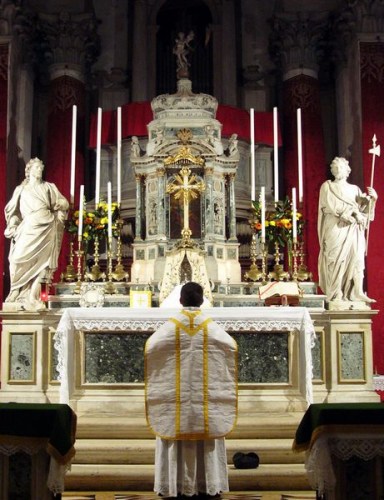
Would That We All Were Bold Restorers
What is a ‘restorer’? One restores buildings, books, institutions, and it seems a good thing to do so. Pope Saint Pius X’s motto was instaurare omnia in Christo – to restore all things in Christ, a mission he accomplished with great gusto in the time given to him. Why Pope Francis thinks this a bad thing is a mystery. What might he mean criticizing all those ‘restorers’ in America? His implication is that they want to reject the Second Vatican Council, or at least its spirit. But like so many of his criticisms and condemnations, the term is left ambiguous.
In a recent article in First Things, Jayd Hendricks, former executive director of government relations for the U.S. Conference of Catholic Bishops, tries to allay the Pope’s fears, claiming that, barring a few fringe elements, everyone in America is fully on board with Vatican II, and here is his evidence:
Latin is largely extinct. The clericalism of the pre-conciliar period, and blind loyalty to priests and bishops, is just a memory. The manualism of Catholic morality is dead. Contemporary music at Mass is the norm. Ecumenical and interreligious dialogue is taken seriously. Religious freedom is extolled.
Let’s begin with the two most glaring.
The Second Vatican Council did not abolish Latin, but did the precise opposite, mandating its continued use, at least liturgically, in no uncertain terms, with a few exceptions permitted for the vernacular.
Particular law remaining in force, the use of the Latin language is to be preserved in the Latin rites (Constitution on the Sacred Liturgy, Sacrosanctum Concilium, 36.1)
And:
Nevertheless steps should be taken so that the faithful may also be able to say or to sing together in Latin those parts of the Ordinary of the Mass which pertain to them (ibid., 55)
As well, the breviary:
The work of revising the psalter, already happily begun, is to be finished as soon as possible, and is to take into account the style of Christian Latin, the liturgical use of psalms, also when sung, and the entire tradition of the Latin Church. (ibid., 91)
For priests:
In accordance with the centuries-old tradition of the Latin rite, the Latin language is to be retained by clerics in the divine office. (101.1)
And, of course, to pray in Latin, one must begin with those studying for the priesthood:
Before beginning specifically ecclesiastical subjects, seminarians should be equipped with that humanistic and scientific training which young men in their own countries are wont to have as a foundation for higher studies. Moreover they are to acquire a knowledge of Latin which will enable them to understand and make use of the sources of so many sciences and of the documents of the Church (Decree on Priestly Formation, Optatam Totius, 13)
On the very eve of the Council, in 1962, Pope John XXIII, promulgated the Apostolic Constitution Veterum Sapienta (Ancient Wisdom) which explicitly prescribed the preservation of Latin as the language of the Church, in education and sacramentally. (A brief read, and well worth it).
Most of the Church’s doctrinal, liturgical and musical treasures – of inestimable worth – is in Latin. If we may rephrase a dictum of Saint Jerome: To be ignorant of Latin is to be ignorant of much of the Church’s Tradition. Oh, and the official version of Scripture, translated by the same Saint Jerome, is also in Latin.
While we’re at it, all of the conciliar discussions were conducted, and all the documents were written, in, yes, Latin.
In sum, to neglect or reject Latin is also to do the same with the Council.
Music? I’m not sure what Mr. Hendricks means by ‘contemporary’ hymns; anything composed after the Council? Again, we may return to Sacrosanctum:
The Church acknowledges Gregorian chant as specially suited to the Roman liturgy (ut liturgiae romanae proprium): therefore, other things being equal, it should be given pride of place (principem locum) in liturgical services. But other kinds of sacred music, especially polyphony, are by no means excluded from liturgical celebrations (116)
And:
The typical edition of the books of Gregorian chant is to be completed; and a more critical edition is to be prepared of those books already published since the restoration by St. Pius X. (ibid., 117)
When was the last time you heard Gregorian chant or sacred polyphony in a Catholic church, outside of a TLM? For that matter, how many priests, or even bishops, even know a smattering of Latin, never mind a competent comprehension?
The rest of Mr. Hendrick’s telling paragraph deserves some mention.
Manualism? The theological manuals had, and still have, their place, as useful summaries of moral theology, as applied to particular and often difficult, questions. There may well have too much dependence on them, and a return to the original sources in order. But we should not throw away such treasures with the bathwater.
‘Clericalism’ is a bogey man with almost no workable definition. The Council supported the proper authority of bishops, which is being undermined by this Magisterium.
‘Blind loyalty’ is rarely a morally sound option, but how prevalent was it before the Council? One need only peruse the life of Teresa of Avila or Catherine of Siena or Mary MacKillop to see how saintly women sure of their own mind, or, more properly, of God’s will, could speak this truth boldly to their own bishops, and, yes, to the Holy Father himself.
Ecumenical dialogue has existed since the time of Saint Paul’s mission to the Jews and the Greeks, and his famous address to the people of Athens and their ‘unknown God’. And what of Athanasius to the Arians, Pope Martin and many others to the Eastern Church, Dominic to the Cathars, Thomas to the Muslims in his Summa contra Gentiles, Francis de Sales to the Calvinists of Geneva, Peter Canisius to the Lutherans of Germany, Newman to his beloved Anglicans. The Council wanted to bring back and invigorate this great ecumenical endeavour of the Church, overlapping with her explicit missionary work, without diminution or loss of the truth, and warns explicitly against a false irenicism and syncretism. When read properly, the Fathers exhorted us to take the treasures of our Tradition, and bring them out to the modern world, not to modernize the Church and corrupt her by the world, and ‘reforming’ only when necessary.
In other words, instaurare omnia in Christo. I like the sound of that. The Latin just rolls off the tongue, especially when pronounced with a wee bit of a brogue.
To paraphrase an old Irish tune, we should all be bold restorers.

Carney’s Amoral Majority
After five defections – euphemistically described as ‘crossing the floor’ – and three by-elections, Mark Carney and his Liberals how have their coveted majority. One wonders what bowls of pottage were offered in back-room deals. In the archaic monarchical system that is the Dominion of Canada, this majority allows the newly-minted Prime Minister to rule[…]Continue reading→

Saint Kateri , Canada’s Protectress
This was the title given to Saint Kateri Tekakwitha, by Pope Benedict XVI, when he canonized her on October 28th, 2012, along with six others, in Saint Peter’ Square (she had been beatified by Pope John Paul II back in 1980). With Saint Joseph as our protector, along with the Canadian martyrs, we seem to[…]Continue reading→
A Closed, Unsustainable, Descending Loop
As a follow-up to my thoughts on Payette’s payout, here be a stark image of where are here in Canada. As the graph shows in, well, graphic terms, since 2025, the public sector has contributed to 95.5% of economic growth. The private sector – which funds the public sector, or is supposed to – has[…]Continue reading→

A Tale of Two Benedicts
A grace-filled Holy Week to all our readers! As we await and prepare for the Resurrection about to dawn upon us, we might keep in mind two Benedicts: Pope Emeritus Benedict XVI, requiescat in pace, elected on this day in 2005; and today’s commemoration of the mystic pilgrim, Benedict Joseph Labre, who died on this[…]Continue reading→

My Name is Bernadette
April 16th is a propitious day, for besides the anniversary of Father de Valk’s death, who founded Catholic Insight in its print form decades ago, and the commemoration of the ‘two Benedicts’, mentioned in accompanying posts, today we also recall Saint Bernadette Soubirous, the young visionary to whom the Virgin Mary appeared numerous times at[…]Continue reading→
Presidential Pardon of Weronika Krawczyk
As a good news, follow-up to our story from Poland, of the persecution of Weronika Krawczyk for her pro-life views, we heard that she has been granted a presidential pardon. One might still wonder why one needs a presidential pardon for simply holding the long-held belief that the child within the womb is a child,[…]Continue reading→

Saint Lydwina of Schiedam and Suffering Joyfully
Saint Lydwina of Schiedam (1380 – 1433) was one of the countless and glorious ‘victim souls’ in the history of the Church, those whose lives are filled with suffering, often of an unimaginable intensity, but who suffer joyfully. She was a fifteen-year old Dutch girl, out skating one day, when she fell and broke one[…]Continue reading→

The Glorious Martyrdoms of Martin and Maximus
As we enter into Eastertide, we recall on this 13th of April Pope Saint Martin I (+655), one of the noblest, if most tragic, of the successors of Saint Peter. Born in Umbria, Italy, he was of noble lineage, with great intelligence combined with charity and love of the poor and the Church. While still[…]Continue reading→
Pope Leo and a Rosary for Peace
Pope Leo XIV has asked Catholics across the world to join him in a Rosary for peace today, at 18:00 Rome time (6 pm), which would be noon from where I write (EST). If you are able, whether at that time or another, and in whatever way you pray, to join in intercession with the[…]Continue reading→
Payette’s Payout
I was glancing through some headlines, and noticed a mention of Julie Payette – engineer and astronaut and sometime the Queen’s representative in Canada – which brought back vague memories. She was appointed Governor-General by Justin Trudeau in 2017. Ms. Payette resigned in 2021, amidst claims that she created a ‘toxic work environment’, with allegations[…]Continue reading→