
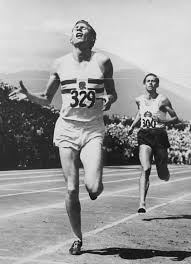
The Barrier of Bannister’s Mile
On May 6th, 1954, on a make-do track field in Oxford, in windy and blustery conditions, medical student Roger Bannister broke what some thought was the unbreakable barrier of the four-minute mile. Paced for the first three-quarters by Chris Brasher – who was not so brash as to stop Bannister’s place in history – Bannister broke free for the last stretch, giving it his all, and crossed the finish line in 3 minutes and 59.4 seconds, to the thunderous cheer of the crowds. Since then, innumerable once-thought-unbeatable records have been broken – the current mile record stands at 3:43:13 by Hicham El Guerrouj on July 7, 1999. And the mile is regularly broken even at the high school level.
The hundred metre dash? Usain Bolt, with his natural physiognomy adapted to sprinting, has run it faster than perhaps any man ever will – 9.58 seconds in 2016. But who’s to say? One could go through the records – weightlifting, high and long jumping, swimming, cycling – and they keep getting broken, but the intervals are getting smaller and smaller, more and more, perhaps, asymptotic.
And by ‘asymptotic’, we mean that there may indeed be a limit, a point beyond which the unaided human body simply, by the sheer force of physical laws, cannot go. Race horses seem to have reached this limit, for after a certain speed, their legs would simply break. But what if their bones were made stronger?
If you’d like a scientific discussion of this question, and whether sports may soon reach its limit, peruse this article.
But if you’re fan of the ‘singularity’ – a proposed seamless harmony between man and machine, in both mind and body – then physiological limits don’t mean that much. But who wants to watch robots or cyborgs compete? The whole point is the striving of the human will, the spirit, mens supra materiam, mind over matter – that indefinable element in all sports, where the underdog may triumph over what seem impossible odds.
And the word ‘impossible’ does not seem to be included in the vocabulary of God. At least, we have authoritative testimony, and precedents, that it be so.

Carney’s Amoral Majority
After five defections – euphemistically described as ‘crossing the floor’ – and three by-elections, Mark Carney and his Liberals how have their coveted majority. One wonders what bowls of pottage were offered in back-room deals. In the archaic monarchical system that is the Dominion of Canada, this majority allows the newly-minted Prime Minister to rule[…]Continue reading→

Saint Kateri , Canada’s Protectress
This was the title given to Saint Kateri Tekakwitha, by Pope Benedict XVI, when he canonized her on October 28th, 2012, along with six others, in Saint Peter’ Square (she had been beatified by Pope John Paul II back in 1980). With Saint Joseph as our protector, along with the Canadian martyrs, we seem to[…]Continue reading→
A Closed, Unsustainable, Descending Loop
As a follow-up to my thoughts on Payette’s payout, here be a stark image of where are here in Canada. As the graph shows in, well, graphic terms, since 2025, the public sector has contributed to 95.5% of economic growth. The private sector – which funds the public sector, or is supposed to – has[…]Continue reading→

A Tale of Two Benedicts
A grace-filled Holy Week to all our readers! As we await and prepare for the Resurrection about to dawn upon us, we might keep in mind two Benedicts: Pope Emeritus Benedict XVI, requiescat in pace, elected on this day in 2005; and today’s commemoration of the mystic pilgrim, Benedict Joseph Labre, who died on this[…]Continue reading→

My Name is Bernadette
April 16th is a propitious day, for besides the anniversary of Father de Valk’s death, who founded Catholic Insight in its print form decades ago, and the commemoration of the ‘two Benedicts’, mentioned in accompanying posts, today we also recall Saint Bernadette Soubirous, the young visionary to whom the Virgin Mary appeared numerous times at[…]Continue reading→
Presidential Pardon of Weronika Krawczyk
As a good news, follow-up to our story from Poland, of the persecution of Weronika Krawczyk for her pro-life views, we heard that she has been granted a presidential pardon. One might still wonder why one needs a presidential pardon for simply holding the long-held belief that the child within the womb is a child,[…]Continue reading→

Saint Lydwina of Schiedam and Suffering Joyfully
Saint Lydwina of Schiedam (1380 – 1433) was one of the countless and glorious ‘victim souls’ in the history of the Church, those whose lives are filled with suffering, often of an unimaginable intensity, but who suffer joyfully. She was a fifteen-year old Dutch girl, out skating one day, when she fell and broke one[…]Continue reading→

The Glorious Martyrdoms of Martin and Maximus
As we enter into Eastertide, we recall on this 13th of April Pope Saint Martin I (+655), one of the noblest, if most tragic, of the successors of Saint Peter. Born in Umbria, Italy, he was of noble lineage, with great intelligence combined with charity and love of the poor and the Church. While still[…]Continue reading→
Pope Leo and a Rosary for Peace
Pope Leo XIV has asked Catholics across the world to join him in a Rosary for peace today, at 18:00 Rome time (6 pm), which would be noon from where I write (EST). If you are able, whether at that time or another, and in whatever way you pray, to join in intercession with the[…]Continue reading→
Payette’s Payout
I was glancing through some headlines, and noticed a mention of Julie Payette – engineer and astronaut and sometime the Queen’s representative in Canada – which brought back vague memories. She was appointed Governor-General by Justin Trudeau in 2017. Ms. Payette resigned in 2021, amidst claims that she created a ‘toxic work environment’, with allegations[…]Continue reading→