
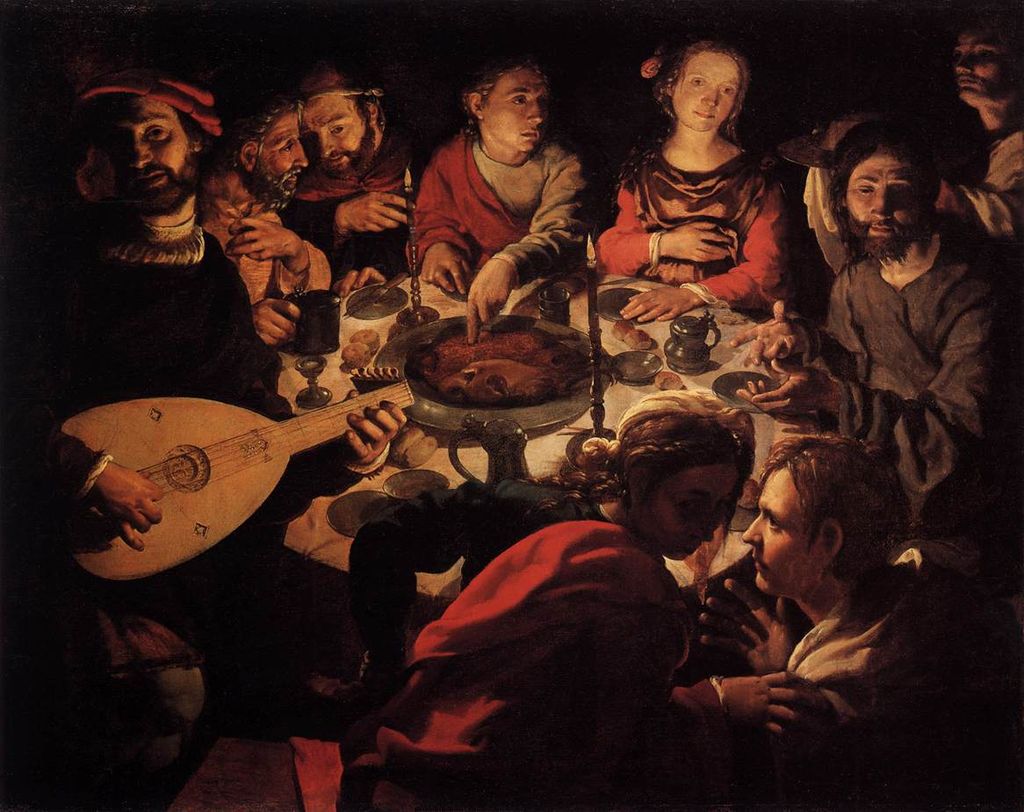
The Wedding at Cana: An In-Law’s Perspective
Dedicated to Rita Ann Knuffman
As the old proverb, now meme, goes, “Blood is thicker than water”. Blood meaning family, and more specifically, individuals who share a blood relationship to each other and water of course is everyone else, friends, neighbors, strangers, and perhaps in-laws. Thicker can only be construed as greater than, better than, more important than. Anyone married or related through a marriage has probably experienced both thicker and thinner. The idea of it seems justified, it helps us stay comfortable with the validity of our own familial histories and loyalties in stark contrast to the often perceived dubious and indeed unknown perspectives of everyone else. This is well illustrated by the joke:
Question: “What’s the difference between an In-Law and an Out-Law?”
Answer: “An Out-Law is wanted.”
The recent loss of my wife’s mother prompted some serious reconsideration of the in-law meme, because, in this case, it simply didn’t apply. She was a person of deep Catholic faith and traditional family values and never treated her in-laws as anything but true family members. It seemed so natural for her, and so unnatural to my expectation. And the strangest part, she received reciprocal respect, it was infectious. I wanted to do for her as I would my own mother. To better appreciate her wonderful approach to marriage and in-laws, I took a second look at one of the more prominent scriptural marriages, the Wedding at Cana.
In the New Testament, John 2:11 describes a Wedding at Cana to which Jesus, his mother, and disciples were invited. In the middle of the festivities, the wine runs out. Clearly, without wine, there would be embarrassment, the marriage and future relations might be severely damaged. But Jesus remedies the situation by turning several jars of water into wine, a red wine, a good wine. The wedding is quietly saved, strife abated, and all is at peace again. This was Jesus’s first miracle, his coming out so to speak. But as miracles go, it seems superfluous, certainly far less important than the raising of Lazarus by contrast. One would think Jesus would want to start things off with a big splash, not something so esoteric.
There are many perspectives on the meaning of this miracle. Pope Benedict XVI cemented the importance of the miracle in his homily on the feast of Epiphany:
John’s Gospel … invites us to consider as an “epiphany” the Wedding at Cana, during which, by changing the water into wine, Jesus “manifested his glory; and his disciples believed in him” (Jn 2:11).
As with many scriptural passages, attributions of meaning vary widely. Some think Cana represents Christ’s approval of marriage and earthly celebrations. Others refer to it as an argument against teetotalism. These interpretations all have merit in the context of the interpreter. None of these interpretations, however, seem directed at marriage and resulting family relations. Perhaps an understanding of why Jesus might choose a wedding for his first miracle is significant. After all, it could have been performed anywhere; someone’s home for a dinner party, a vineyard, or perhaps a pub. In all of these situations, the same previous interpretations can be gleaned. But a wedding has a uniquely interesting feature compared to any other random venue which could provide the perfect situation for Jesus to reveal his future intentions.
The purpose of a wedding, at its essence, is a place where strangers are transformed into family, or, substituting the words from the old proverb, water is transformed into blood. This is key. In the scriptures, wine and blood are synonymous with Jesus, so at Cana, Jesus’ miracle can also be seen as transforming water into blood, the wine. Jesus might be using a wedding for his first miracle because the wedding itself is an analogy to explain the miracle. The transformation of water to wine represents, in the context of a wedding, the transformation of each of us as strangers, water, into family, wine, or blood, Jesus’ blood. This may be why Jesus chose the Wedding at Cana as the site for his first miracle, it represents the entirety of his teachings to come, that Jesus will be the transformer who can turn us all from strangers into his blood relatives. In this perspective, Jesus’ first miracle was indeed a big splash.
There is another, and perhaps instructive, reverse aspect of this interpretation as relates to the two marriage families. Because Jesus performs the miracle at a wedding, the miracle can also be seen as an analogy for marriage. In that regard, Jesus is elevating marriage beyond name and property transfer alone, he would be saying that a marriage, like the miracle, transforms its participants into blood relatives with Jesus again as the transformer. Given this idea, how much more important does the value of marriage become at Cana especially with respect to an understanding of in-laws. Jesus transforms water into wine and so also marriage transforms our mothers-in-law into our mothers and our sons and daughters in-law into our sons and daughters.
Perhaps my late mother-in-law inherently understood and practiced these ideas. Certainly her deep respect for marriage, especially as related to her faith, contributed to her easy acceptance of in-laws as true family. Her scriptural understanding of marriage meant that she didn’t differentiate between “us” and “them”, there was simply all of us.

Saint Kateri , Canada’s Protectress
This was the title given to Saint Kateri Tekakwitha, by Pope Benedict XVI, when he canonized her on October 28th, 2012, along with six others, in Saint Peter’ Square (she had been beatified by Pope John Paul II back in 1980). With Saint Joseph as our protector, along with the Canadian martyrs, we seem to[…]Continue reading→

Remembering Father Alphonse de Valk
(Today marks the sixth anniversary of the death of Father Alphonse de Valk, C.S.B., a faithful, courageous and indefatigable Basilian priest, pro-life-and-family apostle, and the founder of Catholic Insight magazine. Here is what we wrote those on his entering into eternity five years ago, as we continue to remember him in our prayers and thoughts)[…]Continue reading→

My Name is Bernadette
April 16th is a propitious day, for besides the anniversary of Father de Valk’s death, who founded Catholic Insight in its print form decades ago, and the commemoration of the ‘two Benedicts’, mentioned in accompanying posts, today we also recall Saint Bernadette Soubirous, the young visionary to whom the Virgin Mary appeared numerous times at[…]Continue reading→

Canonizing Sister Faustina and Divine Mercy
HOMILY OF THE HOLY FATHER MASS IN ST PETER’S SQUARE FOR THE CANONIZATION OF SR MARY FAUSTINA KOWALSKA Sunday, 30 April 2000 1. “Confitemini Domino quoniam bonus, quoniam in saeculum misericordia eius”; “Give thanks to the Lord for he is good; his steadfast love endures for ever” (Ps 118: 1). So the Church sings on the Octave of[…]Continue reading→

Divine Mercy Sunday – An Echo of Every Mass
Reach out your hand and put it in my side. Do not doubt but believe’… ‘My Lord and my God!’ (Jn. 20:18)). Today is Divine Mercy Sunday, and as we celebrate the end of the Easter Octave, we contemplate the wounded side of our Saviour, the Church’s source of life. On Good Friday in the[…]Continue reading→

Saint Stanislaus of Szczepanów
We celebrate Saint Stanislaus today (+ April 11, 1079), in light of this Easter Octave, a bishop and martyr who accepted the episcopacy only at the direct order of Pope Alexander II. He proved a wise and courageous leader of his flock, put to death by his own king, Boleslaus, for rebuking the monarch’s ‘immoral[…]Continue reading→

First Holy Communion: Sermon from May 16, 1943
Here is a sermon from the good old days by +Rev. Msgr. Vincent Nicholas Foy (August 14, 1915 – March 13, 2017), from 1943. Readers may recall that Pope Saint Pius X, by the decree Quam Singulari in 1910, lowered the customary age of reception of Holy Communion – after the rigours of the plague[…]Continue reading→

In the Glorious Light of Easter, Alleluia!
Set your minds on things that are above, not on things that are on earth, for you have died, and your life is hidden with Christ in God. When Christ who is your life is revealed, then you also will be revealed with him in glory (Col. 3:3-4). The Resurrection of Our Lord and Saviour[…]Continue reading→

An Ancient Homily for Holy Saturday
The time between Good Friday and Easter Sunday is one of waiting, in silence, as the world wonders – anticipates – what will happen, after the death of Christ. We re-live this time each year in the anamnesis of our liturgy, and in turn look forward to the glorious re-creation of all things at the[…]Continue reading→

Europe’s Long Descent
(As we meditate on this day on Christ’s burial, and His descent into hell, it is fitting to ponder here with contributor Peter Marcus how the world seems to be heading there as well. The difference is that, although God cannot ‘redeem’ hell, nor those therein, He can and did redeem the world. There is[…]Continue reading→