
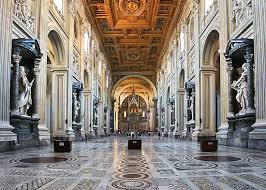
Pretense at Saint John Lateran
Pretense:
- A false appearance or action intended to deceive.
- A professed but feigned reason or excuse; a pretext.
- Something imagined or pretended. (https://www.wordnik.com/words/pretense)
What term does one use for what happened at the cathedral of Saint John Lateran last week, on Tuesday, April 18th? A group of Anglican divines – not priests, still less bishops – said a service in the apse of the primary Church of Christendom, the Pope’s own cathedral.
…a group of about 50 priests, accompanied by their bishop, all belonging to the Anglican Communion, celebrated at the main altar of Rome’s cathedral, contravening canonical norms.
They prayed, we may presume, what they thought was a ‘Mass’ of sorts, which is ironic, as the forebears and founders of their religion, the Tudors, Henry and Elizabeth, Cranmer, Cromwell, the Seymours, and the rest of them, would stop at nothing to stamp out the ‘Holy Sacrifice’ – as well as the priesthood, while we’re at it. That was the point of the gibbet at Tyburn, the martyrs too numerous to be counted, the victims drowned in rivers of blood. Attending Mass, or even being in possession of a Roman Missal or a Rosary, was a capital offence, for which one would be hung, drawn and quartered.
Yet, here were their spiritual descendants, less anti-Catholic as the centuries have rolled on. Still, the sacramental ‘orders’ they presume to have were declared null and void by Pope Leo XIII’s 1896 Constitution, Apostolicae Curae.
When I teach my students about the sacraments working ex opere operato – from the ‘work being worked’, or from the very signifying act itself – I ask them what would happen if I were to say ‘Mass’, or try to – and they rightly answer ‘nothing’.
But not quite nothing, for it would be a gross irreverence, if not a sacrilege, especially if I were out to deceive people.
Now, the Anglicans were just being Anglicans, not pretending to be Catholics, and may not know any better, perhaps not cognizant of canonical norms – ignorantes sine culpa and all that. But the bishops and priests in charge of the cathedral should know, and they are now backtracking, citing a ‘miscommunication’ in allowing this:
A statement April 20 from the Lateran Chapter said Bishop Di Tora “expresses deep regret for what happened last Tuesday, April 18, inside the Basilica of St. John in Rome.
The initial justification was a spirit of ecumenical ‘reciprocity’, even though the be-robed ministers could easily have held their service in any one of the Anglican ecclesial buildings in Rome, where they wouldn’t have twelve oversized statues of the Apostles staring down at them.
Another irony, pointed out by many, is that someone in some sort of authority must have given permission for 50 Anglican divines to pretend to say Mass in the main church of the Church, but just try getting permission to say a TLM anywhere near there. As Liam Neeson might put it, ‘good luck’.
Benedictine Father Martin Browne, an official at the Dicastery for Promoting Christian Unity, admitted it would have been more appropriate if this dicastery and other relevant entities of the Holy See had been involved in considering the request.
Indeed. We may hope that sanity still resides somewhere in Rome, that this debacle was unintended by the highers-up, and doesn’t happen again. But one does wonder…’Tis easier to ask forgiveness than permission, and a misdeed done is easier to do once, twice, three times more.
The Church used to be stricter about ecumenical endeavours, as one may gather from a brief perusal of Pius XI’s 1928 encyclical Mortalium Annos, when Catholics were scarcely ever allowed even to enter a Protestant building, never mind be present at their services. Perhaps it’s time to revisit some of those principles and practices, which were not uncharitable, but rather spoke to a deeper charity: Maintaining the distinctions between true and false worship – and consequent teaching – allows those outside the Church founded by Christ more easily to see and accept the fullness of truth, clearly and without compromise.

Carney’s Amoral Majority
After five defections – euphemistically described as ‘crossing the floor’ – and three by-elections, Mark Carney and his Liberals how have their coveted majority. One wonders what bowls of pottage were offered in back-room deals. In the archaic monarchical system that is the Dominion of Canada, this majority allows the newly-minted Prime Minister to rule[…]Continue reading→

Saint Kateri , Canada’s Protectress
This was the title given to Saint Kateri Tekakwitha, by Pope Benedict XVI, when he canonized her on October 28th, 2012, along with six others, in Saint Peter’ Square (she had been beatified by Pope John Paul II back in 1980). With Saint Joseph as our protector, along with the Canadian martyrs, we seem to[…]Continue reading→

A Tale of Two Benedicts
A grace-filled Holy Week to all our readers! As we await and prepare for the Resurrection about to dawn upon us, we might keep in mind two Benedicts: Pope Emeritus Benedict XVI, requiescat in pace, elected on this day in 2005; and today’s commemoration of the mystic pilgrim, Benedict Joseph Labre, who died on this[…]Continue reading→

My Name is Bernadette
April 16th is a propitious day, for besides the anniversary of Father de Valk’s death, who founded Catholic Insight in its print form decades ago, and the commemoration of the ‘two Benedicts’, mentioned in accompanying posts, today we also recall Saint Bernadette Soubirous, the young visionary to whom the Virgin Mary appeared numerous times at[…]Continue reading→

Saint Lydwina of Schiedam and Suffering Joyfully
Saint Lydwina of Schiedam (1380 – 1433) was one of the countless and glorious ‘victim souls’ in the history of the Church, those whose lives are filled with suffering, often of an unimaginable intensity, but who suffer joyfully. She was a fifteen-year old Dutch girl, out skating one day, when she fell and broke one[…]Continue reading→

The Glorious Martyrdoms of Martin and Maximus
As we enter into Eastertide, we recall on this 13th of April Pope Saint Martin I (+655), one of the noblest, if most tragic, of the successors of Saint Peter. Born in Umbria, Italy, he was of noble lineage, with great intelligence combined with charity and love of the poor and the Church. While still[…]Continue reading→

Saint Stanislaus of Szczepanów
We celebrate Saint Stanislaus today (+ April 11, 1079), in light of this Easter Octave, a bishop and martyr who accepted the episcopacy only at the direct order of Pope Alexander II. He proved a wise and courageous leader of his flock, put to death by his own king, Boleslaus, for rebuking the monarch’s ‘immoral[…]Continue reading→

Saint Gemma Galgani
On this April 11th, in 1903 – the same year that the Italian Guiseppe Sarto was elected Pope later that summer as Pius X – a lovely, young Italian woman died, by the name of Gemma Galgani. She lived a brief life of 24 years, as did a number of other young saints, including Pier[…]Continue reading→
An Ideological and Improper Translation
I noticed something odd with the psalm reading at Mass the other day. Our bishops’ conference here in Canada has decreed that the Mass in English – Novus Ordo – use the ‘NRSV’, the ‘New Revised Standard Version’, an ‘updated’ translation of the original RSV, first published in 1952. This ‘new translation’ has the tendency[…]Continue reading→
Saint Jean-Baptiste de la Salle: A Teacher for Teachers
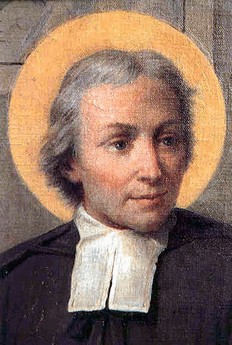
Jean-Baptiste de la Salle (1651 – 1719), a French nobleman, ordained a priest, founded the first order in the Church’s history entirely without priests, and this came about almost by accident. I say ‘almost’, for, of course, there are no accidents with God. Destined for ordination from an early age, Jean-Baptiste never looked back, even[…]Continue reading→