
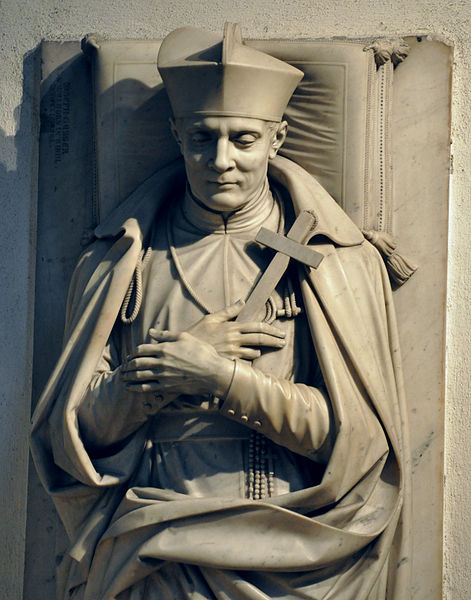
The Tremendous Work of Clement Mary Hofbauer
The tumultuous life of Saint Clement Mary Hofbauer (1751 – 1820) proves what the devil once admitted to the Cure d’Ars, that if there but three priests like him, his kingdom would be destroyed. Clement was one such priest, totally dedicated to his mission and work for Christ’s own kingdom.
Events precluded Johannes – his birth name – for many years from following his desire to become a priest – not least, his family’s poverty – his father died when he was but six – and his lack of education. So he became a baker and a hermit instead – which I suppose sort of go together. He made a pilgrimage to Rome in 1782, staying there for some time, before returning to his native Bruck. By the aid of benefactors, he completed his philosophy degree at the University of Vienna, and, in 1784, at the age of 33, he and a companion set off on foot once again for Rome, this time joining the Redemptorists on March 19, 1785, and ten days later (!) were ordained to the priesthood.
He took the name Clement Mary in religion, and, hand to the plow, never looked back. His priestly work was tremendous in all senses of the word, nearly superhuman, as he fulfilled every task in the time that was to be given him. He first was a missionary to Poland, then to Vienna, during some of the most tumultuous times of history, in that age of revolution. Father Clement kept his eyes on the prize, involved in almost every apostolate of the Church – sacramental ministry, preaching, education, taking care of the untold number of orphans – as he struggled against secular emperors and potentates, not least Joseph II, who closed every seminary, monastery and religious house in his realm. Almost singlehandedly, Clement – by prayer, writing, and preaching – prevented Germany from going into schism under the lead of the priest Ignaz Wessenberg – would that the Redemptorist had lived to see Germany in 2023. We’re going to need a new Clement Hofbauer.
At one point, in 1791, as the French Revolution raged in France, Clement and his Redemptorists decided to begin a ‘perpetual mission’ at their centre in Warsaw, and I will allow Wikipedia give a description:
In the church, Hofbauer and the community of five Redemptorist priests and three lay brothers began what they called the Perpetual Mission. Instead of celebrating only a morning Mass in the church on a weekday, they conducted a full-scale mission every day of the year. One could attend St. Benno’s every day and be able to hear five sermons both in German and Polish. There were three High Masses, the office of the Blessed Virgin Mary, public visits to the Blessed Sacrament, the Way of the Cross, vespers, prayer services, and litanies. And priests were available for confessions all hours of the day and night. In 1793, Hofbauer was made vicar-general of the Congregation north of the Alps. With Warsaw as center, he undertook the foundation of new establishments of the Congregation in Germany and in Switzerland
Whew. Ad maiorem Dei gloriam, indeed. Would that but a few more of us had a smidgen of his zeal, and the world would be set ablaze for God tomorrow – or today.
Clement Mary Hofbauer died on this day, March 15th, 1820, canonized by Leo XIII in 1888, and canonized by fellow saint, Pius X, on May 20, 1909.
Ora pro nobis, faithful servant of God. +

Carney’s Amoral Majority
After five defections – euphemistically described as ‘crossing the floor’ – and three by-elections, Mark Carney and his Liberals how have their coveted majority. One wonders what bowls of pottage were offered in back-room deals. In the archaic monarchical system that is the Dominion of Canada, this majority allows the newly-minted Prime Minister to rule[…]Continue reading→

Saint Kateri , Canada’s Protectress
This was the title given to Saint Kateri Tekakwitha, by Pope Benedict XVI, when he canonized her on October 28th, 2012, along with six others, in Saint Peter’ Square (she had been beatified by Pope John Paul II back in 1980). With Saint Joseph as our protector, along with the Canadian martyrs, we seem to[…]Continue reading→
A Closed, Unsustainable, Descending Loop
As a follow-up to my thoughts on Payette’s payout, here be a stark image of where are here in Canada. As the graph shows in, well, graphic terms, since 2025, the public sector has contributed to 95.5% of economic growth. The private sector – which funds the public sector, or is supposed to – has[…]Continue reading→

Remembering Father Alphonse de Valk
(Today marks the sixth anniversary of the death of Father Alphonse de Valk, C.S.B., a faithful, courageous and indefatigable Basilian priest, pro-life-and-family apostle, and the founder of Catholic Insight magazine. Here is what we wrote those on his entering into eternity five years ago, as we continue to remember him in our prayers and thoughts)[…]Continue reading→

A Tale of Two Benedicts
A grace-filled Holy Week to all our readers! As we await and prepare for the Resurrection about to dawn upon us, we might keep in mind two Benedicts: Pope Emeritus Benedict XVI, requiescat in pace, elected on this day in 2005; and today’s commemoration of the mystic pilgrim, Benedict Joseph Labre, who died on this[…]Continue reading→

My Name is Bernadette
April 16th is a propitious day, for besides the anniversary of Father de Valk’s death, who founded Catholic Insight in its print form decades ago, and the commemoration of the ‘two Benedicts’, mentioned in accompanying posts, today we also recall Saint Bernadette Soubirous, the young visionary to whom the Virgin Mary appeared numerous times at[…]Continue reading→
Presidential Pardon of Weronika Krawczyk
As a good news, follow-up to our story from Poland, of the persecution of Weronika Krawczyk for her pro-life views, we heard that she has been granted a presidential pardon. One might still wonder why one needs a presidential pardon for simply holding the long-held belief that the child within the womb is a child,[…]Continue reading→

Saint Lydwina of Schiedam and Suffering Joyfully
Saint Lydwina of Schiedam (1380 – 1433) was one of the countless and glorious ‘victim souls’ in the history of the Church, those whose lives are filled with suffering, often of an unimaginable intensity, but who suffer joyfully. She was a fifteen-year old Dutch girl, out skating one day, when she fell and broke one[…]Continue reading→

The Glorious Martyrdoms of Martin and Maximus
As we enter into Eastertide, we recall on this 13th of April Pope Saint Martin I (+655), one of the noblest, if most tragic, of the successors of Saint Peter. Born in Umbria, Italy, he was of noble lineage, with great intelligence combined with charity and love of the poor and the Church. While still[…]Continue reading→

Canonizing Sister Faustina and Divine Mercy
HOMILY OF THE HOLY FATHER MASS IN ST PETER’S SQUARE FOR THE CANONIZATION OF SR MARY FAUSTINA KOWALSKA Sunday, 30 April 2000 1. “Confitemini Domino quoniam bonus, quoniam in saeculum misericordia eius”; “Give thanks to the Lord for he is good; his steadfast love endures for ever” (Ps 118: 1). So the Church sings on the Octave of[…]Continue reading→