
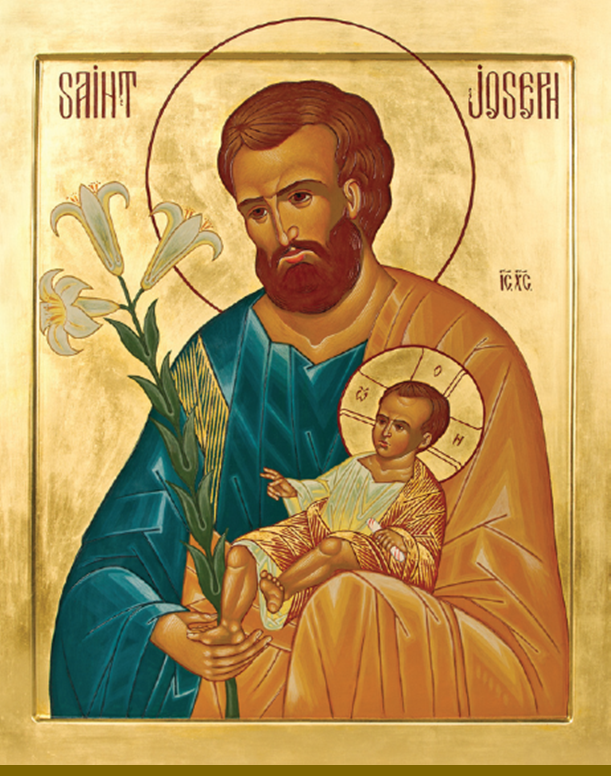
“Joseph, the God-Possessor”: ὁ θεοπάτωρ Ἰωσὴφ
Recently I came across a show on YouTube called “Cuppa Joe,” which is a great show which centers around discussing topics in Josephology, the theological study of Saint Joseph.[1] This YouTube show, hosted by John David Lewis — who is also the author of the book Journey with Joseph,[2] — features various guests, including well-known names in theology such as Deacon Dr. Mark Miravalle, Father Donald H. Calloway, MIC, and Mike Aquilina.
While browsing the list of episodes of “Cuppa Joe” that Lewis has on his YouTube channel called “Josephology,” I found the episode that featured Mike Aquilina,[3] and I noticed in the description of the video for this episode something that was of interest to me. In the description was written the following: “44:23 Theotata?” With my curiosity piqued, I went to this video and watched that part of it from 44:23 on. What I discovered was that Lewis in this section of the video is telling Mike Aquilina about a Greek title that Lewis had come up with for Saint Joseph, which was a version of ἡ Θεοτόκος — which in Greek means both “The Mother of God” or more literally “The God-Bearer.” For those who are not aware, ἡ Θεοτόκος was the title that was used at the Council of Ephesus in 431 A.D. to proclaim the dogma of Mary’s true motherhood of God the Son,[4] and before this dogmatic pronouncement ἡ Θεοτόκος was consistently used by the Greek Fathers of the Church to describe the nature or reality of Mary’s maternity in relation to Jesus Christ.[5] To continue with the video, this title for Saint Joseph that Lewis came up with was that of Theotata, which — as he explains in the video — is a version of Θεοτόκος which he coined in his book Journey with Joseph for the following reasons: 1) like Θεοτόκος, Theotata has the prefix Θεο- or Theo-, which is taken from θεός, -οῦ, -ὁ, which means “God” in Greek; 2) like Θεοτόκος, this prefix is joined to a word which expresses parenthood, which for Θεοτόκος is τόκος, ου, ὁ, which, among other things, means “bearer,” and hence we get the meaning of “God-Bearer” or “Mother of God” for Θεοτόκος, while tata in Greek, Croatian, and some other languages means “daddy,” and so hence Theotata would mean “The Daddy of God” or “The God-Raiser.”[6] Before giving all of this information, Lewis also prefaced this part of the video by saying the following about the title Theotata, “probably there was some, like, ancient guy 2000 years ago that probably already thought of this, but I haven’t found it yet.”[7]
As I watched this video, listening to Lewis describe how he came up with Theotata and hearing the comment that he made about the possibility of an “ancient guy” two millennia ago coming up with this title already, and in this moment of the video when I heard and reflected upon all of this I thought to myself, “Wow, he is right; there is actually an ‘ancient guy’ about 2000 years ago who already came up with a similar title to that of Theotata, which is essentially the masculine, paternal counterpart to ἡ Θεοτόκος — and I know both what that title is and who came up with it.” This title that I was thinking about in that moment was that of “ὁ θεοπάτωρ,” which is found in an important hagiography called Vita Sancti Stephani Junioris, Monachi et Martyris — or, in English, “The Life of Saint Stephen the Younger, Monk and Martyr” — and the “ancient guy” who coined this title for Saint Joseph was Stephen the Constantinopolitan Deacon.[8]
Now, to explain a little bit more about the title ὁ θεοπάτωρ. I say that ὁ θεοπάτωρ is the counterpart to ἡ Θεοτόκος for the following four reasons, two of which echo Lewis’ reasons: 1) this title ὁ θεοπάτωρ was used by Stephen the Deacon to express the paternity of Joseph, just as ἡ Θεοτόκος was used by the Greek Fathers of the Church to describe the maternity of Mary; 2) ὁ θεοπάτωρ possesses the prefix θεο- from θεός, -οῦ, -ὁ, just as ἡ Θεοτόκος does; 3) ὁ θεοπάτωρ also possesses a word which expresses parenthood like ἡ Θεοτόκος does, since the word contained in ὁ θεοπάτωρ is πάτωρ, ορος, ὁ, which means “possessor,” and is related to πατήρ, πατρός, ὁ, which is the Greek word for “father,” as ἡ Θεοτόκος has the word τόκος, ου, ὁ, which means “bearer” and “mother”; 4) ὁ θεοπάτωρ has a two-word hyphenated meaning to it in addition to a meaning which follows the formulation of “The Parent of God” like ἡ Θεοτόκος does, since the former not only means “The Father of God” but also means “the God-Possessor,” just as ἡ Θεοτόκος means both “The Mother of God” and “the God-Bearer.”
The only difference between these two titles — other than the fact that the “Θ” in ἡ Θεοτόκος is capitalized while the “θ” in ὁ θεοπάτωρ is not — is the frequency of the use of these titles. For ἡ Θεοτόκος was consistently and constantly used by the Greek Fathers of the Church in their writings to describe Mary’s maternity, while ὁ θεοπάτωρ is only used once in the writings of the Greek patristic tradition to describe Joseph’s paternity, whereas elsewhere in the writings of the Greek Fathers of the Church we see the term ὁ θεοπάτωρ used with a fair amount of frequency to refer to King David, and sometimes even with the “θ” in ὁ θεοπάτωρ capitalized to make ὁ Θεοπάτωρ.[9]
In closing, I commend the attempts of both John David Lewis and Stephen the Deacon to coin a parallel term to ἡ Θεοτόκος to refer to Joseph. Due to the lack of frequency of the appearance of the term ὁ θεοπάτωρ to refer to the Joseph in the writings of the Greek Fathers of the Church, I think that this title for him — viz., that of ὁ θεοπάτωρ Ἰωσὴφ, “Joseph, the God-Possessor” or “Joseph, the Father of God” — should be something that is championed by men like John David Lewis and Mike Aquilina, and not only by them, but also by patrologists, by theologians in general, by Catholics everywhere and especially by josephologists when speaking about the paternity or fatherhood of Joseph, the Living Image of God the Father; for ὁ θεοπάτωρ is a rare gem of Josephology that has been hidden for quite some time, and must be put on display in full view for all to see, so that all will come to see the reality and significance of Joseph’s fatherhood, and in so doing fulfill the condition or pre-requisite for the Restoration of Christendom in the Age of Peace Promised at Fatima, which is not only the universal knowledge and love of Saint Joseph, but also the universal recognition of the greatness of ὁ θεοπάτωρ Ἰωσὴφ, “Joseph, the God-Possessor.”
[1] See this link to the YouTube channel of “Cuppa Joe” called “Josephology,” where Lewis’ episodes can be found: https://www.youtube.com/channel/UCTULq11HoniDIXrN0yN7vzw.
[2] See Amazon for John David Lewis’ book Journey with Joseph: https://www.amazon.com/Journey-Joseph-John-David-Lewis/dp/999655645X/ref=sr_1_1?crid=2ONA9LNZ8DWGD&keywords=journey+with+joseph&qid=1666205721&qu=eyJxc2MiOiIwLjYwIiwicXNhIjoiMC4wMCIsInFzcCI6IjAuMDAifQ%3D%3D&sprefix=%2Caps%2C91&sr=8-1.
[3] John David Lewis, “Cuppa Joe: Mike Aquilina, author of 70+ books, tells us about his book ‘St. Joseph and His World’!”, Josephology, May 13, 2022, https://www.youtube.com/watch?v=NQbIcsUgbP0&list=PLfZ44RRulnpY274Kc-SqZwzpOIGXZqZnX&index=7.
[4] Heinrich Denzinger, Compendium of Creeds, Definitions, and Declarations on Matters of Faith and Morals, 43rd ed., ed. Peter Hünermann, Robert Fastiggi, and Anne Englund Nash (San Francisco: Ignatius Press, 2012), Denz. 252; Dr. Ludwig Ott, Fundamentals of Catholic Dogma, ed. James Canon Bastible, D.D., trans. Patrick Lynch, Ph.D. (Charlotte: TAN Books, 1974), 196.
[5] A cursory search of the Patrologia Graeca would provide this information about the frequency of the use of ἡ Θεοτόκος among the Greek Fathers of the Church. Here is the link to the Patrologia Graeca: https://patristica.net/graeca/.
[6] John David Lewis, “Cuppa Joe: Mike Aquilina, author of 70+ books, tells us about his book ‘St. Joseph and His World’!”, Josephology, May 13, 2022, https://www.youtube.com/watch?v=NQbIcsUgbP0&list=PLfZ44RRulnpY274Kc-SqZwzpOIGXZqZnX&index=7, 44:23-45:16.
[7] Ibid., 44:29-44:34
[8] Stephanus Constantinopolitanus Diaconus, Vita Sancti Stephani Junioris, Monachi et Martyris, in Nicephorus Archiepiscopus Constantinopolitanus, Tomus Unicus, Patrologia Graeca, ed. J.P. Migne (1860), https://patristica.net/graeca/, PGn. 100, 415A-416B (1087-1088): “καὶ ὑπ’ ἀγγέλου ὁδηγούμενοι, καθάπερ ποτὲ ὁ θεοπάτωρ Ἰωσὴφ σὺν τῇ Θεοτόκῳ ἐν τῇ κατ᾽Αἴγυπτον φυγῇ ἀπὸ προσώπου τοῦ βρεφοκτόνου Ἡρώδου.”
[9] A cursory search of the Patrologia Graeca would provide this information about the frequency of the use of ὁ θεοπάτωρ in the Greek tradition to refer to Saint Joseph and to refer to King David. Here is the link to the Patrologia Graeca: https://patristica.net/graeca/.

Saint Kateri , Canada’s Protectress
This was the title given to Saint Kateri Tekakwitha, by Pope Benedict XVI, when he canonized her on October 28th, 2012, along with six others, in Saint Peter’ Square (she had been beatified by Pope John Paul II back in 1980). With Saint Joseph as our protector, along with the Canadian martyrs, we seem to[…]Continue reading→

Remembering Father Alphonse de Valk
(Today marks the sixth anniversary of the death of Father Alphonse de Valk, C.S.B., a faithful, courageous and indefatigable Basilian priest, pro-life-and-family apostle, and the founder of Catholic Insight magazine. Here is what we wrote those on his entering into eternity five years ago, as we continue to remember him in our prayers and thoughts)[…]Continue reading→

A Tale of Two Benedicts
A grace-filled Holy Week to all our readers! As we await and prepare for the Resurrection about to dawn upon us, we might keep in mind two Benedicts: Pope Emeritus Benedict XVI, requiescat in pace, elected on this day in 2005; and today’s commemoration of the mystic pilgrim, Benedict Joseph Labre, who died on this[…]Continue reading→

My Name is Bernadette
April 16th is a propitious day, for besides the anniversary of Father de Valk’s death, who founded Catholic Insight in its print form decades ago, and the commemoration of the ‘two Benedicts’, mentioned in accompanying posts, today we also recall Saint Bernadette Soubirous, the young visionary to whom the Virgin Mary appeared numerous times at[…]Continue reading→

Saint Lydwina of Schiedam and Suffering Joyfully
Saint Lydwina of Schiedam (1380 – 1433) was one of the countless and glorious ‘victim souls’ in the history of the Church, those whose lives are filled with suffering, often of an unimaginable intensity, but who suffer joyfully. She was a fifteen-year old Dutch girl, out skating one day, when she fell and broke one[…]Continue reading→

The Glorious Martyrdoms of Martin and Maximus
As we enter into Eastertide, we recall on this 13th of April Pope Saint Martin I (+655), one of the noblest, if most tragic, of the successors of Saint Peter. Born in Umbria, Italy, he was of noble lineage, with great intelligence combined with charity and love of the poor and the Church. While still[…]Continue reading→

Canonizing Sister Faustina and Divine Mercy
HOMILY OF THE HOLY FATHER MASS IN ST PETER’S SQUARE FOR THE CANONIZATION OF SR MARY FAUSTINA KOWALSKA Sunday, 30 April 2000 1. “Confitemini Domino quoniam bonus, quoniam in saeculum misericordia eius”; “Give thanks to the Lord for he is good; his steadfast love endures for ever” (Ps 118: 1). So the Church sings on the Octave of[…]Continue reading→

Divine Mercy Sunday – An Echo of Every Mass
Reach out your hand and put it in my side. Do not doubt but believe’… ‘My Lord and my God!’ (Jn. 20:18)). Today is Divine Mercy Sunday, and as we celebrate the end of the Easter Octave, we contemplate the wounded side of our Saviour, the Church’s source of life. On Good Friday in the[…]Continue reading→

Saint Stanislaus of Szczepanów
We celebrate Saint Stanislaus today (+ April 11, 1079), in light of this Easter Octave, a bishop and martyr who accepted the episcopacy only at the direct order of Pope Alexander II. He proved a wise and courageous leader of his flock, put to death by his own king, Boleslaus, for rebuking the monarch’s ‘immoral[…]Continue reading→

Saint Gemma Galgani
On this April 11th, in 1903 – the same year that the Italian Guiseppe Sarto was elected Pope later that summer as Pius X – a lovely, young Italian woman died, by the name of Gemma Galgani. She lived a brief life of 24 years, as did a number of other young saints, including Pier[…]Continue reading→