
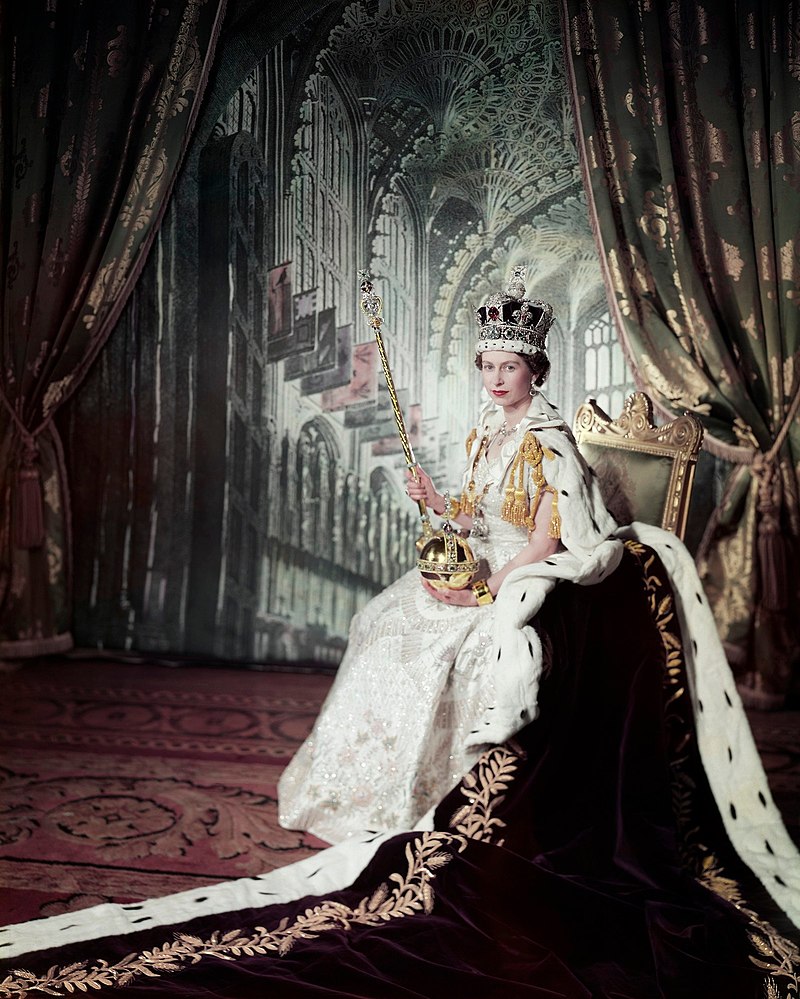
Queen Elizabeth’s Mixed Legacy
The many accolades heaped upon Queen Elizabeth have their place. She was, as promised in that early address of 1941, devoted to her duty, at least as she saw it, exemplified in her wartime service as an ambulance driver; her staying in London during the blitz; her many years of doing the rounds of what must at times have been a rather wearing royal routine, first, as princess, and as queen. She always publicly maintained her composure, her dignity, her manners, which maketh not just the man, but perhaps even more so, the woman.
Although we don’t know much of her private life, she seems to have been devoted to her husband Philip. They bore four children. Charles, their eldest, now the Third king of that name, whose odd views and life decisions we may attribute largely to his own proclivities, even if his dad did dream of coming back as a virus to reduce the human population. Andrew, allegedly caught up in the Epstein-fantasy-island scandal, has emerged relatively unscathed. Then again, how normal might one grow up in any royal household? It was hard enough in the Middle Ages, never mind the ubiquitous scrutiny in our own day.
Elizabeth also loved her horses, her estates, not least the vast Scottish estate of Balmoral, a walk through the heather followed by a warm a cup of tea. People recount that she was genuinely interested in her innumerable guests and visitors. There was a photo in my childhood home of my Scotch-Irish grandparents meeting the Queen on the ship, Maid of the Loch, which traversed Loch Lomond just north of my hometown. I don’t know of the Queen’s devotion and religious observance, but the signs are she lived out the prayers, prescriptions and rituals of her Anglican religion.
Yet, for a’ that, as the Bard might say, we should keep perspective, and not lose our wits, nor the doctrines of our Faith. We should not be quick to canonize her. What is said here is not so much about the Queen, but about our Church, and the Faith which she is called to safeguard and preserve.
First, we need to avoid syncretism and indifferentism: The Anglican ‘church’ is not a Church, of which there is only one, centred in Rome, founded by Christ. The various assemblies we now know as ‘Anglicanism’ have their origin with the tragic Tudor dynasty, and Henry’s adamant desire to rid himself of papal authority.
Nor is Anglicanism, per se, a path to salvation – anything salvific in Anglicanism is already in the Catholic Church. The doctrine of extra ecclesiam nulla salus still holds: Outside the Church, there is no salvation. As the Church’s constitution, Lumen Gentium, declares:
Whosoever, therefore, knowing (non ignorantes) that the Catholic Church was made necessary by Christ, would refuse to enter or to remain in it, could not be saved.
Yet, we are no Feeneyites, and one may still be saved outside the visible confines of the Roman Catholic Church:
The Church recognizes that in many ways she is linked with those who, being baptized, are honored with the name of Christian, though they do not profess the faith in its entirety or do not preserve unity of communion with the successor of Peter.
Anglicans profess Christianity, and have elements of the Faith, but not its fullness. They have some sacraments, not least Baptism, if proper form is observed – and one never knows with some au courant views of the Trinity. The same with marriage, if they do not leave the door open for divorce, which is permitted in their communion, and which started the whole Anglican ball rolling (indissolubility unto death is required as a proper good for a valid marriage, and we may presume Elizabeth and Philip intended such).
Anglicans also sadly lack the Holy Eucharist, since their ministers do not have the sacramental priesthood[1]. Hence, neither can they offer the reconciliatory grace of Confession, or the Last Rites.
Now, it is true that God may work outside the sacraments. Simulacra of these holy signs may provide in some way an occasion for grace, in the mystery and mercy of God’s providence. But, like the Church, once one is aware of the necessity of the sacraments, one is bound to use them.
What did the Queen think of all this? Was she ignorantes non culpa? Did she ponder deep religious questions in her perambulations around the grounds of bucolic Balmoral? Only God knows that. We may have hoped – I know, against hope – she would become Catholic, and let the chips fall where they may. Others have done so, from Campion to Newman, at great cost. It would have been earth-shattering, but our world needs a good shaking out of its somnambulant slumber to prepare for Christ’s glorious return. And the true Faith would have allowed the Queen to see more clearly, and govern more effectively.
On that note, what of the Queen’s reign? George Weigel eulogistically thanks ‘Her Majesty’ for governing without misstep, which must be a first in the annals of monarchs. James Bogle spends much of his time defending the Queen’s response – or lack thereof – to the moral issues of her time, not least the ‘royal assent’, given to all the gravely immoral legislation passed in the last half-century. Here in Canada, we have had Pierre Trudeau’s Omnibus Bill of 1969, which legalized abortion, contraception, easy divorce, and homosexuality. Paul Martin gave the go-ahead to same-sex marriage in 2005. And one of Justin Trudeau’s first acts was to give legal sanction to physician-assisted murder and suicide. All of which received the Queen’s affirmation, via her Governor-General. And this is but the most egregious sampling.
Mr. Bogle claims that the Queen had no effective power to veto such laws, that her assent was pro forma, that she may not even have been aware what was in the legislation, and so on, all of which is debatable. He goes so far as to say that for her to block such laws would itself have been a ‘grave sin’:
to claim that the Monarch can and should unconstitutionally veto immoral or bad Bills passed by the Parliament is thus to claim that the Crown should over-ride both the Constitution and the Parliament, and thus to undertake what would be, in effect, a seditious coup d’etat. It goes without saying that it would be wholly wrong for the Monarch, of all people, sitting at the apex of the Constitution, to undertake a seditious act or a coup. It would also, of course, be gravely immoral.
What of the morality of a society officially legalizing state-sanctioned murder? And as far as undermining the state goes, we may offer the warning of Pope Saint John Paul II:
Disregard for the right to life, precisely because it leads to the killing of the person whom society exists to serve, is what most directly conflicts with the possibility of achieving the common good. Consequently, a civil law authorizing abortion or euthanasia ceases by that very fact to be a true, morally binding civil law. (72)
And, hence:
When this happens, the process leading to the breakdown of a genuinely human co-existence and the disintegration of the State itself has already begun. (20)
That is, the formal legalization of abortion – or any grave crime against life – itself leads to the breakdown of the constitutional order, of society and of the nation. We are witnessing such in real time in Canada and Britain.
Could or should the Queen have done more? Certainly, the notion of formal, material and remote cooperation with evil is a complex and fraught one, but affixing your name to something means something, or should do so. Thomas More knew he couldn’t have done anything to stop Henry VIII, and that the king would have his illicit annulment whatever he did. But, by the clarity of his conscience, More knew he could not append his signature to the Oath of Supremacy, even, as chancellor, pro forma, as his friends, even his own family, urged him to do.
This is not to imply the Queen should necessarily have lost her head, or her realm. Again, we don’t know how if the Queen mulled over the complexities of abortion and euthanasia. Perhaps she considered them as something unpleasant on the fringes of society, but it is difficult to see how anyone, not least the monarch, could be unaware of how far such nefarious practices had spread. A note of protest would have been welcome, some mention of the culture of life, and the crimes against that culture, in any one of her addresses. (If anyone knows of such, please do let me know). This would not have been ‘meddling in politics’, for these are not primarily political issues, but deeply moral ones. It’s all very well for the British empire to work to abolish slavery – and we should have gratitude for such – but then to permit the destruction of vast swathes of innocent life? Britain, Canada, and the rest of her dominions, are now in a perilous state, on the very edge of an moral abyss, with calls now for infanticide and the medical murder of minors, as Pope John Paul sadly predicted.
If her royal assent was purely automatic, and the monarchy but a symbol, I would suggest that her son and successor divest himself of any lingering entanglement in the legislative process, if nothing else than for the sake of his own conscience. We may be glad of any further limits to Charles’ power, for, with his zealotry for climate change extremism and the communistic Great Reset, he plays the ideologue far more than his mother.
Elizabeth’s interior life, where resides the real crux of our destiny, is ultimately between her and God. We may end on a note of gratitude, at least for her calm, steadfast and abiding public presence in an increasingly unstable world run by apparent lunatics. She in many ways belonged to a former and better time, when, as the song goes, men were men and women were women, a time which, who knows, may yet be again. And we may pray, that in some way she followed the truth as she saw it, and found the mercy and peace of God. +
[1] As decreed by Pope Leo XIII in his Apostolic Constitution, Apostolicae Curae of September 15th, 1896

Carney’s Amoral Majority
After five defections – euphemistically described as ‘crossing the floor’ – and three by-elections, Mark Carney and his Liberals how have their coveted majority. One wonders what bowls of pottage were offered in back-room deals. In the archaic monarchical system that is the Dominion of Canada, this majority allows the newly-minted Prime Minister to rule[…]Continue reading→

Saint Kateri , Canada’s Protectress
This was the title given to Saint Kateri Tekakwitha, by Pope Benedict XVI, when he canonized her on October 28th, 2012, along with six others, in Saint Peter’ Square (she had been beatified by Pope John Paul II back in 1980). With Saint Joseph as our protector, along with the Canadian martyrs, we seem to[…]Continue reading→

A Tale of Two Benedicts
A grace-filled Holy Week to all our readers! As we await and prepare for the Resurrection about to dawn upon us, we might keep in mind two Benedicts: Pope Emeritus Benedict XVI, requiescat in pace, elected on this day in 2005; and today’s commemoration of the mystic pilgrim, Benedict Joseph Labre, who died on this[…]Continue reading→

My Name is Bernadette
April 16th is a propitious day, for besides the anniversary of Father de Valk’s death, who founded Catholic Insight in its print form decades ago, and the commemoration of the ‘two Benedicts’, mentioned in accompanying posts, today we also recall Saint Bernadette Soubirous, the young visionary to whom the Virgin Mary appeared numerous times at[…]Continue reading→

Saint Lydwina of Schiedam and Suffering Joyfully
Saint Lydwina of Schiedam (1380 – 1433) was one of the countless and glorious ‘victim souls’ in the history of the Church, those whose lives are filled with suffering, often of an unimaginable intensity, but who suffer joyfully. She was a fifteen-year old Dutch girl, out skating one day, when she fell and broke one[…]Continue reading→

The Glorious Martyrdoms of Martin and Maximus
As we enter into Eastertide, we recall on this 13th of April Pope Saint Martin I (+655), one of the noblest, if most tragic, of the successors of Saint Peter. Born in Umbria, Italy, he was of noble lineage, with great intelligence combined with charity and love of the poor and the Church. While still[…]Continue reading→

Saint Stanislaus of Szczepanów
We celebrate Saint Stanislaus today (+ April 11, 1079), in light of this Easter Octave, a bishop and martyr who accepted the episcopacy only at the direct order of Pope Alexander II. He proved a wise and courageous leader of his flock, put to death by his own king, Boleslaus, for rebuking the monarch’s ‘immoral[…]Continue reading→

Saint Gemma Galgani
On this April 11th, in 1903 – the same year that the Italian Guiseppe Sarto was elected Pope later that summer as Pius X – a lovely, young Italian woman died, by the name of Gemma Galgani. She lived a brief life of 24 years, as did a number of other young saints, including Pier[…]Continue reading→

An Ideological and Improper Translation
I noticed something odd with the psalm reading at Mass the other day. Our bishops’ conference here in Canada has decreed that the Mass in English – Novus Ordo – use the ‘NRSV’, the ‘New Revised Standard Version’, an ‘updated’ translation of the original RSV, first published in 1952. This ‘new translation’ has the tendency[…]Continue reading→
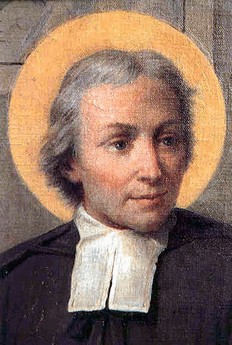
Saint Jean-Baptiste de la Salle: A Teacher for Teachers
Jean-Baptiste de la Salle (1651 – 1719), a French nobleman, ordained a priest, founded the first order in the Church’s history entirely without priests, and this came about almost by accident. I say ‘almost’, for, of course, there are no accidents with God. Destined for ordination from an early age, Jean-Baptiste never looked back, even[…]Continue reading→